
A company's claimed pipeline is credible only when its narrative disclosures survive cross-checks against primary registries, financial capacity, and internal timeline consistency, not when the story simply sounds coherent. Two indicators separate credible coverage from engineered coverage: corroborating registry entries (trial IDs, patent filings, partner confirmations) and R&D spend that actually tracks the pace of the stated progress. The five-dimension framework below turns that judgment into a repeatable audit.
TL;DR:
- Verifying pipeline credibility requires matching public registry entries with management claims, especially for trial IDs and patent numbers, rather than relying on narrative language.
- A credible pipeline is supported by external registry confirmations and an R&D spend trajectory that aligns with advertised progress, avoiding underfunding or sudden spending declines.
- Immediate red flags include missing program entries in registries, inconsistent timelines without explanation, decreasing R&D spend amid progress claims, and repeated financings that suggest short-term funding instead of strategic planning.
- Conducting thorough, documented checks at three levels—quick triage, medium follow-up, and deep review—helps identify engineered disclosures before they reach governance or market reactions.
- Automated, systematic analysis tools like Lacuna Index facilitate scale, traceability, and objectivity in cross-referencing filings, registries, and disclosures for credible pipeline assessment.
Table of Contents
- What Is Pipeline Coverage Credibility?
- What Should You Check in Each Primary Disclosure Source?
- Which Red Flags Deserve Immediate Escalation?
- How Does a Forensic Platform Turn Records Into a Score?
- What Belongs on a Final Verification Checklist?
- Why This Framework Matters Now
- How Lacuna Index Helps Teams Run These Checks at Scale
- Sources
- FAQ
What Is Pipeline Coverage Credibility?
Pipeline coverage credibility measures how well a company's narrative claims about its product, drug, or deal pipeline match what public records actually document. The term matters because "pipeline risk evaluation" and "coverage assessment reliability" often get conflated with simple disclosure compliance, checking that a filing exists, rather than substance verification, checking whether the filing's content holds up. A 10-K can be fully compliant and still describe a pipeline that is stalled, underfunded, or quietly redefined between filing periods.
Assessing credibility requires five dimensions, scored independently before they are combined into a single view:
- Disclosure specificity — does the company name trial phases, patent numbers, or partner entities, or does it rely on generic aspirational language?
- Documentary corroboration — do external registries and filings confirm what management describes?
- Financial capacity — does R&D spend and cash runway plausibly support the stated pace of progress?
- Timeline realism — do promised catalysts arrive on schedule, or do they migrate quarter to quarter without explanation?
- Narrative structure — how concentrated or dispersed is the tone and topic coverage across disclosures?
Each dimension gets a simple High, Medium, or Low rating. A High disclosure-specificity rating requires named trial identifiers or patent numbers, not phrases like "multiple candidates in development." A Low financial-capacity rating follows when cash runway calculations show fewer than two quarters of unencumbered spend against a multi-year roadmap. These ratings are qualitative triage tools, not statistical models, and they are most useful when applied consistently across a peer set rather than in isolation.
One caution belongs at the center of this framework: investors do not process complex narrative disclosures quickly. Research on investor distraction and multi-dimensional financial narrative finds that dense or unusually structured MD&A language gets incorporated into prices on a delay, which means voluntary disclosures with heavy narrative complexity deserve more scrutiny, not less, precisely because the market is slower to price them.
What Should You Check in Each Primary Disclosure Source?
Different filing types reveal different failure modes, and reading them in isolation misses most of the signal. The sequence below moves from the richest narrative source to the hardest external corroboration.
- 10-K and MD&A language. Flag phrases that shift between filing periods, such as "expected to initiate" becoming "planning to initiate" without explanation. New risk factors tied to a single program, footnote changes to accrued milestone liabilities, and timing mismatches between the Business section and the MD&A discussion are all worth documenting. Guidance on reading a biotech 10-K identifies Item 1, Item 1A, and the footnotes as the sections carrying the most pipeline-relevant signal.
- 8-Ks and press releases. Check the actual filing date against the event date, confirm any registration or application numbers cited, and note whether forward-looking claims carry specific quarters or only vague "near-term" language.
- Registries and primary databases. ClinicalTrials.gov entries, patent office records, and partner-company disclosures should independently confirm a program's existence, enrollment status, and sponsor identity. Standard due-diligence practice treats registry cross-checking as non-negotiable precisely because press releases alone cannot be trusted without that match.
- Financial cross-checks. Compare R&D spend trajectory against the pace of claimed progress, calculate cash runway against milestone obligations, and note whether spend is declining while the narrative describes acceleration.
Pro Tip: When a disclosure-quality composite score is your goal, the practical proxies are relative disclosure amount (words devoted to a topic versus its stated importance), topic spread across sections, and quantitative anchor density, the same measures behind a four-dimensional content-analysis framework for narrative disclosures.
Which Red Flags Deserve Immediate Escalation?
Some inconsistencies are noise. Others are diagnostic. The five that warrant escalation on sight:
- Timelines that shift between consecutive quarters without a disclosed reason.
- Pipeline programs referenced in press releases but absent from ClinicalTrials.gov or the relevant patent registry.
- R&D spend declining while narrative language describes accelerating progress.
- A single new risk factor appearing that concentrates disclosure risk on one unproven program.
- Repeated "subsequent event" financings that suggest the company is funding operations quarter to quarter rather than against a multi-year plan.
A three-tier verification protocol keeps the process disciplined rather than reactive. Quick triage (five to fifteen minutes) means scanning the most recent 10-K and 8-K for date consistency and registry mentions. Medium follow-up (one to two hours) means pulling the actual registry entries, comparing quarter-over-quarter R&D figures, and checking footnote language for milestone liabilities. Deep follow-up means building a documented evidence trail, citing exact filing sections and timestamps, preserving screenshots or file hashes, and, where warranted, submitting a clarifying question through investor relations or a proxy channel.
Pro Tip: Log every red flag with the filing section, page, and timestamp where it appears. An evidence log that can be reproduced by a second analyst is the difference between an observation and a finding a governance committee can act on.
How Does a Forensic Platform Turn Records Into a Score?
A systematic approach treats every filing, call transcript, and press release as raw evidence rather than narrative to be summarized. A systematic approach ingests SEC filings, earnings call transcripts, and press releases, then extracts the same disclosure-quality signals described above, tone dispersion, topic spread, and the density of quantitative anchors, at scale.
The workflow runs in three stages:
- Ingest primary filings and call transcripts tied to a specific issuer or sector cohort.
- Extract measurable narrative attributes and cross-reference them against financial context (R&D spend, cash runway, milestone liabilities).
- Generate an audit-traceable evidence log and an execution score that reflects the gap between what was promised and what public records confirm.
Author Glen's review of this methodology emphasizes that automated extraction does not replace judgment. It replaces guesswork with a documented trail. Anonymized case comparisons across sector cohorts show the same disclosure-quality signals recurring in companies later found to have overstated pipeline progress, reinforcing why documentary corroboration outranks narrative polish in any credible scoring system.
What Belongs on a Final Verification Checklist?
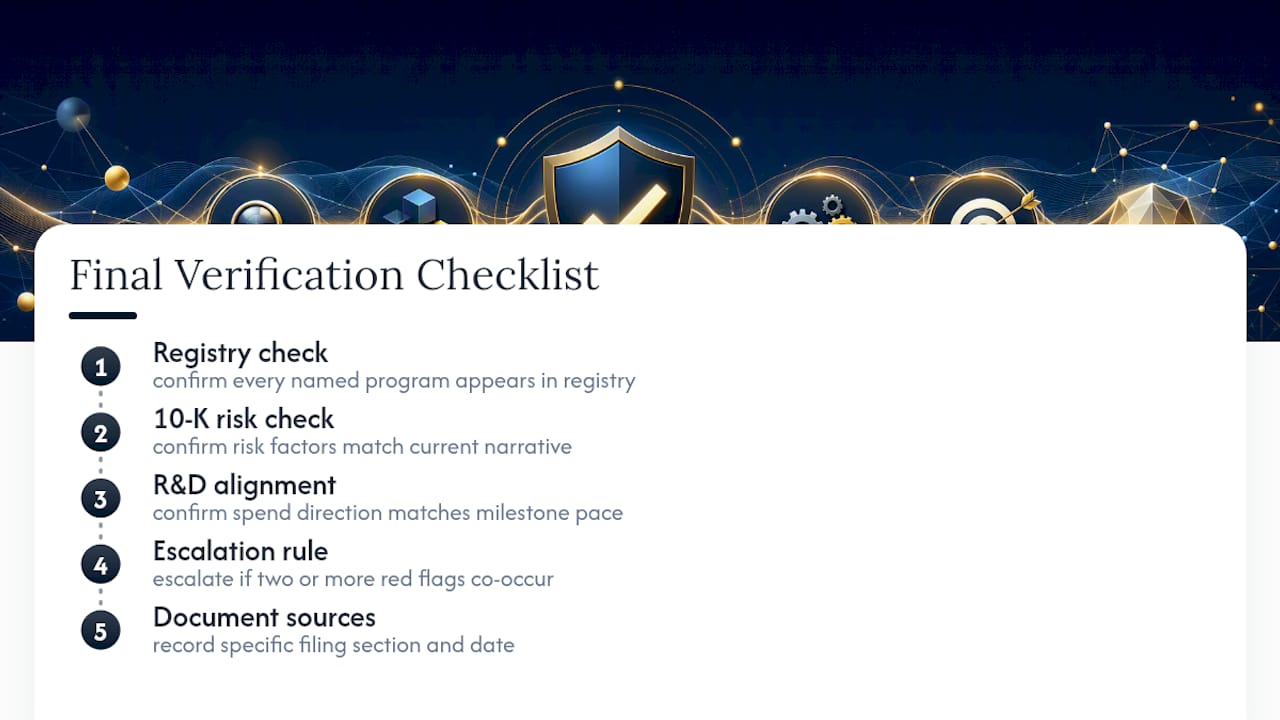
Before a credibility assessment moves from analyst notes to a governance memo or published finding, run the position through a final pass: confirm every named program appears in its relevant registry, confirm the most recent 10-K's risk factors match the current narrative rather than a stale version, and confirm R&D spend direction aligns with claimed milestone pace.
Escalate immediately when two or more red flags from the previous section co-occur, a missing registry entry paired with declining R&D spend is a materially different signal than either alone. Document every check with the specific filing section and date, not a paraphrase, since a governance committee or editor reviewing the finding later needs to verify the same primary source without redoing the research. A step-by-step validation approach built around this sequence catches most engineered narratives well before they reach a proxy statement or an earnings call transcript.
Why This Framework Matters Now
Academic work on tone dispersion and investor distraction confirms what forensic analysts have long suspected: narrative complexity delays market correction, which means the analysts willing to do the documentary work gain a real edge over those who read press releases at face value.
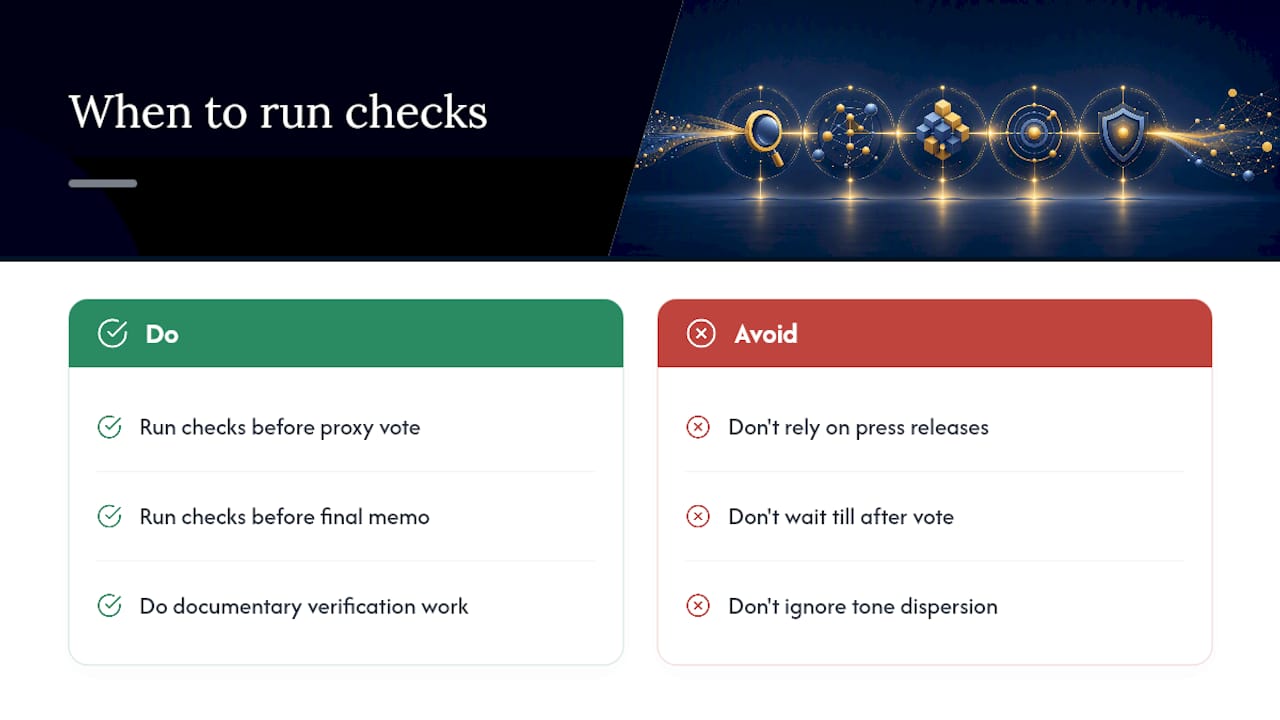
Governance teams should run these checks before, not after, a proxy vote or an investment memo goes final.
— Glen
How Lacuna Index Helps Teams Run These Checks at Scale
Lacunaindex exists for exactly the workflow this article describes: instead of manually cross-referencing filings, registries, and call transcripts one company at a time, a subscriber gets that cross-checking done systematically, with every score traceable back to the exact disclosure that produced it.
Three offerings map to different scales of this work. Per-company analysis delivers a full forensic report on a single issuer, an execution score, a narrative-versus-delivery gap measurement, and the underlying evidence log, useful when a specific holding or governance vote is under review. Cohort Pulse and Sector Sweep, both detailed on the pricing page, extend the same methodology across peer groups, which matters when a proxy advisor or portfolio team needs to benchmark one company's pipeline claims against its sector rather than judge it in isolation. Every score ties back to public filings only, no insider access, no proprietary data, which is what makes the output usable in a governance memo or published finding. Review the per-company benchmarks to see a sample report structure before subscribing.
Sources
Keep SEC EDGAR, Clinicaltrials, patent office search tools, and the tone dispersion research cited above within direct reach for any credibility review.
- Investor distraction and multi-dimensional financial narrative | Review of Accounting Studies
- A four-dimensional framework for holistic content analysis of narrative disclosures
- Biotech Due Diligence Checklist: How to Evaluate a Drug Pipeline and Probability of Approval | BiopharmaWatch
- How to Read a Biotech 10-K: The Sections That Actually Matter | BioSniper
FAQ
What Makes a Pipeline Disclosure Credible Rather Than Promotional?
A credible disclosure names specific programs, dates, and identifiers that independently appear in registries like ClinicalTrials.gov or patent databases. Promotional language relies on aspirational phrasing without documentary corroboration, and it tends to shift between filing periods without explanation.
How Long Does a Basic Pipeline Credibility Check Take?
A quick triage pass, scanning the most recent 10-K and 8-K for date consistency and registry mentions, takes five to fifteen minutes. A medium follow-up involving registry pulls and R&D spend comparison typically takes one to two hours.
Can Tone Dispersion Really Predict Disclosure Problems?
Tone dispersion, the spread of sentiment language across a narrative, correlates with both current performance and management's incentive to manage perceptions, according to research on voluntary disclosure narratives. It is one useful signal among several, not a standalone predictor.
Does Lacuna Index Score Every Public Company?
Lacunaindex builds forensic reports and sector benchmarks from public records for companies covered in its platform, with detailed company-level analysis available through paid subscriptions and sector benchmarks accessible more broadly. Coverage scope and current offerings are listed on the Lacuna Index site.
What Is the Single Fastest Red Flag to Check First?
Confirm whether a claimed program actually appears in ClinicalTrials.gov or the relevant patent registry under the sponsor's name. A missing registry entry for a program described in a press release is one of the fastest, highest-value checks in the entire verification protocol.