
Evaluating financial performance integrity using only narrative versus disclosure evidence remains difficult for forensic corporate analytics teams. Many platforms withhold transparent pricing, rely on proprietary data, or lack reproducible, citation-based scoring frameworks essential for rigorous peer benchmarking and accountability mapping. This comparison covers core scoring methods, coverage focus, evidence reliability, and procurement terms so forensic analysts can select a suitable NRGmetrics.com alternative for their next diligence cycle.
Table of Contents
Lacuna Index

At a Glance
Scores companies purely from public documents, mapping executives statements and investor-facing narratives to the actual disclosures that exist in filings and transcripts. The review output includes sector benchmarks and verdicts that highlight when narrative claims outpace disclosed evidence. That focus helps surface potential mispricing and disclosure opacity for market participants.
Core Features
The site builds accountability scores from public filings, earnings call transcripts, proxy statements, press releases, and other disclosures. It pairs those scores with sector benchmarks and cohort comparisons so readers can see relative performance on narrative versus delivery. The methodology is systematic and reproducible, producing verdicts and execution measures that rely only on publicly available evidence.
Key Differentiator
The single distinct capability is that every company score ties narrative claims directly to cited public documents, rather than to private sources or proprietary feeds. That connection produces a measurable gap between what companies say and what their own disclosures support. The approach standardizes evidence citation so comparisons across issuers are consistent and traceable.
Pros
The methodology does not require insider access; its analysis depends exclusively on public filings and disclosures, which reduces attribution risk when using the output in research or reporting. The scoring framework is applied consistently across sectors, allowing governance teams and analysts to benchmark peers and cohorts directly. The output includes verdicts and execution-oriented metrics that make it easier to prioritize deeper due diligence or journalistic follow up.
Cons
- Pricing details are temporarily unavailable, which may slow procurement or trial evaluation for readers assessing immediate fit.
Who It's For
Institutional investors conducting forensic due diligence, governance advocates tracking disclosure integrity, and financial journalists investigating mismatches between corporate statements and filings will find the work product relevant. Analysts who require reproducible, citation-backed evidence for investment memos or published stories will gain the most value from the platform.
Unique Value Proposition
Execution scores and archetype classifications such as earned, borrowed, or undervalued convert evidence gaps into decision signals for sector cohorts. That translation lets research teams move from qualitative doubt about a narrative to a ranked list of names that merit more work. The result is a workflow where narrative risk is quantified and mapped to relative valuation cohorts.
Real World Use Case
A hedge fund uses Lacuna Index to compare public statements by technology issuers with their SEC filings and earnings transcripts. The team flags issuers whose narrative claims lack corroborating disclosures and then allocates analyst time to those names for deeper legal and operational review. That process helps prioritize investigations into companies with elevated disclosure opacity.
Website: https://lacunaindex.com
ESGAUGE
At a Glance
ESGAUGE's marketing materials state it applies AI and machine learning to deliver customized ESG analyses for U.S. public companies. The service concentrates on executive compensation, governance, shareholder engagement, and sustainability disclosures. It targets professional buyers in law, asset management, and corporate advisory.
Core Features
ESGAUGE combines large scale data mining of public filings and disclosures with tailored models to produce sector specific peer comparisons and benchmarks. The platform covers executive compensation and incentive plans, corporate governance metrics such as board composition and shareholder rights, and sustainability indicators including emissions and human rights disclosures. Outputs emphasize comparability across peers and evidence based summaries for advisory work.
Key Differentiator
That capability centers on bespoke analyses for professional clients rather than off the shelf dashboards for retail users. ESgauge positions its workflow to deliver client specific benchmarking and focused evidence sets for advisory engagements. That focus separates it from generalist ESG data providers.
Pros
Deeply tailored data analyses align with legal and advisory workflows and produce citation ready evidence for reports and memos. The coverage spans compensation, board practices, shareholder activism, and sustainability metrics so teams can reuse one source for multiple governance questions. Use of machine learning allows targeted peer group construction and pattern detection across filings while keeping analyst input central to validation.
Cons
-
No publicly available third party reviews exist to benchmark user satisfaction or implementation experience.
-
The platform may feel complex for teams without ESG measurement experience or disclosure analysis skills.
-
Pricing and subscription models are not published, which complicates budget planning for smaller firms.
-
There are no consumer facing features, so individual investors and DIY researchers will not find self service access.
When It May Not Fit
Organizations that need free or self serve ESG tools will find ESgauge mismatched to their needs. Teams without an analyst familiar with filings and disclosure frameworks will face a learning curve. Procurement teams requiring transparent list pricing will have limited public information to compare prior to vendor contact.
Who It's For
Corporate counsel, governance teams, law firms, asset managers, and consultants who require evidence based, firm level ESG analysis. Users should have an internal analyst or advisor who can interpret filings and translate ESgauge outputs into client deliverables. The product fits engagements that demand custom benchmarking and point by point disclosure assessment.
Real World Use Case
A law firm uses ESgauge to assemble a board compensation benchmark before advising a client on proxy disclosure language. An asset manager requests peer level sustainability metrics to refine exclusion and engagement lists. Both players receive tailored peer groups and exportable evidence to support formal recommendations.
Pricing
Pricing is not publicly specified. The vendor targets professional and enterprise clients and offers customized engagements. Prospective buyers must contact ESgauge for licensing terms and subscription details.
Website: https://esgauge.com
Forensic Alpha
At a Glance
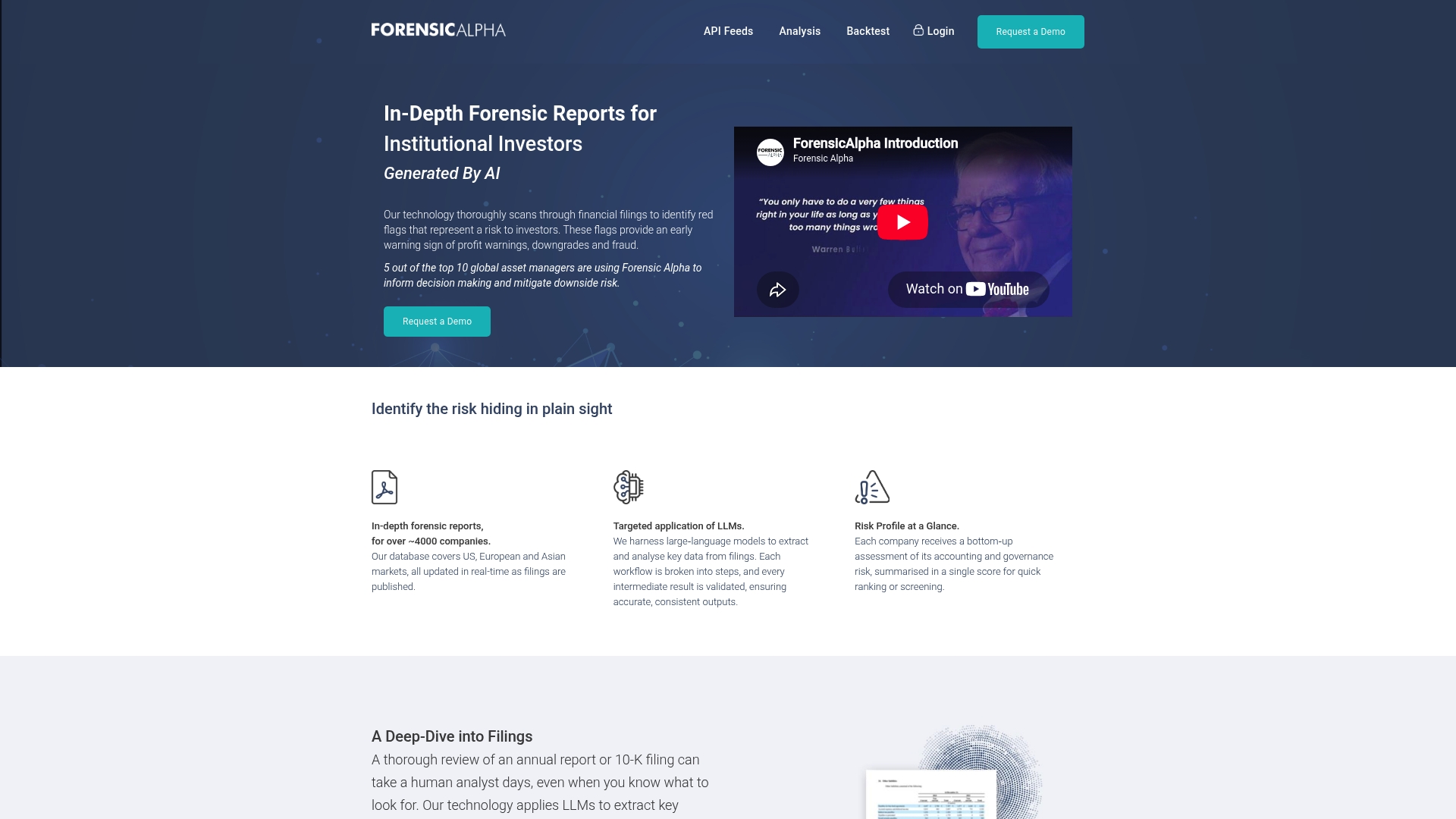
Forensic Alpha reports coverage of thousands of companies across US, European, and Asian markets, delivering real-time monitoring and automated forensic reports. The platform produces concise risk scores and red flag indicators that summarize accounting and governance risks for quick screening. The presentation focuses on filing-level evidence and time-stamped alerts rather than proprietary market signals.
Core Features
The product applies large-language models to extract structured facts from earnings releases, SEC filings, and other disclosures, and then applies pattern detection to surface anomalies and recurring disclosure gaps. Reports include a mix of quantitative signals and narrative snippets tied to evidence lines from filings, and the database updates continuously to reflect new disclosures and flagged events. Automated scoring ranks companies by accounting and governance risk to support prioritization workflows.
Key Differentiator
The defining element is a multistep extraction flow that combines LLM parsing with rule-based validation to reduce false positives when processing dense, footnote-heavy filings. That layered approach aims to convert free text and tables into standardized signals that feed the risk scoring engine and generate audit-traceable red flag summaries.
Pros
The platform applies machine intelligence to filings, which accelerates analyst triage and reduces manual reading hours. According to the company, top asset management firms use the tool, which suggests institutional interest in its output. Continuous updates across US, European, and Asian filings support ongoing monitoring, and the combination of narrative excerpts plus scores helps translate disclosure anomalies into prioritized investigative leads.
Cons
- No user reviews are available to validate claimed strengths and to assess usability or support quality.
- Public documentation is limited, leaving feature detail and workflow examples unclear for prospective buyers.
- Website pages for pricing, features, and integrations are missing, which complicates procurement and trial planning.
When It May Not Fit
Buyers who require transparent, self-serve evaluation will find the lack of public documentation and reviews problematic. Small teams without dedicated procurement resources may struggle to assess total cost because pricing is not published. Organizations that need rich third-party integration lists will find no public information on connectors.
Who It's For
The product targets institutional investors and portfolio managers focused on forensic financial analysis and early detection of disclosure risk. Risk analysts performing due diligence for audit committees or activist research groups will find the filing-focused signals directly relevant. The profile fits teams that can absorb vendor briefings to validate fit before purchase.
Real World Use Case
A portfolio manager screens a watchlist after an earnings season and receives alerts flagged for unusual revenue recognition language and conflicting footnote disclosures. The manager uses the report excerpts and the associated score to prioritize a focused accounting review, avoiding deeper diligence on companies with clean signals. The evidence-linked summaries shorten the path from suspicion to escalation.
Pricing
Pricing is not published. The product data marks pricing as Not applicable — informational only, and procurement requires direct vendor engagement for licensing terms and enterprise arrangements. Prospective buyers should request a demonstration and a scoped quote to understand seat counts and data access terms.
Website: https://forensicalpha.com
Valid8 Financial
At a Glance
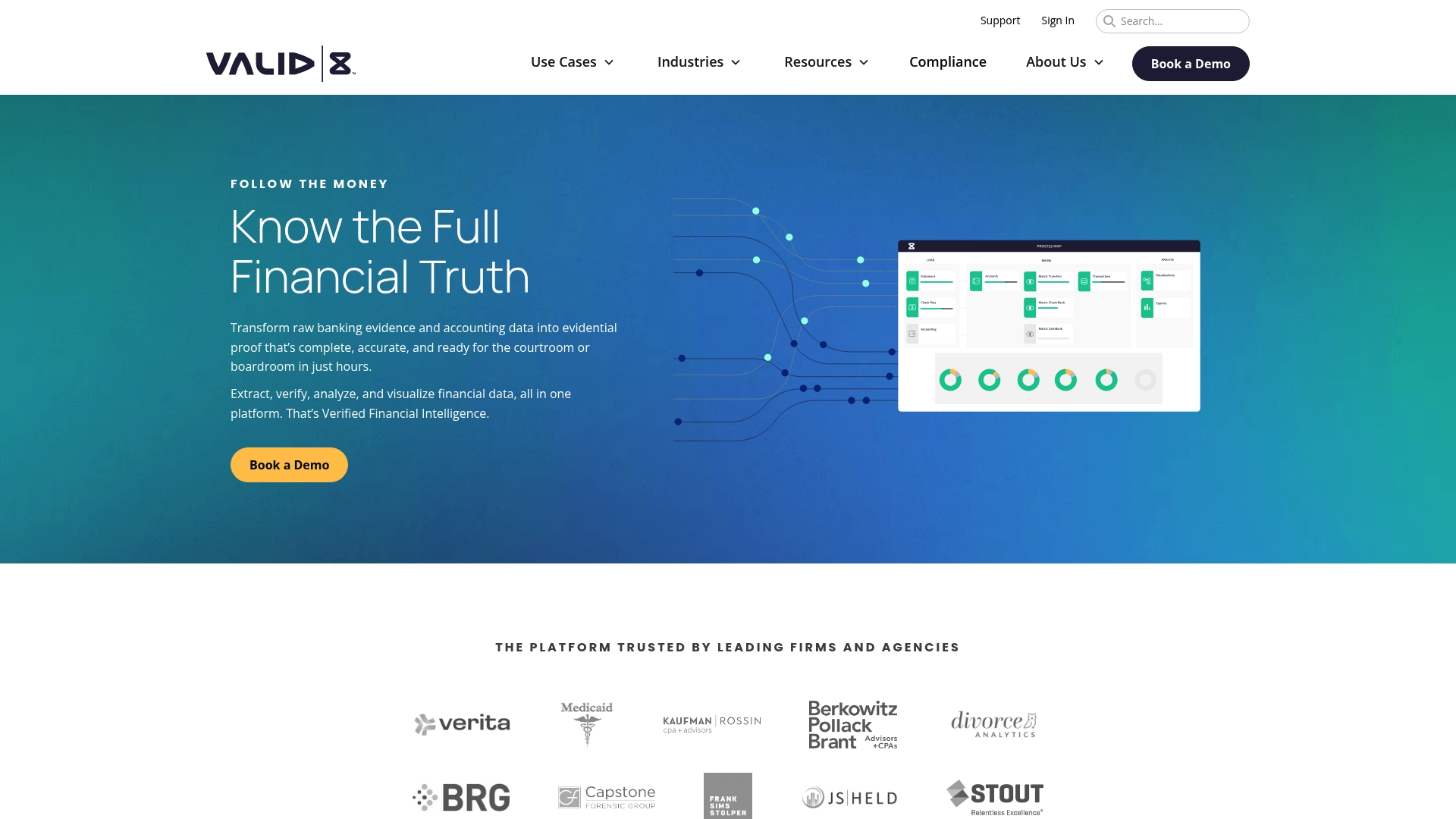
Valid8 Financial reports case analysis that can be over 10x quicker than manual review for complex banking evidence. The vendor positions the platform as a single environment that turns raw bank and accounting records into court-ready evidence and visualizations. The product targets investigative workflows where document provenance and repeatable verification matter.
Core Features
The platform extracts, verifies, analyzes, and visualizes financial records within one cloud workspace, enabling forensic teams to centralize case files and annotations. It pairs transaction-level parsing with AI-driven confirmation of banking records against accounting data, and it supports engagements such as litigation, valuation, bankruptcy, family law, and financial crime inquiries. Security and centralized case management are built into the platform to support collaborative investigations.
Key Differentiator
Valid8 Financial centers on AI-driven confirmation that cross-checks banking evidence against accounting sources at scale. That emphasis on automated corroboration reduces manual reconciliation tasks and produces an auditable chain of evidence aimed at legal and enforcement uses.
Pros
The platform helps teams scale investigations while limiting the need for proportional headcount increases, which frees forensic resources for higher-value analysis. It provides transaction verification against supporting documents, increasing confidence in evidence presented in boardroom or courtroom settings. Secure, centralized access supports multiuser investigations and controlled handoffs to counsel or regulators. The vendor cites adoption by leading firms and government agencies, which signals enterprise orientation. Broad case support covers forensics, bankruptcy, valuation, and expert testimony.
Cons
-
No user-reported weaknesses found in third-party sources. This absence limits independent vetting and public critique.
-
Limited available third-party reviews or user feedback. Procurement teams will face a thinner public reference set.
-
May require significant data integration from existing systems. Organizations with fragmented feeds will incur integration effort and potential preprocessing.
Who It's For
Valid8 Financial fits financial investigators, forensic accountants, legal teams preparing expert testimony, and government investigators handling complex money movement. It suits groups that need an auditable workflow for extracting and corroborating transaction evidence across multiple file types. Smaller teams with heavy case loads will find the centralized workflow particularly relevant.
Real World Use Case
According to the company, a government agency used Valid8 to analyze bank statements for money laundering probes, reducing analysis time from weeks to days and improving case outcomes. That claim highlights the platform's focus on accelerating investigative throughput while producing verifiable evidence chains for prosecution or regulatory referral.
Pricing
Pricing is not specified publicly. The vendor describes enterprise deployments, so expect an enterprise SaaS pricing model with case or seat licensing and professional services for integration and onboarding.
Website: https://valid8financial.com
Boardroom Alpha
At a Glance
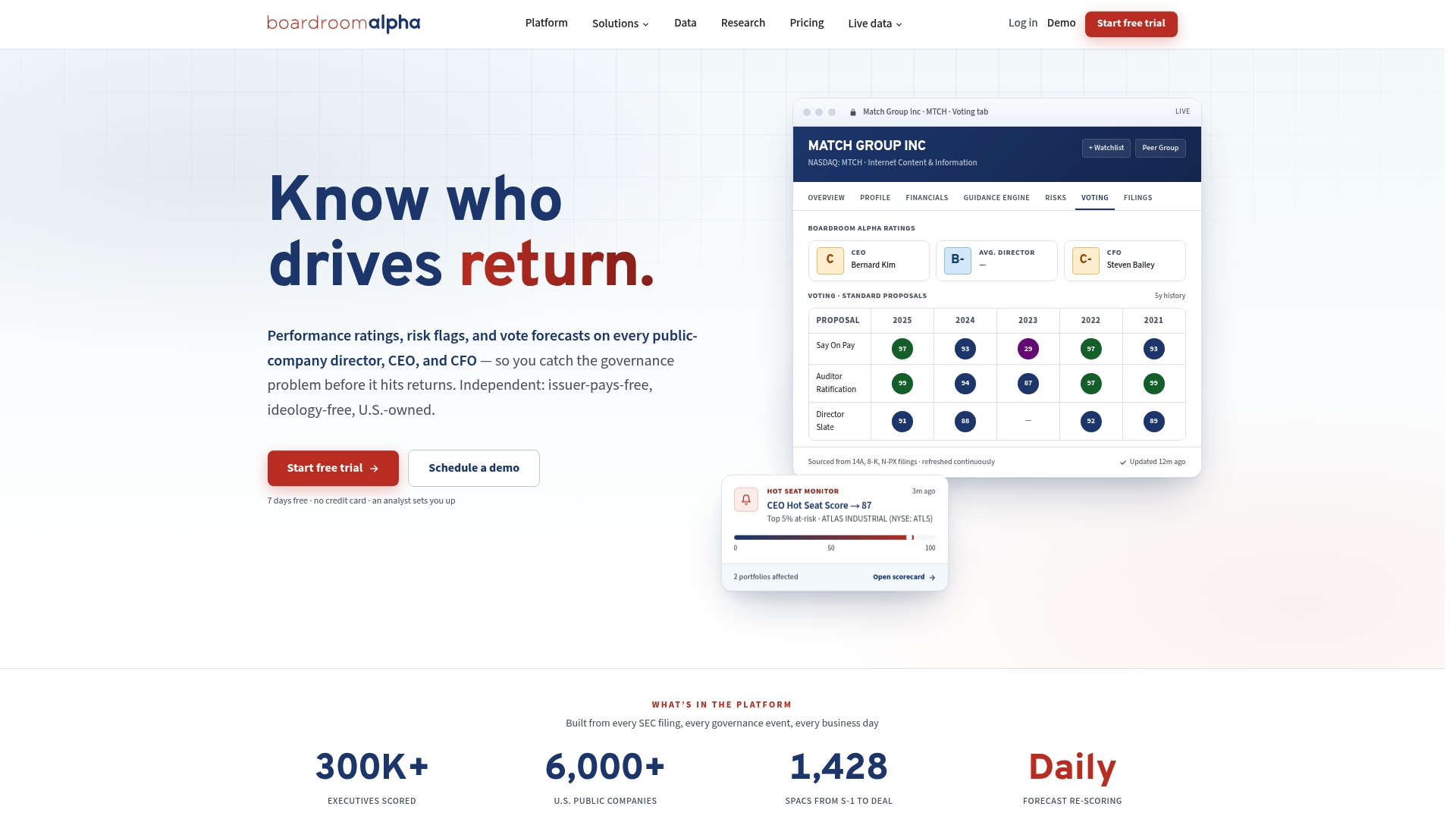
Daily-updated predictive scores such as CEO Hot Seat and Activist Vulnerability power its governance alerts. The platform derives signals from SEC filings and governance events processed each day. It targets analysts and engagement teams focused on anticipating governance risks before those risks affect returns.
Core Features
Performance ratings, risk flags, and vote forecasts appear for public-company directors, CEOs, and CFOs, enabling pre-event screening. Analytics cover ratings, performance attribution, network mapping, and disclosure analysis while real-time monitors track meetings, proxy fights, executive moves, SPAC votes, and CEO pay. The platform also supports API access and dataset downloads to fold governance signals into existing workflows.
Key Differentiator
Daily refreshes of governance signals from SEC filings and governance events set the product apart for active governance monitoring. Predictive scoring that focuses on executive vulnerability and activist exposure gives a forward-looking view of boardroom pressure. The emphasis on governance metrics tailored for professional analysts distinguishes it from broader corporate data providers.
Pros
Boardroom Alpha reports daily-updated governance data across thousands of U.S. public companies, which supports broad coverage for U.S. universes. Built-in predictive scores and vote forecasts let engagement and activist teams identify pressure points ahead of proxy season. The product offers data extraction options via API and dataset downloads to integrate governance signals into risk models and monitoring systems. Independent, U.S.-owned sourcing aligns with practitioners who prioritize transparency in evidence provenance.
Cons
-
No substantive external user reviews are publicly available to validate ease of use or support quality.
-
Public documentation on specific integrations and feature depth is limited, so a demo may be required to assess fit.
-
The vendor does not publish a free tier or clear pricing bands, making procurement planning harder.
-
The platform assumes familiarity with governance metrics and filings, which raises the learning curve for new users.
When It May Not Fit
Teams new to governance analysis or those without a specialist on staff may find the signal set difficult to interpret. Organizations that require visible, tiered pricing or a free evaluation tier will likely find procurement friction. Groups seeking global company coverage beyond the U.S. should confirm geographic breadth before committing.
Who It's For
Financial analysts, portfolio managers, corporate secretaries, legal and compliance teams who track governance health of U.S. public companies. Activist research teams and engagement desks seeking early warning signals for proxy contests and executive transitions. Banks and advisors monitoring CEO and CFO moves tied to transactions and restructurings.
Real World Use Case
An asset management firm uses Boardroom Alpha to scan its U.S. holdings for elevated activist vulnerability and vote risk before proxy season. That early flagging lets engagement teams prepare talking points and vote recommendations ahead of client meetings. The signal set also helps the firm reprioritize monitoring resources around at-risk names.
Pricing
No public pricing or free tier is listed; procurement appears to be informational only. The vendor materials suggest interested teams will need a demo or trial to evaluate capabilities and delivery formats. Budget planning should assume enterprise licensing or data subscription discussions.
Website: https://boardroomalpha.com
Comparison of alternatives
The comparison of Lacuna Index with other platforms reveals distinct capabilities across corporate governance and forensic analytics tools. These solutions cater to different institutional needs, ranging from ESG benchmarking to narrative versus disclosure validation.
Evidence transparency and traceability
Lacuna Index uniquely ties narrative claims to specific evidence points from publicly available documents, creating measurable narrative versus delivery scores. This approach contrasts with platforms like Forensic Alpha, which focus on risk signal automation, and ESGAUGE, known for its tailored peer group analyses. Lacuna Index ensures standardized evaluations across sectors, grounding its analysis in citation-backed principles that differ markedly from competitors relying on general pattern extraction or advisory customizations.
Client-specific customization and workflow alignment
Professional client services, such as those by ESGAUGE, demonstrate exceptional adaptability, enabling customized ESG analysis suitable for advisory firms and asset managers. Conversely, Valid8 Financial emphasizes secure, centralized workflows designed for legal and investigative contexts, offering transaction-level auditing tools for specialized financial forensics tasks. These platforms may better suit organizations requiring bespoke services over systematized public filing assessments.
Best fit
- Analysts needing a tool to quantify corporate narrative risks through public documents will find Lacuna Index indispensable for enhancing due diligence frameworks.
- Corporations requiring precise ESG performance data for peer benchmarking should consider ESGAUGE, particularly for its professional customization services.
- Teams prioritizing governance risk signals refreshed daily will benefit from Boardroom Alpha, ensuring proactive monitoring of shareholder or executive activities.
- Investigative accountants working on complex financial cases requiring auditable evidence trails will align well with Valid8 Financial’s verification tools.
- Managers needing focused insights into board dynamics and activist exposure are exceptionally served by Forensic Alpha's targeted risk alerts.
Our pick
Lacuna Index emerges as the superior choice for users valuing citation-backed, sector-comparable evaluation metrics grounded in public evidence. This platform suits institutions requiring accountability scoring to detect alignment or deviation between narrative statements and verifiable disclosures. However, clients with specific customization needs or unique financial investigation scenarios might alternatively select platforms like ESGAUGE or Valid8 Financial.
This comparison highlights the versatility of forensic corporate analysis tools based on their unique methodologies and target use cases to assist informed decision-making.
| Product | Key Differentiator | Best for | Pricing | Notable Limitation |
|---|---|---|---|---|
| Lacunaindex | Evidence-backed scores tied to public disclosures for accountability analysis | Institutional investors and journalists | Price not published | Pricing details are currently unavailable |
| ESGAUGE | Customized ESG analyses using machine learning for targeted professional clients | Law firms and asset managers | Price not published | Lacks consumer-facing features and public pricing information |
| Forensic Alpha | Real-time risk scores from document-level evidence and anomaly detection | Asset managers and portfolio managers | Price not published | Limited public documentation and no user reviews |
| Valid8 Financial | Automated financial record verification for fast forensic investigations | Financial investigators and legal teams | Price not published | Requires significant data integration for existing systems |
| Boardroom Alpha | Predictive governance scores and daily monitoring of executive risks | Financial analysts and compliance teams | Price not published | Limited public reviews and documentation on feature depth and integrations |
Addressing Narrative Delivery Gaps in Financial Performance Analysis
Investors, governance advocates, and financial journalists seeking alternatives to nrgmetrics.com confront the challenge of assessing corporate narratives versus actual disclosures. Lacunaindex directly tackles this problem by measuring the gap between corporate statements and evidence in public filings, offering precise execution scores and classification archetypes. This approach reveals mispricing risks and disclosure opacity without relying on private data sources.
Lacunaindex offers:
- Forensic analytics grounded in SEC filings, earnings calls, and public disclosures
- Sector benchmarks that contextualize narrative claims to delivery
- Measures that transform narrative risk into quantifiable insights
Explore Lacunaindex to assess corporate accountability using objective evidence. Access detailed reports and benchmarks that enable focused due diligence where it matters most.
FAQ
How does Lacunaindex improve accountability in corporate disclosures?
Lacunaindex generates accountability scores from public filings, earnings call transcripts, and proxy statements. This scoring ties narrative claims directly to disclosed evidence, helping to identify potential mispricing and disclosure opacity. Users can rely on these scores to better assess the integrity of corporate narratives in their investment analyses.
What is the difference between Lacunaindex and Forensic Alpha?
Forensic Alpha specializes in real-time monitoring and automated forensic reports, providing risk scores and red flag indicators for accounting and governance risks. In contrast, Lacunaindex focuses on mapping executive statements to actual disclosures, giving users a different lens for forensic corporate analytics. This makes Lacunaindex more suitable for those specifically interested in narrative versus delivery comparisons.
Which platform offers better sector benchmarks, Lacunaindex or ESGAUGE?
Lacunaindex provides sector benchmarks that allow users to see relative performance on narrative versus execution. ESGAUGE, while offering customized ESG analyses, does not emphasize this comparative aspect in its benchmarking. Therefore, for users needing detailed sector comparisons against execution scores, Lacunaindex is the better choice.
Can I rely on Lacunaindex's scoring framework for governance risk assessment?
Lacunaindex’s scoring framework applies consistently across sectors, making it valuable for assessing governance risk in various corporate environments. This consistency allows teams to benchmark peers and prioritize further due diligence effectively.
How does Lacunaindex facilitate forensic due diligence for institutional investors?
Lacunaindex ties narrative claims directly to cited public documents, making it a key tool for institutional investors conducting forensic due diligence. This capability allows users to quantify narrative risk and correlate it with relative valuation, strengthening their investigative workflows.