
Engineered corporate narratives materially affect valuation, and forensic, audit-traceable review is not optional for institutional decision-makers. A 2025 EFMA paper demonstrates that positive, unsubstantiated changes in R&D rhetoric within MD&A filings predict elevated one-year-ahead idiosyncratic stock price crash risk and are negatively associated with patent outputs over the following three years. The mechanism is straightforward: inflated narrative raises price expectations; unmet delivery triggers sharp correction. Every governance professional, proxy advisor, and institutional investor who relies on disclosure text without a systematic delivery check is operating on incomplete evidence.
Key finding: Unsubstantiated R&D rhetoric in MD&A predicts elevated crash risk and reduced patent output over a three-year horizon, per the 2025 EFMA study.
Immediate actions for institutional readers:
- Cross-reference R&D narrative changes in MD&A against USPTO patent filings and R&D capitalization trends.
- Apply Beneish M-score and accrual quality tests to any filing where narrative sentiment diverges from operating cash flow.
- Flag coordinated narrative-plus-graph distortion in 10-K filings for governance escalation.
- Request a forensic execution score before voting on material compensation or capital allocation proposals.
Table of Contents
- How do engineered narratives move stock prices and analyst forecasts?
- What tactics do managers use to engineer disclosures?
- Reproducible forensic checks you can run on public records
- How does Lacunaindex operationalize these checks?
- Key Takeaways
- The gap between narrative and delivery is the actual risk
- Lacunaindex forensic reports: access and next steps
- Sources and forensic method references
How do engineered narratives move stock prices and analyst forecasts?
The valuation distortion mechanism operates through two channels: price inflation during the narrative-delivery gap, and correction when the gap becomes undeniable. Morph experiments on earnings call transcripts show that specific linguistic dimensions, including sentiment, confidence, guidance framing, and uncertainty signaling, produce measurable shifts in analyst forecast revisions even when no new quantitative data is introduced. Analysts systematically overreact to sentiment and underreact to uncertainty, creating a predictable attention bias that managers can and do exploit.
A composite linguistic index, the Aggregate Attribute Index (AAI), captures multi-dimensional attributes that standard tone measures miss. The AAI shows that complexity attenuates immediate market reactions for distracted investors and produces staggered pricing effects over longer horizons, meaning the full valuation impact of obfuscated disclosures may not surface for quarters after filing.
Consider a representative archetype: a mid-cap technology company reports flat R&D expenditure but substantially increases forward-looking innovation language in its MD&A. Sell-side analysts revise estimates upward, the stock re-rates on narrative alone, and the multiple expands. Eighteen months later, patent filings remain flat, a product launch is delayed, and the correction is abrupt. Evidence from China's STAR Market, cited as corroborative cross-market evidence, shows that validated narrative signals carry return predictability, while unvalidated ones do not, reinforcing the case for delivery verification before acting on narrative signals.
Key valuation risk indicators to monitor:
- Divergence between narrative sentiment trajectory and operating cash flow trend.
- Increasing MD&A word count without proportional increase in quantitative disclosures.
- Analyst forecast revisions driven by guidance language rather than revised financial metrics.
- Post-filing volatility spikes, particularly in sectors with judgment-heavy fair-value assumptions.
What tactics do managers use to engineer disclosures?
Narrative engineering in public reports operates through a set of identifiable, reproducible techniques. The most common are forward-looking language inflation (aspirational claims without milestones), selective emphasis (burying negative operational data in footnotes while amplifying positive outcomes in the MD&A narrative), guidance framing (anchoring analyst expectations to optimistic scenarios), and sentiment amplification (increasing positive tone without corresponding improvement in realized metrics).
The more consequential pattern is coordinated deployment: empirical analysis of S&P 500 10-K filings finds a positive association between narrative thematic bias and financial graph distortion, with the effect concentrated in firms with weak governance structures. Managers jointly calibrate verbal and visual signals, a dual-coding strategy that produces stronger investor impressions than either channel alone. A graph that truncates the Y-axis to exaggerate revenue growth, paired with MD&A language emphasizing "record performance," creates a reinforcing impression that neither element would achieve independently.
Specific engineered patterns to recognize:
- Complexity spikes — in fair-value footnotes, which 2026 research links to amplified post-filing volatility.
Pro Tip: When reviewing a 10-K, compare the graph presentation index (PGDI elements: scale distortion, cherry-picked periods, missing baselines) against the MD&A sentiment score in the same section. Coordinated distortion across both channels is a stronger governance signal than either flag in isolation.
Reproducible forensic checks you can run on public records
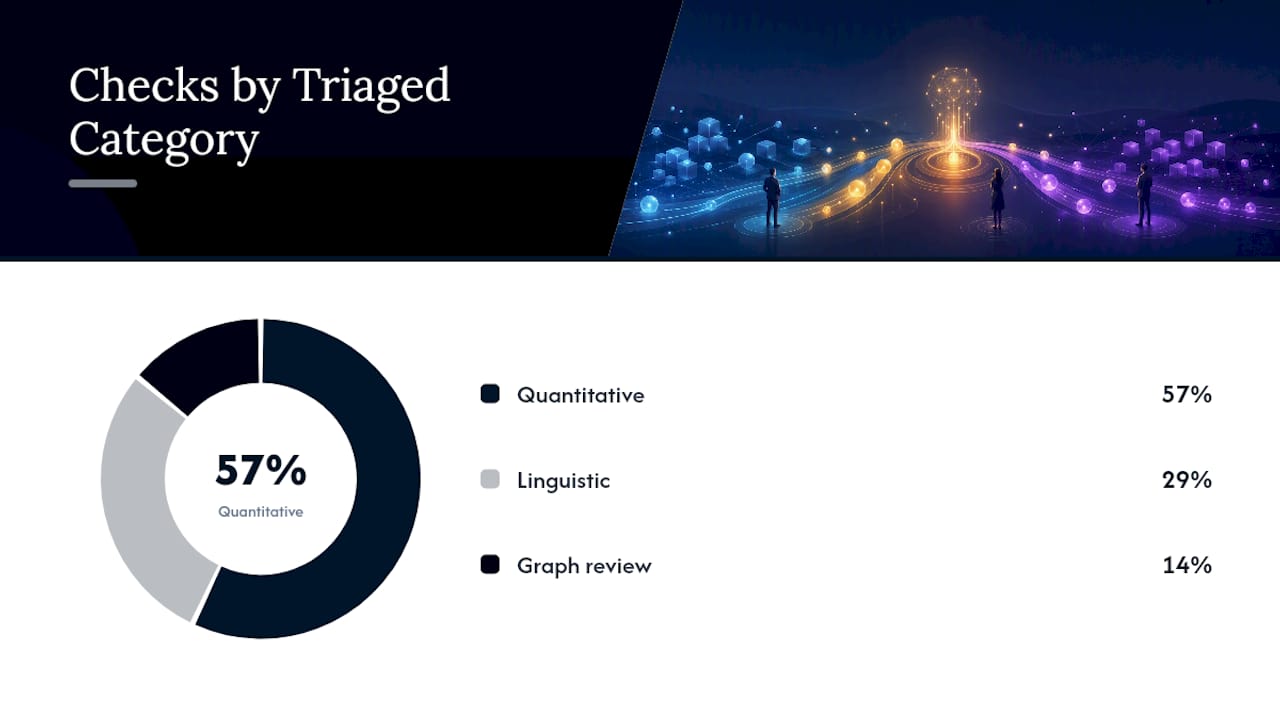
Each check below maps to a public evidence source, an expected signal, and a recommended action. The sequence is designed to triage efficiently: quantitative tests first, linguistic checks second, graph review third.
| Forensic Check | Public Evidence Source | Expected Signal | Recommended Action |
|---|---|---|---|
| R&D narrative vs. patent output | MD&A text + USPTO patent database | Rhetoric increase without patent growth | Adjust valuation; open R&D delivery inquiry |
| Beneish M-score | SEC 10-K financial statements | Score above threshold indicates manipulation probability | Escalate to full forensic audit |
| Accrual quality model | Cash flow statement vs. net income | High accruals relative to cash earnings | Adjust earnings quality discount |
| Benford's Law test | Reported financial figures | Non-conforming digit distribution | Flag for independent audit request |
| PGDI graph distortion | 10-K graphs (scale, period, baseline) | Truncated axes, missing baselines | Governance escalation; proxy vote flag |
| AAI / linguistic complexity | Earnings call transcripts, MD&A | High complexity + low readability | Schedule follow-up check post-filing |
| Altman Z-score | Balance sheet and income statement | Z-score in distress zone | Credit risk reassessment |
Forensic accounting methods including Benford's Law, accrual quality models, the Beneish M-score, and Altman Z are well-validated for detecting earnings manipulation and should be embedded in credit and underwriting workflows, not reserved for post-crisis reviews.
For audit traceability, record each check with: the query date and time, the specific filing version accessed (SEC EDGAR accession number), a source snapshot or PDF hash, and the analyst ID. This chain supports reproducible evidence in governance proceedings or shareholder proposals.
Pro Tip: Run quantitative tests (Beneish, accrual quality) before linguistic checks. A clean M-score does not rule out narrative engineering, but a flagged M-score combined with high MD&A sentiment divergence substantially raises the prior probability of coordinated misrepresentation. Sequence matters for false-positive control.
For a structured detection framework, the high-risk narrative company identification guide provides additional triage criteria mapped to public disclosure sources.
How does Lacunaindex operationalize these checks?
Lacunaindex maps each forensic check to a structured output, making the evidence chain audit-traceable and reproducible without requiring insider access.
| Forensic Check | Lacunaindex Output | Governance / Investment Use |
|---|---|---|
| R&D narrative vs. delivery | Execution score + evidence snapshot | Valuation adjustment; engagement trigger |
| Linguistic complexity / AAI | Narrative score with dimensional breakdown | Analyst forecast calibration |
| Graph distortion (PGDI) | Disclosure quality flag in forensic report | Proxy vote flag; audit committee inquiry |
| Accrual quality / Beneish | Quantitative forensic report section | Credit risk reassessment; underwriting review |
| Sector narrative benchmarks | Public sector benchmark tables | Peer comparison; governance screening |
| Company archetype classification | Earned / borrowed / undervalued classification | Portfolio positioning; engagement priority |
Sector benchmarks are publicly accessible at lacunaindex.com/benchmarks and require no subscription. Full company-level forensic reports, execution scores, and narrative-versus-delivery analyses are available under a paid institutional subscription. Governance professionals and proxy advisors can request a pilot or demo to evaluate report format and evidence chain before committing to full access.
Key Takeaways
Engineered corporate narratives produce measurable valuation distortion, and the forensic checks required to detect them are reproducible from public records alone.
| Point | Details |
|---|---|
| Crash risk is empirically linked to rhetoric | Unsubstantiated R&D narrative changes in MD&A predict elevated one-year-ahead idiosyncratic crash risk and reduced patent output. |
| Dual-channel distortion amplifies impact | Coordinated narrative bias and graph distortion in 10-Ks, concentrated in weak-governance firms, produce stronger investor impressions than either channel alone. |
| Sequence quantitative tests first | Run Beneish M-score and accrual quality checks before linguistic analysis to control false positives and prioritize escalation efficiently. |
| Trigger-based workflow reduces cost | Forensic triage takes 1–2 days; full review runs 5–10 business days when triggered by specific events such as guidance changes or pre-vote due diligence. |
| Lacunaindex delivers audit-traceable outputs | Execution scores, narrative-versus-delivery reports, and sector benchmarks map each forensic check to a reproducible evidence chain for governance and investment decisions. |
The gap between narrative and delivery is the actual risk
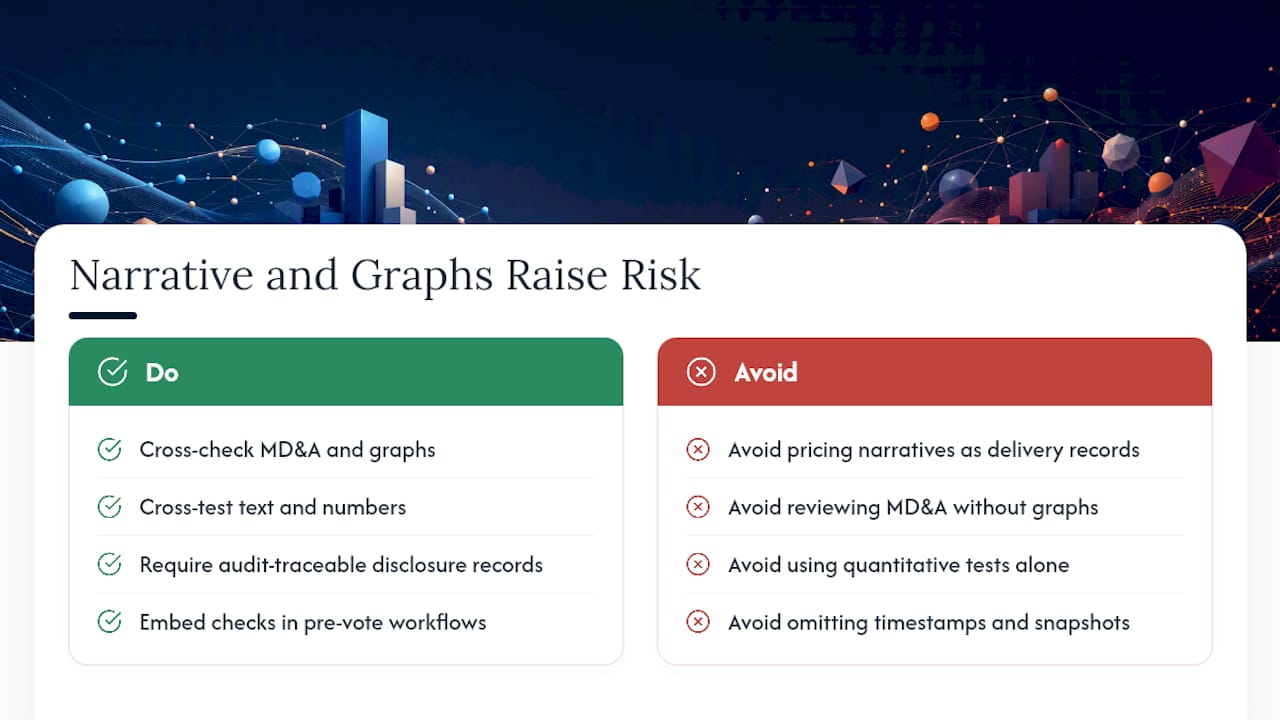
The conventional framing treats narrative engineering as a disclosure quality problem, a matter of best practice and regulatory nudge. That framing understates the risk. The empirical record now shows that engineered disclosures produce measurable crash risk, distort analyst forecasts, and amplify post-filing volatility in ways that compound over quarters. The problem is not that companies tell stories. The problem is that the market prices those stories as if they were delivery records, and the correction, when it comes, is rarely gradual.
What most governance frameworks still underweight is the coordinated nature of the distortion. Narrative bias and graph manipulation are not independent choices; they are jointly deployed, and the joint signal is substantially more informative than either check run in isolation. A forensic framework that reviews MD&A text without reviewing the accompanying graphs, or that applies quantitative tests without cross-referencing linguistic complexity, will generate false negatives at precisely the firms where the risk is highest.
The audit-traceability requirement is not bureaucratic overhead. It is what separates a defensible governance action from an assertion. Every check, timestamp, and source snapshot is evidence that can support a shareholder proposal, an audit committee inquiry, or a regulatory referral. Institutions that build this discipline into pre-vote and pre-underwrite workflows are not doing more work; they are doing the work that the disclosure system was designed to require but rarely enforces.
Lacunaindex forensic reports: access and next steps
Lacunaindex provides institutional investors, governance professionals, and financial journalists with forensic company reports that quantify the aspiration-to-execution gap using public records only. Each report includes an execution score, a narrative-versus-delivery analysis, dimensional linguistic flags, and a sector benchmark comparison, all structured for audit traceability.
Public sector benchmarks are available without a subscription and provide an immediate reference point for peer comparison and governance screening. For full company-level forensic reports and pilot access, contact Lacunaindex directly through the platform landing page to arrange a demo or institutional pilot. Procurement teams can request a sample report to evaluate evidence chain format before committing to subscription access.
Sources and forensic method references
The claims and checklist items in this article draw on the following primary research and method references. Each entry notes what it supports.
| Source | What It Supports |
|---|---|
| EFMA 2025: Stock price crash risk and managerial rhetoric | R&D narrative-to-crash-risk link; justifies R&D vs. patent cross-check |
| arXiv 2511.15214v2: Earnings calls and analyst beliefs | Linguistic dimension effects on analyst forecasts; supports AAI and NLP checks |
| ScienceDirect: Narrative bias and graph distortion | Coordinated dual-channel distortion in S&P 500 10-Ks; supports PGDI + thematic bias checks |
| Zenodo: Forensic accounting and CDS/bond underwriting | Benford, Beneish, accrual quality, Altman Z integration into credit workflows |
| Review of Accounting Studies 2026: AAI and investor distraction | Multi-dimensional linguistic index; staggered pricing effects; timing of follow-up checks |
| Financial Research Letters 2026: STAR Market narrative validation | Cross-market corroboration that validated narratives predict returns; unvalidated ones do not |
| 2026: Narrative obfuscation, fair value, and volatility | Complexity and fair-value disclosures amplify post-filing volatility; supports readability checks |
Limitations and false positive/negative considerations: Benford's Law generates false positives in industries with naturally constrained number distributions (e.g., regulated utilities). The Beneish M-score was calibrated on historical U.S. samples and may underperform in sectors with atypical accrual structures. Linguistic complexity checks require baseline calibration by sector and filing type; a high AAI score in a pharmaceutical company's clinical trial disclosure is not equivalent to the same score in a consumer goods MD&A. Cross-check sequencing, as described in the forensic checklist above, is the primary control for false positive accumulation. False negatives are most likely when narrative engineering is confined to the visual channel (graph distortion only) without corresponding text anomalies, reinforcing the case for joint checks.
This article provides general forensic and analytical information for institutional and professional audiences. It does not constitute legal, investment, or accounting advice. Readers should verify current regulatory requirements and filing standards with primary sources or qualified professionals.