
Narrative accountability in proxy decision making means using public disclosures — SEC EDGAR filings, earnings-call transcripts, and proxy statements — to measure the gap between what a company claims and what it demonstrably delivers, then treating that gap as a defensible, audit-traceable input to vote and engagement decisions. The immediate operational step: select 3–10 high-conviction holdings, pull their most recent 10-K, 10-Q, and proxy statement from SEC EDGAR, and map each material narrative claim against the corresponding delivery signal. Lacunaindex applies this methodology systematically, classifying companies into performance archetypes and producing execution scores derived entirely from public records.
Table of Contents
- What does narrative accountability mean for proxy decisions?
- Why the narrative interest standard outperforms a balance-sheet approach
- How to operationalize narrative-vs-delivery analysis in your proxy workflow
- How to build an audit-traceable forensic scoring model
- Where accountability scores change the outcome
- Implementation checklist, staffing, and vendor-evaluation criteria
- Limitations and U.S. legal considerations
- Key Takeaways
- Why the gap between narrative and delivery is the signal that matters most
- Lacunaindex turns public disclosures into defensible proxy scores
- Useful sources and further reading
What does narrative accountability mean for proxy decisions?
Narrative accountability is the forensic practice of comparing what an organization says it will do against what the public record shows it actually did. In a proxy context, the relevant disclosure types are:
- 10-K and 10-Q filings (EDGAR): audited financials, risk factors, and management discussion
- Proxy statements (DEF 14A): board composition, compensation rationale, and shareholder proposals
- Earnings-call transcripts: forward guidance, strategic framing, and Q&A commitments
- Investor presentations and press releases: aspirational claims and milestone announcements
- Regulatory filings: restatements, material-event 8-Ks, and SEC comment letters
Consider a company that repeatedly describes itself as pursuing "sustainable, organic growth." Delivery signals to test that claim include revenue-mix shifts toward acquired versus organic lines, one-time accounting adjustments that inflate reported EBITDA, and any restatements filed within 24 months of the original disclosure. When the delivery signals contradict the narrative, the aspiration-to-execution gap is measurable and documentable — the foundation of a defensible proxy position.
Why the narrative interest standard outperforms a balance-sheet approach
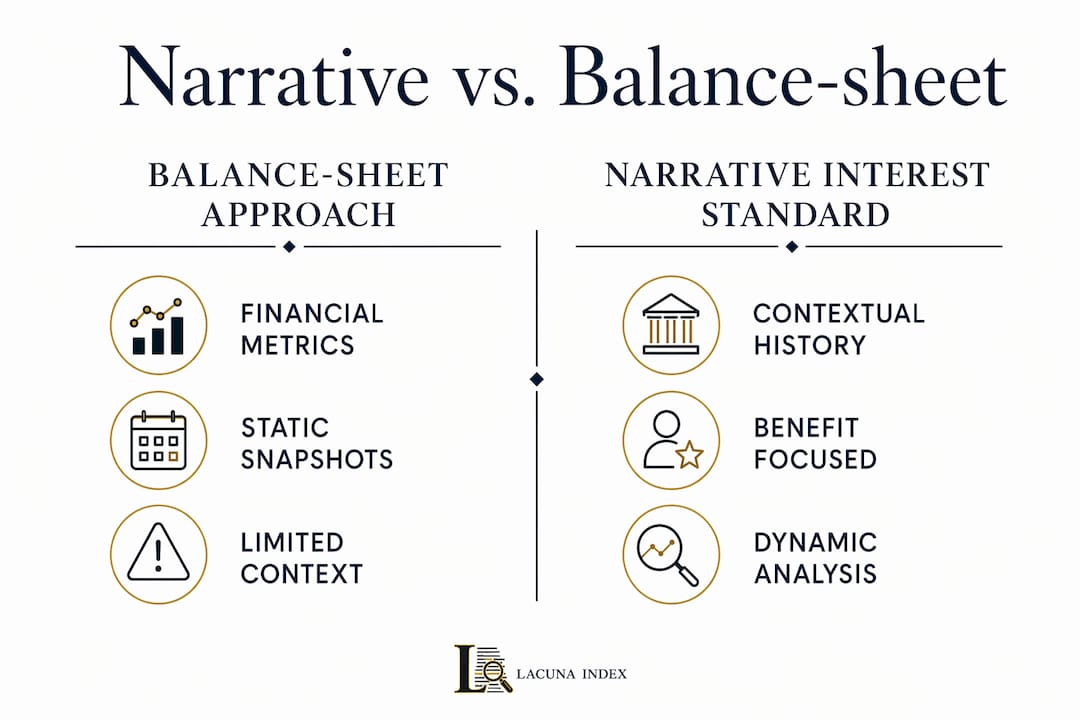
The narrative interest standard, drawn from surrogate decision-making research, holds that context, history, and benefit-burden ratios produce more defensible decisions than rigid quantitative benchmarks alone. Applied to proxy governance, it means evaluating a company's current disclosures against its historical trajectory, not just its most recent quarter.
| Dimension | Balance-sheet approach | Narrative interest standard |
|---|---|---|
| Contextualization | Treats each metric in isolation | Links metrics to stated strategy and prior commitments |
| Temporal scope | Single-period snapshot | Multi-period trajectory with trend analysis |
| Conflicting evidence | Defaults to the stronger number | Requires explicit reconciliation and documented rationale |
| Progressive conditions | Poorly suited to evolving strategies | Accounts for evolving preferences and strategic pivots |
| Proxy defensibility | Vulnerable to cherry-picking | Audit-traceable narrative synthesis reduces regret exposure |
Case vignette. A mid-cap industrial company reports strong free cash flow in its 10-K but has, over three consecutive proxy cycles, disclosed material weaknesses in internal controls, withdrawn prior-year guidance without explanation, and replaced its CFO twice. A balance-sheet lens produces a "vote for" recommendation based on the cash-flow figure. The narrative lens surfaces a pattern of disclosure opacity and governance instability that shifts the recommendation to "engage with conditions" — a materially different outcome that the narrative on-switch makes visible.
How to operationalize narrative-vs-delivery analysis in your proxy workflow
A repeatable workflow requires six numbered steps, timed to the proxy season.
- Scope the universe. Identify 3–10 holdings where narrative risk is plausible: recent guidance withdrawals, CEO transitions, or activist pressure.
- Collect evidence. Pull 10-K, 10-Q, DEF 14A, and earnings transcripts from EDGAR; capture and timestamp each source.
- Synthesize the narrative. Extract material claims from management commentary; map each to a measurable delivery signal in the financials or disclosures.
- Score the gap. Rate narrative fidelity, execution evidence, and disclosure completeness on a consistent scale; document the rationale for each rating.
- Apply decision rules. Map scores to vote, engage, escalate, or abstain outcomes using pre-defined thresholds.
- Record and retain. Archive timestamped source captures, synthesis notes, and reviewer attestations for at least the period required by your firm's record-retention policy.
Timing guidance: Pre-proxy season (weeks 1–4), complete scoping and evidence collection. During solicitation (weeks 5–8), finalize scoring and run decision-rule mapping. Post-vote (weeks 9–12), document outcomes and update the engagement log. For spotting high-risk narrative companies early, prioritize companies with recent 8-K material-event filings or SEC comment-letter exchanges.
Red flags that trigger escalation: repeated guidance withdrawal without restatement, material-weakness disclosures in consecutive periods, compensation structures misaligned with disclosed strategic priorities, and auditor changes within 18 months of a major transaction.

How to build an audit-traceable forensic scoring model
Scoring dimensions should cover five domains: narrative fidelity, execution evidence, disclosure completeness, remediation transparency, and governance responsiveness. The table below maps each archetype to its definition and primary evidence streams.
| Archetype | Definition | Primary evidence streams |
|---|---|---|
| Earned | Delivery consistently meets or exceeds stated commitments | Organic revenue growth, on-time milestone completion, clean audit opinions, no restatements |
| Borrowed | Valuation or reputation exceeds delivery; narrative is ahead of execution | Guidance misses, one-time items inflating reported metrics, high P/E relative to peer execution scores |
| Undervalued | Delivery exceeds narrative; company under-communicates performance | Consistent beat-and-raise cadence, low investor-relations activity, discount to sector peers |
| Deteriorating | Historical delivery record weakening relative to prior narrative | Trend of widening aspiration-to-execution gaps, increasing disclosure opacity, rising restatement frequency |
Scoring models must articulate conflict-resolution rules when evidence is mixed — for example, when execution metrics are strong but disclosure completeness is poor. The model should specify which dimension takes precedence and why, and that rationale must be recorded.
Minimum audit-trail requirements: timestamped source captures for every cited disclosure, versioned synthesis notes with reviewer initials, and a signed attestation confirming the evidence base before any vote recommendation is finalized. For governance teams evaluating whether their current process meets board-level evidence standards, the audit trail is the first thing scrutinized.
Pro Tip: Preserve chain-of-evidence by saving a PDF snapshot of each EDGAR filing at the time of retrieval, not just a URL. Filing amendments can alter the document at the same URL, making a live link an unreliable audit record.
Where accountability scores change the outcome
Scores translate into four discrete governance actions:
- Vote with management: Earned archetype, narrative fidelity high, no material red flags.
- Vote against or withhold: Borrowed archetype with repeated disclosure opacity, or deteriorating archetype with unaddressed material weaknesses.
- Engage with conditions: Score indicates a remediable gap; management has acknowledged the issue but remediation is incomplete.
- Escalate or divest: Persistent non-transparency across multiple proxy cycles, or a score that worsens despite prior engagement.
At the portfolio level, aggregate scores reveal concentration risk. A portfolio where more than a third of holdings score in the Borrowed or Deteriorating archetypes signals systemic narrative risk that warrants a governance committee review, not just individual engagement. The benefits of systematic accountability scoring are most visible at this aggregation stage, where individual anomalies resolve into patterns.
Implementation checklist, staffing, and vendor-evaluation criteria
Pilot checklist:
- Select several holdings for the pilot; include examples from each archetype hypothesis.
- Define data sources in advance: EDGAR, earnings transcripts, and proxy statements only.
- Assign roles: one analyst for evidence collection, one reviewer for scoring attestation, one escalation lead for edge cases.
- Set governance sign-off: a written protocol approved by the governance committee before scoring begins.
- Run a calibration session comparing two analysts' independent scores on the same company before finalizing the rubric.
Vendor-evaluation criteria: auditability of the scoring methodology, public-disclosure-first data sourcing (no proprietary data or insider access), sector benchmarks for normalization, a documented archetype taxonomy, compatibility with existing proxy voting platforms, and a defined SLA for report updates during proxy season. The AI governance audit trail literature reinforces that auditability is not optional — it is the criterion that determines whether a score survives internal or regulatory review.
Budget and timeline: a focused pilot covering 5–8 companies typically runs 4–6 weeks with one analyst and one reviewer. Scaling to a full portfolio requires a dedicated analyst, a senior reviewer, and a governance-committee liaison.
Limitations and U.S. legal considerations
Limitations:
- All analysis depends on public disclosures; undisclosed information is, by definition, outside scope.
- Attribution of intent is not possible from public records alone; the methodology measures delivery gaps, not motives.
- Retrospective rationalization risk: management often reframes prior commitments in later filings, requiring versioned source captures to detect.
- Scoring quality varies with disclosure quality; sectors with lower mandatory disclosure density produce noisier scores.
U.S. compliance notes: Proxy solicitation rules under SEC Regulation 14A govern how vote recommendations are communicated; governance teams using forensic scores in published recommendations should confirm applicability with counsel. Materiality thresholds under SEC guidance determine which narrative claims are legally significant; not every aspirational statement in an earnings call meets the materiality bar. Record retention for proxy-related analysis should align with SEC Rule 17a-4 standards where applicable. Scholars note the difficulty in reconciling technically value-congruent decisions with high internal regret, which argues for transparent, documented scoring rather than post-hoc justification.
Practical mitigations: publish the scoring methodology in the governance committee's standing procedures, require reviewer attestation on every final score, and route escalation cases through legal counsel before any public communication.
This article is general information, not legal or investment advice. Governance teams should confirm current SEC rules and proxy-solicitation requirements with qualified legal counsel for their specific situation.
Key Takeaways
Forensic narrative accountability produces more defensible proxy decisions than balance-sheet analysis alone when it is grounded in audit-traceable evidence, explicit conflict-resolution rules, and a documented archetype taxonomy.
| Point | Details |
|---|---|
| Start with a focused pilot | Select 5–8 holdings, define evidence sources in advance, and run a calibration session before scaling. |
| Prioritize audit-traceable evidence | Timestamped EDGAR captures and versioned synthesis notes are the minimum for a defensible scoring record. |
| Map scores to discrete vote rules | Pre-define thresholds for vote, engage, escalate, and abstain before proxy season begins. |
| Use archetype classification | Earned, Borrowed, Undervalued, and Deteriorating archetypes translate gap scores into portfolio-level risk signals. |
| Lacunaindex for pilots | Lacunaindex provides public-disclosure-first forensic reports, sector benchmarks, and archetype classifications ready for governance workflow integration. |
Why the gap between narrative and delivery is the signal that matters most
The conventional proxy advisory model treats financial metrics as the primary signal and narrative as supplementary color. That framing inverts the actual information hierarchy. A company's narrative commitments, made in SEC filings and earnings calls, are the promises against which delivery must be measured. When delivery consistently falls short of those promises, the financial metrics often look acceptable precisely because management has learned to calibrate guidance to achievable outcomes rather than genuine ambition. The gap is the signal; the metrics are the output of managing to that gap.
Governance teams that adopt forensic narrative accountability are not adding a soft layer to a hard-number process. They are correcting a systematic blind spot: the tendency to treat a company's most recent quarter as evidence of its character rather than as one data point in a longer trajectory. The narrative on-switch is what connects those data points into a coherent, auditable account of whether a company earns the trust its valuation implies.
The practical implication is straightforward. Before the next proxy season, governance teams should run at least one pilot using the workflow described here, document the scoring rationale, and compare the outcome to their existing vote recommendations. The divergences will be instructive.
Lacunaindex turns public disclosures into defensible proxy scores
Governance teams that need audit-traceable forensic analysis without proprietary data access or insider sourcing have a direct path: Lacunaindex. The platform mines SEC filings, earnings-call transcripts, proxy statements, and press releases to produce execution scores, narrative fidelity ratings, and archetype classifications for public companies, all derived from the public record.
Lacunaindex serves institutional investors, proxy committees, and governance professionals who need a documented, reproducible methodology they can present to a board or regulator. Sector benchmarks are available without a subscription and provide immediate comparative context. For teams ready to integrate forensic scoring into their proxy workflow, the Lacuna user guide walks through report interpretation, archetype classification, and workflow integration step by step. Start with the user guide, run a pilot on 5–8 holdings, and use the sector benchmarks to calibrate your scoring thresholds before the next proxy season opens.
Useful sources and further reading
- SEC EDGAR full-text search and filing database — primary source for 10-K, 10-Q, DEF 14A, and 8-K filings
- Narrative Interest Standard: A Novel Approach to Surrogate Decision-Making — foundational framework for the narrative interest standard applied in this guide
- Patient narrative: an 'on-switch' for evaluating best interests — source for the narrative-as-context principle and balance-sheet fallacy argument
- Measuring proxy decision quality: challenges and implications — evidence base for conflict-resolution rules and scoring transparency requirements
- Constructing authentic decisions: proxy decision making for research involving adults who lack capacity to consent — qualitative research on authenticity and trust in proxy decision frameworks
- Taking to Giving Account: Narrative Frameworks of Accountability in Transformative Justice Responses — source for the giving-account model and audit-traceable narrative synthesis
- Narrative Accountability Course: Ethics, Theory and Methods — training framework for professional narrative accountability practice
- Exploring How Accountability Affects the Medical Decisions We Make for Other People — empirical research on accountability salience and surrogate risk-taking
- Lacunaindex sector benchmarks — free public valuation and execution benchmarks by sector
- Lacunaindex user guide — step-by-step guide to reading forensic reports and integrating scores into governance workflows