
The strongest independent alternatives to mashinii.com for forensic corporate ethics evaluation are RepRisk, THEIA Analytics Group, and Lacuna Index. Each platform sources data from adversarial, uneditable records — court filings, regulatory enforcement actions, and investigative reporting — rather than relying on corporate self-disclosure. The distinction matters because voluntary disclosures are structurally insufficient for governance-grade analysis; companies control what they report, but they cannot alter what regulators file or what courts rule.
| Platform | Data Sources | Methodological Approach | Transparency and Traceability | User Focus |
|---|---|---|---|---|
| RepRisk | Court filings, media, enforcement actions | Expert analyst curation, daily updates | Provenance links to primary records | Investors, compliance teams |
| THEIA Analytics Group | Regulatory filings (18+ years) | Quantified Risk Quotients by GICS sector | Sector-level scoring with document lineage | Risk analysts, governance researchers |
| Lacuna Index | SEC filings, earnings calls, proxy statements | Forensic gap analysis, archetype classification | Traceable execution scores, public data only | Ethics investors, governance advocates |
Core ethics evaluation dimensions addressed across these platforms include:
- Enforcement actions and regulatory sanctions: formal government findings that companies cannot revise after the fact
- Court rulings and litigation history: docket-sourced records providing independently verified accountability signals
- Investigative journalism: third-party reporting that surfaces conduct not captured in official filings
- SEC and proxy disclosures: earnings calls, 10-K filings, and proxy statements analyzed for aspiration-to-execution gaps
- Sector benchmarks: normalized risk scores enabling cross-company and cross-sector comparison
How each platform approaches corporate ethics evaluation
The three platforms share a commitment to adversarial data but diverge sharply in methodology, update cadence, and the type of output they produce.
RepRisk operates through a combination of 150+ expert analysts and AI-assisted monitoring, producing daily-updated risk incident records drawn from public sources worldwide. Its coverage spans public and private companies across emerging and frontier markets, making it the broadest-reach option for investors who need continuous reputational risk signals across a global portfolio. The platform's data-as-a-service model is designed for integration into existing compliance workflows, with outputs structured for due diligence and regulatory reporting rather than standalone forensic investigation.
THEIA Analytics Group takes a different angle. Its RRX™ platform processes regulatory filings spanning over 18 years, tracking 12 billion data points from 2 million regulatory documents to generate quantified Risk Quotients by GICS sector. The output is a scored, sector-normalized risk measure rather than a narrative incident log. Researchers who need to compare regulatory exposure across an entire industry vertical, rather than monitor a single company's daily news, will find THEIA's approach well-suited to that task.

Lacuna Index applies forensic gap analysis to public company disclosures, measuring the distance between what management claims and what the underlying records confirm. The platform classifies companies into archetypes — earned, borrowed, or undervalued — based on execution scores derived solely from SEC filings, earnings call transcripts, press releases, and proxy statements. No insider access, no proprietary surveys. The methodology is designed to surface disclosure opacity and mispricing caused by engineered narratives.
Pricing and access structures vary across all three. RepRisk operates on an enterprise licensing model; THEIA's access is not publicly listed. Lacuna Index publishes tiered access plans on its website. For researchers who need compliance-grade regulatory data at accessible price points, platforms like DataDock.ai offer entity resolution and sanctions screening as a supplementary data layer, though without the forensic narrative analysis the three primary platforms provide.
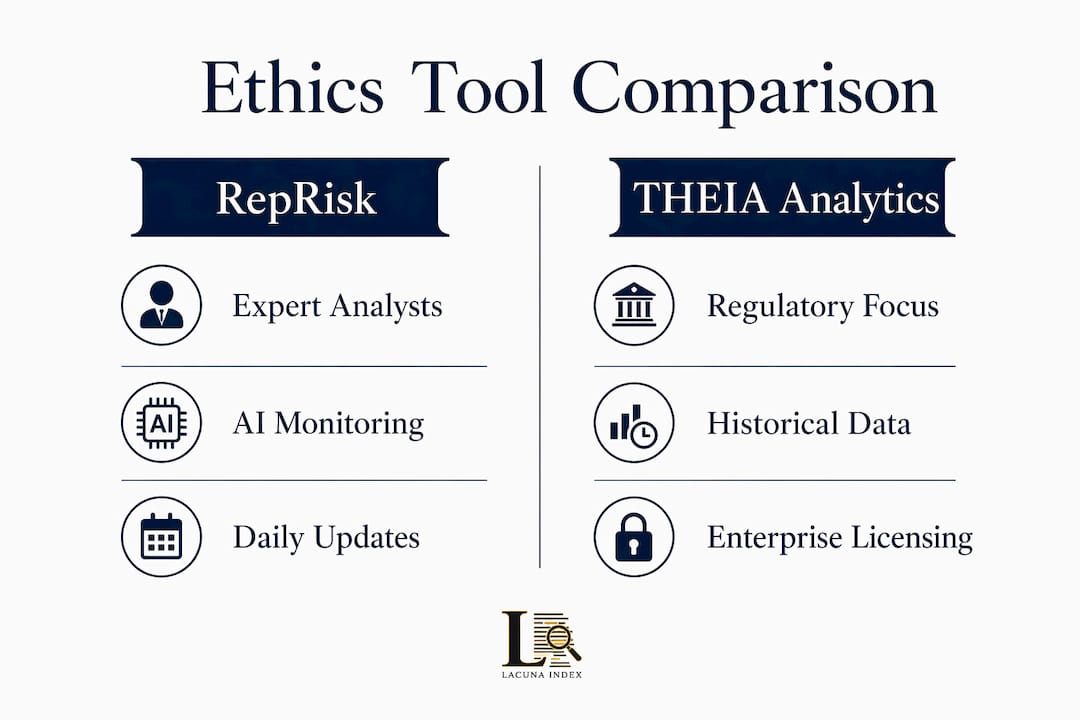
Community and expert involvement also differs. RepRisk's analyst team drives curation decisions. THEIA's scoring is model-driven at scale. Lacuna Index's methodology is documented and open to audit, aligning with the principle that open and auditable methodologies allow users to avoid black-box effects common in proprietary ESG ratings.
How to choose a corporate ethics evaluation tool
Selecting among mashinii.com competitors requires evaluating several dimensions that go beyond headline feature lists.
Data source reliability is the foundational criterion. Platforms drawing from court dockets, SEC enforcement releases, and regulatory archives produce evidence that companies cannot alter after the fact. This is the core advantage of adversarial data over voluntary questionnaire-based ESG scores.
Traceability to primary records separates forensic-grade tools from aggregators. Platforms that provide direct links to source documents — SEC docket numbers, government enforcement releases, specific filing exhibits — allow independent verification of every claim. Without that traceability, a governance advocate cannot confirm whether a risk signal reflects a real regulatory finding or a data processing artifact.
Methodology transparency and open auditability determine whether you can interrogate the scoring logic. Proprietary black-box ratings carry an inherent credibility risk; if the weighting criteria are undisclosed, the score cannot be independently validated. Platforms with auditable scoring frameworks allow users to reweight criteria and verify outputs against their own governance standards.
Additional practical criteria:
- Update frequency: daily updates matter for active portfolio monitoring; quarterly suffices for annual governance reviews
- Coverage scope: global multi-market coverage versus U.S.-focused regulatory depth
- User interface: dashboard-based visualization versus API-first raw data access for model builders
- Pricing and access: enterprise licensing versus tiered self-serve plans
Pro Tip: When evaluating any ethics platform, request a sample report on a company with a known enforcement history. If the platform's output does not surface the enforcement action with a traceable reference to the original regulatory filing, the provenance chain is incomplete.
The broader shift in responsible investment practice moves away from single ESG scores toward multi-dimensional, adversarial-data-centered platforms. Relying solely on corporate self-reported data introduces selection bias at the source; the company decides what to disclose and how to frame it. Forensic platforms that mine governance red flags from public records correct for that bias structurally.
Lacuna Index: forensic corporate evaluation grounded in public records
Lacuna Index occupies a specific and well-defined position among mashinii.com similar platforms. Its methodology measures the aspiration-to-execution gap: the quantified distance between what a company's management communicates in earnings calls, press releases, and proxy statements, and what the underlying SEC filings and financial records actually confirm.
The platform's archetype classification system produces three output categories:
- Earned: companies whose execution scores match or exceed their narrative claims, supported by verifiable disclosure evidence
- Borrowed: companies whose market valuations rest on narrative claims that the underlying records do not yet substantiate
- Undervalued: companies whose actual delivery exceeds the market's current assessment of their narrative
Each classification is derived from forensic reports, sector benchmarks, and execution scores built entirely from publicly available data. No proprietary surveys, no management interviews, no insider access. The methodology is traceable: every score links back to the specific filing, transcript, or disclosure that generated it.
For ethics-focused investors and governance advocates, this approach addresses a structural gap in the evaluation toolkit. Traditional ESG ratings aggregate self-reported data and apply proprietary weights that are rarely disclosed. Lacuna Index inverts that process, starting from the public record and measuring backward to assess whether the corporate narrative holds. Researchers who need to document forensic corporate analysis findings for institutional review or governance reporting will find the traceable evidence chain particularly useful.
The platform's sector benchmarks allow cross-company comparison within an industry, normalizing execution scores against peer groups rather than evaluating companies in isolation.
Lacunaindex offers a different path to corporate accountability
The platforms compared above — RepRisk, THEIA Analytics Group — are enterprise-grade services built for compliance teams and large institutional workflows. Lacunaindex takes a different approach to the same accountability question.
Rather than monitoring daily risk incidents or scoring regulatory filing volumes, Lacunaindex measures whether public companies actually deliver on what they tell the market. The forensic methodology applies to any investor or governance advocate who reads SEC filings and wants an independent, evidence-based assessment of whether the narrative holds up. The user guide walks through how to interpret execution scores and archetype classifications in practice, and the sector benchmarks provide the peer-group context needed to assess relative performance. For researchers who have found mashinii.com insufficient and are not ready to commit to enterprise licensing, Lacunaindex offers forensic-grade analysis built on public records alone.
Key Takeaways
The strongest mashinii.com alternatives share one defining characteristic: they source from adversarial, uneditable records rather than corporate self-disclosure, producing evaluations that companies cannot engineer after the fact.
| Point | Details |
|---|---|
| Adversarial data is the baseline | Court filings, enforcement actions, and investigative reports provide evidence companies cannot alter or withhold. |
| RepRisk leads on global breadth | Over 150 expert analysts produce daily-updated risk incidents across public and private companies worldwide. |
| THEIA quantifies at scale | The RRX™ platform tracks 12 billion data points from 2 million regulatory documents to generate sector Risk Quotients. |
| Traceability separates forensic tools | Platforms linking scores to specific SEC docket numbers or filing exhibits allow independent verification of every claim. |
| Lacunaindex measures the narrative gap | Forensic execution scores and archetype classifications are derived solely from public disclosures, with no insider access required. |