
For U.S. investigative financial reporting, the highest-value sources to open first are PACER (federal court dockets, affidavits, and exhibits), SEC EDGAR (10-K, 10-Q, 8-K, proxy statements), IRS Form 990 records via ProPublica Nonprofit Explorer, FinCEN Beneficial Ownership Information filings, state Secretary of State corporate registries, and county property records. Specialized platforms, including Lacunaindex, add a forensic scoring layer on top of those primary documents. The choice of starting point depends on the lead type:
- Litigation or hidden ownership: Open PACER first; cross-check with OpenCorporates and state SOS filings.
- Public-company narrative vs. performance: Start with SEC EDGAR (MD&A, earnings releases, 8-K exhibits); layer in Lacunaindex execution scores and sector benchmarks.
- Nonprofit or foundation front: IRS Form 990 via ProPublica Nonprofit Explorer, then state charitable-registration filings.
- Political or lobbying ties: FEC disclosures and OpenSecrets, then correlate with EDGAR filings for timing.
- Ownership opacity or shell structures: FinCEN BOI portal, OpenCorporates, and county assessor records for address clustering.
These investigative financial journalism data sources form the evidentiary backbone of any corporate accountability investigation. The sections below detail access mechanics, practical search strategies, and a reproducible workflow for linking them into a publishable chain of evidence.
Table of Contents
- What do the essential federal records actually contain?
- What do state and local records reveal that federal sources miss?
- What do specialized datasets and platforms add to raw records?
- How do you build a reproducible chain of evidence from multiple sources?
- Which tools and skills make financial data analysis defensible?
- How does the workflow look on a concrete hypothetical lead?
- What are the legal and ethical constraints on using financial data?
- Key Takeaways
- Why source-first reporting still wins
- Lacunaindex: forensic analytics built for reporters who work from public records
- Useful sources and quick links
What do the essential federal records actually contain?
Federal records are the primary-source layer that no secondary database can fully replicate. Each system below holds distinct document classes with distinct investigative value.
PACER (Public Access to Court Electronic Records) indexes every U.S. federal district, appellate, and bankruptcy court filing. Dockets, affidavits, and exhibits surface hidden ownership structures, undisclosed contracts, and financial disputes that never appear in corporate disclosures. PACER charges $0.10 per page, capped at $3.00 per document, with a quarterly fee waiver for accounts that accrue under $30. The RECAP browser extension (Internet Archive's PACER cache) automatically uploads retrieved documents to a public repository, reducing redundant fees and preserving copies for provenance purposes.
SEC EDGAR holds the authoritative disclosure record for every U.S. public company. The MD&A section of a 10-K is where management's narrative meets auditor-attested figures; divergence between the two is a primary signal of disclosure opacity. Proxy statements (DEF 14A) reveal executive compensation structures, related-party transactions, and board independence. Exhibits attached to 8-K filings, particularly material contracts and press releases filed as Exhibit 99.1, frequently contain forward-looking claims that can be tested against subsequent quarterly results. Mining public disclosures for management gaps requires systematic comparison of what management said in earnings calls against what the audited financials confirm.
FinCEN BOI filings, introduced under the Corporate Transparency Act, changed how beneficial ownership is reported for millions of U.S. entities. Coverage gaps remain: certain exempt categories (large operating companies, SEC-reporting issuers) are excluded, and the database is not fully public-facing for journalists. Treat BOI as a corroborating signal rather than a definitive ownership map; cross-reference with state SOS filings and OpenCorporates to identify discrepancies.
FEC and OpenSecrets provide campaign finance records that correlate corporate behavior with political contributions and lobbying expenditures. When a company's regulatory posture shifts after a significant PAC contribution cycle, the FEC filing record is the primary-source evidence for that timing.
IRS Form 990 is the financial disclosure document for U.S. tax-exempt organizations. ProPublica Nonprofit Explorer provides searchable, downloadable 990s without navigating the IRS TEOS portal directly. Schedule L (transactions with interested persons) and Schedule O (supplemental information) are the sections most likely to surface self-dealing or undisclosed compensation.
Pro Tip: When batching PACER queries, search by attorney name and law firm in addition to party name. Law firms that repeatedly appear across multiple defendants in a sector often signal a coordinated legal strategy worth investigating. Log every docket number and retrieval date in your evidence file from the first query.
What do state and local records reveal that federal sources miss?
State and county records fill the ownership and asset gaps that federal filings leave open, particularly for privately held entities and real-estate-linked shell structures.

State Secretary of State filings document articles of incorporation, annual reports, registered agent changes, and UCC lien filings. Registered agent changes, especially rapid successive changes, are a reliable signal of ownership restructuring. UCC-1 financing statements identify secured creditors and can reveal undisclosed lending relationships. Reading the distinction between officers (management) and members or shareholders (ownership) is critical; many reporters conflate the two and misattribute control.
County property and assessor records are among the most underused sources in financial investigations. Address clustering, where multiple shell entities share a single registered address or a residential property, is a standard ownership-linkage technique. County assessor parcel data, combined with deed transfer records from the county clerk, traces asset movement across entities. Offline and older records in county archives often contain ownership links that modern digital indexes have not captured.
State court and county clerk records surface local civil litigation, judgment liens, and probate records. A judgment lien filed against a principal's personal assets can establish financial distress that contradicts a company's public narrative of stability.
- Search name variations systematically: include maiden names, middle initials, common abbreviations, and both "LLC" and "L.L.C." formats.
- Use physical addresses as entity-linking anchors across SOS, county assessor, and PACER records.
- When a registry search returns no results, request a certified search from the clerk's office; some older filings are not digitized.
Pro Tip: Where state SOS offices offer bulk index exports (several do, including Delaware and Wyoming), download the full dataset and query it locally. Combining parcel IDs from county assessor data with satellite mapping tools lets you validate whether a claimed physical asset actually exists at the reported address.
What do specialized datasets and platforms add to raw records?
Specialized investigative datasets provide pre-indexed linkages, cross-jurisdictional entity resolution, and historical snapshots that raw registries cannot efficiently deliver. OpenCorporates, the ICIJ offshore leaks databases, and PACER are commonly cross-checked to reveal discrepancies between declared ownership and active litigation. Trade and customs records (UN Comtrade, import/export manifest data) corroborate whether a company's claimed revenue from a specific geography is plausible given actual trade flows. OpenSanctions aggregates sanctions lists, politically exposed persons data, and watchlists from hundreds of global sources, making it a practical first screen for international counterparty risk.
Lacunaindex occupies a distinct position in this ecosystem. Rather than aggregating raw filings, it applies a forensic scoring methodology to public records, quantifying the aspiration-to-execution gap between a company's stated narrative (earnings calls, press releases, proxy statements) and its audited delivery. The platform's sector benchmarks allow a reporter to contextualize a single company's execution score against peers, identifying whether a narrative-performance divergence is idiosyncratic or sector-wide. Lacunaindex does not replace primary filings or human sourcing; it functions as an analytic filter that prioritizes which companies warrant deeper document review.
Pro Tip: Treat every platform output, including entity graphs and ownership trees, as a lead to be corroborated against primary filings and court exhibits. A platform's entity resolution may reflect stale or incomplete data; the primary document is always the publication-grade evidence.
How do you build a reproducible chain of evidence from multiple sources?
A reproducible workflow converts a raw lead into a publishable, legally defensible investigation. The five-step sequence below applies regardless of lead type.
Step 1: Formulate a testable claim. Narrow the narrative to a specific, falsifiable proposition: "Company X's Q3 earnings call claimed 22% revenue growth in its Southeast division, but its 10-Q filed 18 days later shows a 4% decline in that segment." Vague hypotheses produce unfocused document searches.
Step 2: Open sources by claim type. For ownership disputes, start with PACER and SOS. For narrative-performance gaps, start with EDGAR and Lacunaindex. For nonprofit fronts, start with Form 990. For political ties, start with FEC. The forensic financial analysis methodology follows a similar triage logic.
Step 3: Extract and normalize documents. PDF-locked financial tables are a persistent barrier; Tabula extracts tables to CSV, but converted outputs frequently require manual cleaning in OpenRefine to remove formatting artifacts and merged-cell errors. Log every file name, docket ID, form section, and retrieval date at the point of extraction.
Step 4: Triangulate across sources. Link names, addresses, and corporate IDs across PACER, EDGAR, SOS, OpenCorporates, and trade datasets. Record confidence levels and discrepancies explicitly; a discrepancy is itself a reportable finding when the methodology is transparent.
Step 5: Human-source outreach. Market analysts, economists, and company insiders add interpretive context that raw data cannot supply. An analyst who covers the sector can confirm whether a timing anomaly is standard practice or genuinely irregular.
| Source | Doc ID / Reference | Excerpt | Date Retrieved | Confidence |
|---|---|---|---|---|
| SEC EDGAR 10-Q | CIK [redacted], Q3 | "Southeast segment revenue" | 2026 | High |
| Earnings call transcript | Q3 call, p. 4 | "22% growth in Southeast" | 2026 | High |
| PACER docket | Case 1:XX-cv-XXXXX | Complaint alleges revenue misstatement | 2026 | Medium |
| SOS (Delaware) | Entity No. [redacted] | Registered agent changed Oct | 2026 | High |
Pro Tip: Preserve document-level SHA-256 hashes and store originals in an immutable folder before any editing or annotation. This meets chain-of-evidence standards and protects against claims that documents were altered post-retrieval.
Which tools and skills make financial data analysis defensible?
Data journalism is story-first: the analysis exists to support a fact-based narrative, not to substitute for one. Technical proficiency without editorial judgment produces findings that are accurate but unpublishable.
- Core skills: data hygiene, reproducible workflows, source triangulation, basic descriptive statistics, and the discipline to document every manual-cleaning decision.
- Extraction tools: Tabula for PDF-to-CSV conversion; OpenRefine for deduplication, clustering, and normalization; AI-assisted document extraction for high-volume PDF processing, validated with spot checks against originals.
- Analysis environments: Python (pandas, numpy) or R (tidyverse) for joins, aggregations, and reproducible cleaning scripts; Jupyter notebooks or R Markdown for documented, shareable methodology.
- APIs: SEC EDGAR full-text search API, OpenCorporates API for entity resolution, UN Comtrade API for trade-flow corroboration.
- Visualization: Datawrapper or Flourish for publication-ready charts; QGIS or Google Earth Engine for spatial analysis of property and asset claims.
- Statistical grounding: Core data analysis skills remain essential for critically evaluating AI-generated outputs and distinguishing genuine anomalies from noise.
Pro Tip: Validate every automated extract with a 10% spot check against the original document. Record each manual correction in a methodology log with a timestamp; that log is your defense if the analysis is challenged after publication.
How does the workflow look on a concrete hypothetical lead?
Consider this scenario: a mid-cap industrial company announces a major asset acquisition in an 8-K filed three days after an upbeat earnings call projecting "accelerating free cash flow." The acquiring entity is a Delaware LLC with no prior public record.
- EDGAR: Pull the 8-K exhibit (the purchase agreement) and the most recent 10-K. The MD&A's liquidity section shows cash reserves insufficient for the stated acquisition price without undisclosed financing. The annual report discrepancy between the earnings narrative and the balance sheet is the first documented red flag.
- PACER: Search the acquiring LLC's name and its registered agent. A 2024 breach-of-contract case in the Southern District of New York names the same LLC as a defendant in a dispute over a prior asset transfer.
- SOS and OpenCorporates: The Delaware LLC was formed 11 days before the acquisition announcement. Its registered agent manages several hundred entities, a common shell-company indicator.
- County records: The acquired property's deed transfer, filed with the county clerk, lists a purchase price 40% below the figure stated in the 8-K exhibit.
- Human sources: An industry analyst confirms the asset class typically trades at a premium, not a discount, in the current market, corroborating the pricing anomaly.
Pro Tip: Document alternative explanations at each step. If the county deed price discrepancy could reflect a partial transfer or a recorded easement value, note that possibility and search for it. Negative results, when the search parameters are fully documented, are reportable evidence of methodological rigor.
What are the legal and ethical constraints on using financial data?
- Confirm that every data source is genuinely public before publication; court records under seal, grand jury materials, and certain BOI filings carry legal restrictions even when technically accessible.
- Do not publish unverified personal financial details, including home addresses linked to individuals rather than entities, without a clear public-interest justification.
- Respect platform terms of service when scraping or bulk-downloading; some registries prohibit automated access and may block or pursue legal action against violators.
- File FOIA requests (under 5 U.S.C. § 552 for federal agencies) when a document is withheld; log the request date, the agency, and the statutory basis. The request date and any agency response become part of the document's provenance record.
- Prepare a retrieval log, document hashes, and expert corroboration notes before submitting any investigation for legal review.
- Regulatory oversight gaps in public reporting create ambiguity about what is technically accessible versus legally publishable; when in doubt, escalate to newsroom legal counsel before publication.
Pro Tip: Consult legal counsel before acting on leaked spreadsheets or data obtained by scraping behind a paywall. The public-interest defense is not automatic, and the evidentiary value of improperly obtained data may be negated entirely if challenged.
This article is general information for professional journalists and researchers, not legal advice. Confirm current rules with a qualified attorney or the relevant primary source for your specific situation.
Key Takeaways
The most defensible investigative financial reporting combines primary federal and state records with systematic triangulation, documented provenance, and human-source corroboration at every evidentiary step.
| Point | Details |
|---|---|
| Start with federal records | PACER, SEC EDGAR, FinCEN BOI, FEC, and IRS Form 990 are the primary-source layer no secondary database can fully replace. |
| Triangulate across registries | Cross-check OpenCorporates, SOS filings, and county records to surface ownership discrepancies that single-source searches miss. |
| Document provenance immediately | Log docket IDs, form sections, retrieval dates, and document hashes at the point of extraction, before any editing. |
| Corroborate with human sources | Analyst and expert contacts confirm whether a data anomaly is standard practice or genuinely irregular. |
| Lacunaindex as forensic filter | Use Lacunaindex execution scores and sector benchmarks to prioritize which companies warrant deeper primary-document review. |
Why source-first reporting still wins
The proliferation of aggregation platforms and AI-assisted entity resolution has not changed the fundamental constraint of investigative financial journalism: a story is only as strong as its primary-source documentation. Platforms accelerate the discovery phase, but they compress the evidentiary chain in ways that create publication risk. An entity graph generated by an aggregator reflects the aggregator's data vintage and matching logic, not the original filing. When a company's legal team challenges a story, the question is always the same: what does the primary document say?
The more consequential shift is the growing gap between what companies disclose and what they communicate. Earnings calls, investor day presentations, and press releases operate in a narrative register that is largely unconstrained by auditor attestation. The MD&A section of a 10-K is attested; the CEO's opening remarks on a quarterly call are not. Experienced investigators compare those two registers systematically, treating divergence as the primary signal of intentional framing gaps. That discipline, applied consistently across a sector, is what Lacunaindex's methodology formalizes. The tool does not replace the reporter's judgment; it quantifies the gap zone so the reporter knows where to look first.
Lacunaindex: forensic analytics built for reporters who work from public records
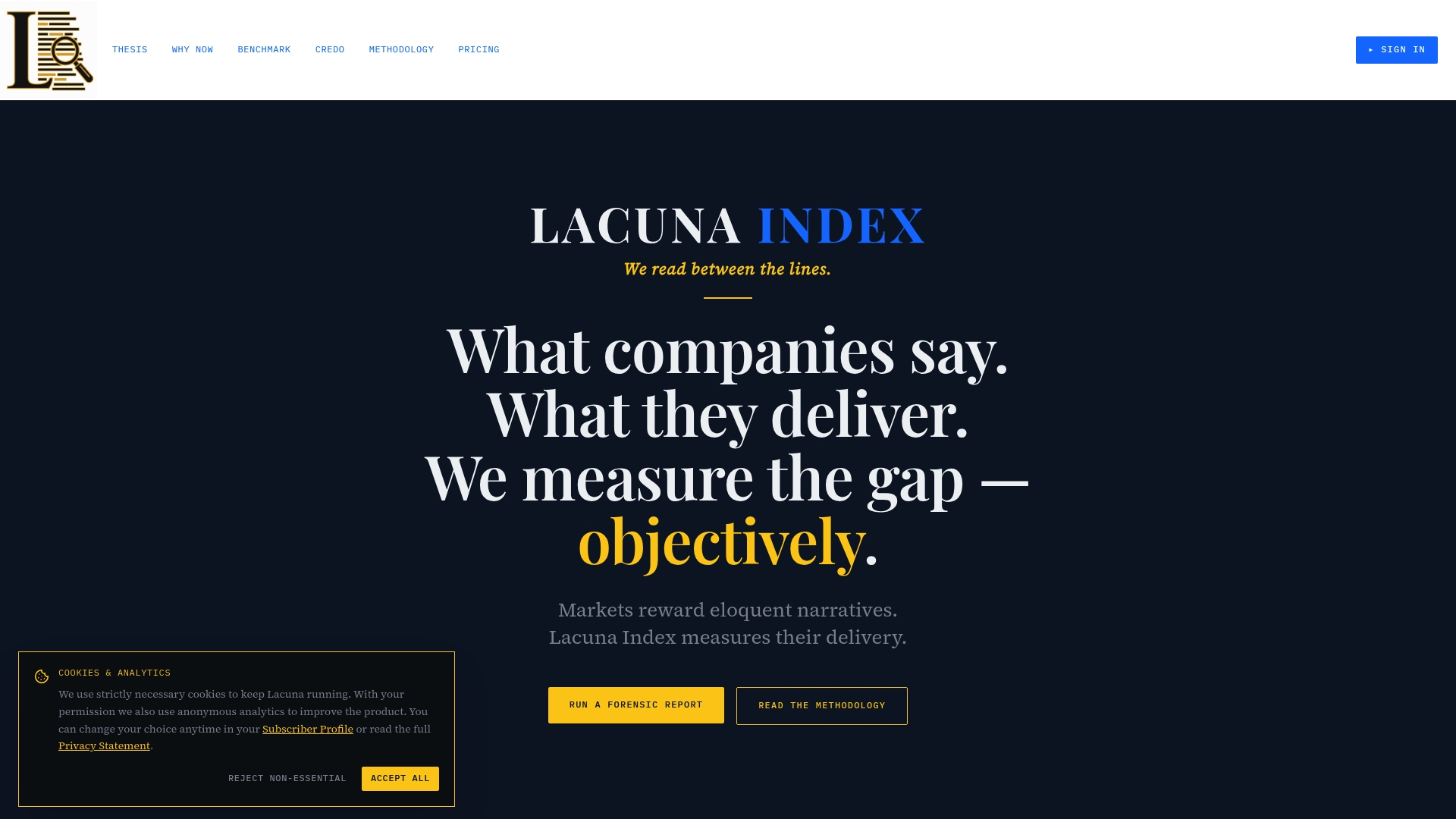
Lacunaindex applies a consistent, evidence-based scoring methodology to public company disclosures, quantifying the aspiration-to-execution gap between stated narrative and audited delivery. For a reporter investigating a specific company, the platform's sector benchmarks provide immediate context: is this company's narrative-performance divergence an outlier, or is it typical for the sector? That benchmark flag narrows the document review to the filings most likely to contain material discrepancies, saving hours of manual triage. The platform's forensic reports are built entirely from public records, which means every finding it surfaces can be traced back to a primary document. Visit Lacunaindex to access sector benchmarks or request a demo for your newsroom.
Useful sources and quick links
- PACER: pacer.gov — federal court dockets, affidavits, and exhibits
- RECAP / Internet Archive PACER cache: free.law/recap — reduces fees and preserves document copies
- SEC EDGAR: efts.sec.gov and EDGAR full-text search — 10-K, 10-Q, 8-K, proxy statements
- FinCEN BOI: fincen.gov/boi — beneficial ownership filings and guidance
- ProPublica Nonprofit Explorer: projects.propublica.org/nonprofits — searchable IRS Form 990 database
- OpenSecrets / FEC: opensecrets.org and fec.gov — campaign finance and lobbying records
- OpenCorporates: opencorporates.com — global corporate registry aggregator with API access
- OpenSanctions: opensanctions.org — sanctions lists, PEPs, and watchlists from hundreds of sources
- USPTO: patents.google.com and tmsearch.uspto.gov — patent and trademark filings for IP-claim verification
- FOIA resources: foia.gov for federal requests; state equivalents vary by jurisdiction
- Evidence log fields: Source, Doc ID, Excerpt, Date Retrieved, Confidence (see workflow table above for a minimal template)