
The most defensible approach to forensic due diligence treats every report as a traceable evidence asset, not a verdict: each finding maps to a named source, carries an explicit confidence level, and feeds directly into screening, diligence, and post-close monitoring workflows. Investment teams that operationalize this discipline consistently surface governance and disclosure-pattern risks that standard financial and legal workstreams miss entirely.
Immediate integration checklist:
- Establish a screening trigger policy (sector sensitivity, deal size, beneficial-ownership complexity) before commissioning any forensic engagement.
- Require that every finding references its source document, page, and paragraph, with a confidence classification (factual observation vs. interpretive opinion).
- Map findings to decision checkpoints: IC memo, valuation model, 100-day plan.
- Assign a forensic lead who is distinct from the investment analyst to preserve analytical independence.
- Set a minimum escalation threshold: any finding rated material must reach legal counsel and the investment committee within a defined SLA.
The sections below cover the operational framework, data sources, legal guardrails, and how Lacunaindex operationalizes this methodology for institutional teams.
Table of Contents
- What does a forensic report actually contain?
- Why forensic inputs add value beyond standard diligence
- How to integrate forensic reports into your due diligence workflow
- Which public data sources matter for US-focused forensic work?
- How to interpret forensic findings without overclaiming
- How to operationalize forensic diligence across teams
- What does implementation realistically cost and how long does it take?
- What KPIs show the forensic program is working?
- US legal, privacy, and ethical constraints on public-data forensics
- Lacunaindex delivers evidence-first forensic integration
- Key Takeaways
- 90-day pilot: actions by phase
- The forensic lens is a fiduciary obligation, not a differentiator
- Authoritative sources and references
What does a forensic report actually contain?
A forensic report is a traceable, method-stated record of evidence and structured observations. The Forensic Science Regulator's guidance is explicit: factual reports communicate observations without interpretation, and any evaluative opinion must be labeled as such and accompanied by a stated uncertainty range. That separation is not a stylistic preference; it is the structural requirement that makes a report defensible under scrutiny.
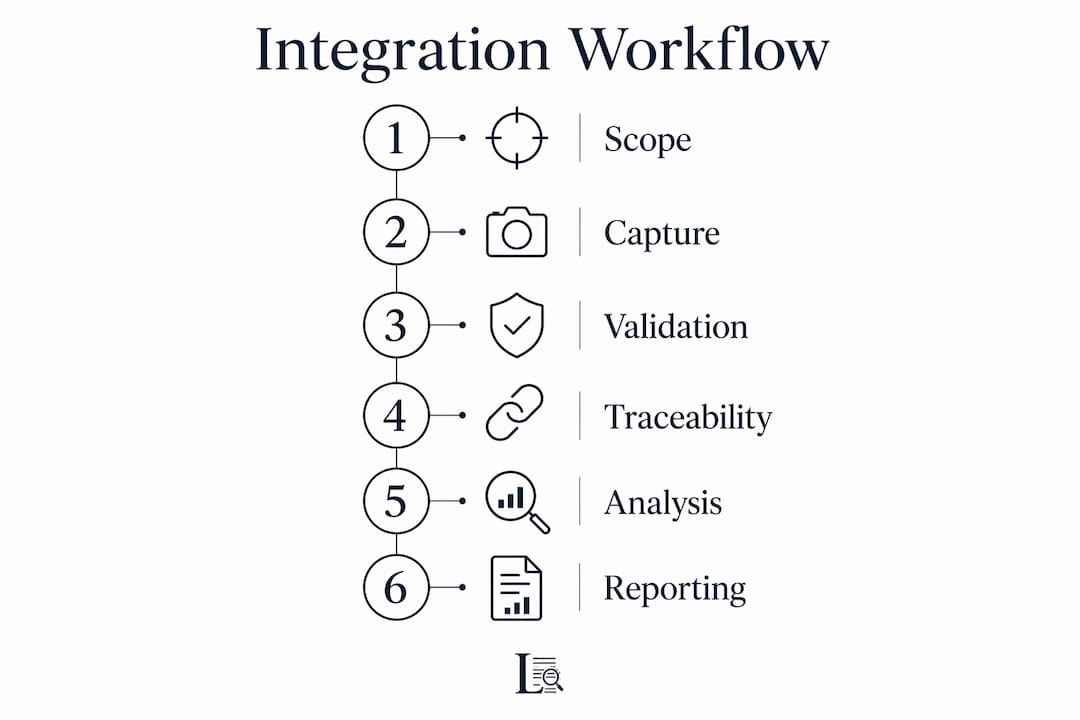
A well-formed forensic report contains: (1) scope and mandate, (2) methodology with tool identification and validation references, (3) raw-source citations with document identifiers, (4) factual findings stated without evaluative language, and (5) interpretive opinions labeled explicitly with confidence levels and alternative explanations considered.
Pro Tip: Demand access to the underlying source extracts, not only the curated PDF. Curated reports reflect examiner choices about what to surface; the raw extraction or source database is the actual evidentiary record and the only basis for independent verification.
Why forensic inputs add value beyond standard diligence
Traditional financial and legal workstreams establish a seller's risk profile through balance-sheet analysis, contract review, and regulatory compliance checks. Forensic inputs operate on a different register: they examine behavioral patterns, conflict mapping, litigation history, and disclosure opacity that routine workstreams are not designed to detect. Forensic due diligence functions as an investigative, evidence-based layer that surfaces integrity, governance, and reputational risks before they become post-close liabilities.
The categories of risk most frequently uncovered by a forensic lens include engineered disclosures (where narrative claims diverge systematically from reported metrics), recurring internal-control failures that appear across multiple filings, and undisclosed related-party transaction patterns detectable only through cross-referencing proxy statements against corporate registry records. These risks affect both valuation and reputational exposure in ways that a standard financial model will not capture. Governance advocates tracking systemic misreporting patterns find that the aspiration-to-execution gap is often widest in sectors with high disclosure complexity and low auditor scrutiny.
How to integrate forensic reports into your due diligence workflow
The integration framework follows five sequential phases: screening, targeted forensic engagement, evidence-linking, validation, and decisioning with ongoing monitoring. Modern due diligence reports that prioritize materiality and cross-workstream synthesis require source traceability for each finding; without it, forensic outputs remain static text rather than operational inputs.
Phase responsibilities by role:
- Investment analyst: owns screening trigger assessment and initial scope definition.
- Forensic lead: executes evidence collection, applies confidence classifications, and produces the traceable findings register.
- Legal counsel: reviews interpretive opinions for defensibility, flags usage constraints, and clears escalation language.
- Portfolio operations: ingests validated findings into the 100-day plan, issue tracker, and monitoring dashboard.
The evidence data model requires each finding to reference: source type (SEC filing, earnings transcript, litigation registry, sanctions list), document identifier (EDGAR accession number, docket number, registry record ID), location (page and paragraph), confidence classification (factual observation or interpretive opinion), and materiality rating (high, medium, low). This structure is what converts a forensic report from a PDF artifact into a traceable evidence asset that post-close teams can verify and update.
Trigger thresholds by transaction type typically recommend full forensic engagement for higher-value or more complex transactions, such as large deals, cross-border structures, or targets in sectors with elevated disclosure opacity; lighter integrity screens are generally suitable for smaller or lower-sensitivity transactions.

Pro Tip: Require a traceability architecture in which every finding carries a hyperlink or object ID pointing to its source record. Teams that skip this step during diligence spend disproportionate time reconstructing evidence lineage post-close when findings are challenged.
Which public data sources matter for US-focused forensic work?
Priority public sources for governance and accountability forensics in the United States are well-defined. The table below maps each source to its primary forensic utility and the recommended capture format.
| Source | Primary forensic utility | Recommended capture format |
|---|---|---|
| SEC EDGAR filings (10-K, 10-Q, proxy) | Disclosure pattern analysis, related-party identification, auditor changes | PDF with EDGAR accession number + page anchor |
| Earnings call transcripts | Narrative-to-metric gap analysis, forward-guidance tracking | Raw text extract with date and speaker tag |
| Federal court PACER records | Litigation history, undisclosed liabilities, counterparty conflicts | Docket number + case ID |
| OFAC sanctions and BIS lists | Beneficial-ownership screening, counterparty exposure | Registry record ID with pull date |
| State corporate registries | Entity structure, officer history, registered-agent changes | Registry record ID + jurisdiction |
| FOIA-released government records | Regulatory correspondence, enforcement history | Document ID + agency identifier |
Standardizing naming conventions and object IDs at ingestion is the operational step most teams defer and later regret. Every finding that cannot be traced to a specific record ID in the virtual data room is a finding that cannot be verified under LP scrutiny or regulatory inquiry.
Pro Tip: Assign a unique ingestion ID to every source record at the point of capture. This single practice compresses evidence-reconstruction time from days to minutes when findings are challenged during post-close audits.
How to interpret forensic findings without overclaiming
The governing rule is straightforward: separate factual observation from interpretation and require explicit confidence or likelihood ranges for every evaluative statement. An interpretive opinion that changes a valuation model must be supported by a minimum-viability evidence trail and a stated sensitivity adjustment; without both, the opinion is not defensible.
Interpretive guardrails for analysts and committees:
- State all assumptions underlying the interpretation explicitly.
- Document at least one alternative explanation consistent with the same evidence.
- Cite tool validation status where technical methods were applied (reference to standards such as NIST SP 800-86 is the recognized benchmark for methodology transparency).
- Disclose any data gaps that constrain the conclusion.
- Apply a materiality threshold before escalating: not every anomaly warrants IC-level attention.
Annual report discrepancy analysis is a common area where overclaiming occurs. Reviewing reporting discrepancies in equity research requires distinguishing between a one-period variance (low materiality) and a pattern across multiple periods (potentially high materiality), a distinction that only a structured evidence register makes reliably.
Pro Tip: Any evaluative conclusion used to adjust a valuation model must include a written sensitivity note stating what evidence would change the conclusion and by how much. This discipline protects the IC from anchoring on a single forensic opinion.
How to operationalize forensic diligence across teams
The integration layer connecting diligence outputs to the systems that consume them is the most overlooked component of any forensic program. Without it, findings accumulate in a PDF archive rather than feeding IC memos, deal models, and monitoring dashboards.
Practical handoffs and tooling requirements:
- Evidence-traceability platform: a workspace that links findings to source records and supports confidence scoring.
- Virtual data room (VDR) integration: findings register accessible to legal, investment, and portfolio ops teams with version control.
- Issue tracker for 100-day plan: each material finding converts to a named task with an owner, a deadline, and a closure criterion.
- IC and LP reporting cadence: forensic findings summary included in every IC memo and quarterly LP update where material findings exist.
Expected turnaround times vary by scope, with light integrity screens generally completed in a few business days, targeted forensic engagements requiring about one to two weeks, and full forensic reviews across multiple workstreams taking several weeks. These timelines assume a dedicated forensic lead and a structured VDR with organized source documents.
What does implementation realistically cost and how long does it take?
A baseline pilot, covering one transaction type and one sector, generally requires several weeks to a few months to implement from policy design through first validated output. Full program roll-out across a portfolio, including tooling integration, role training, and KPI baseline setting, may take several months depending on deal volume and in-house versus vendor resourcing.
Resourcing for a mid-market program: one forensic lead (0.5–1.0 FTE), one investment analyst with forensic training (0.25 FTE), and legal counsel on retainer for interpretive review. Larger programs with higher deal volume add a dedicated portfolio-ops analyst to manage the findings-to-action conversion pipeline. Cost ranges vary significantly by vendor engagement model and in-house capability; banded estimates should be developed against the specific deal volume and sector mix of the program.
What KPIs show the forensic program is working?
- Evidence coverage percentage: proportion of findings with a traceable source reference (target: 100% for material findings).
- Traceability latency: average time from finding identification to source record linkage in the VDR (target: under 24 hours).
- Findings-to-action conversion rate: percentage of material findings that generate a named task in the 100-day plan or monitoring dashboard.
- Valuation-impact adjustments: number and aggregate dollar value of model adjustments attributable to forensic findings per deal cycle.
- Remediation closure time: average days from finding escalation to documented remediation or accepted residual risk.
Accountability scoring methodologies provide a structured basis for calibrating these KPIs by sector and transaction size. IC materials should include a one-page forensic program summary with current-period KPI values and trend direction; LP reporting should include an annual summary of material findings and remediation outcomes.
US legal, privacy, and ethical constraints on public-data forensics
Public data use is permitted under US law but must respect privacy statutes, platform terms of service, and consumer-protection regulations; legal counsel should be integrated into the forensic program design, not consulted only when a finding is challenged.
Key constraints for US-focused forensic work:
- The Computer Fraud and Abuse Act (CFAA) limits automated access to certain web-based sources; scraping must be scoped to sources that explicitly permit it.
- The Gramm-Leach-Bliley Act and state privacy laws (including the California Consumer Privacy Act) constrain the collection and retention of personally identifiable information even when sourced from public records.
- Forensic report robustness depends on a methodology section that documents tool validation and alternative explanations; this standard applies equally to investment-context forensic work.
- Evidence collected for investment purposes must be scoped to task-relevant information; over-collection creates both legal exposure and analytical noise.
Pro Tip: Maintain a one-paragraph collection-method record for every forensic engagement, documenting the sources accessed, the tools used, and the legal basis for access. This record is the first document regulators and LPs will request if a finding is disputed.
This article is general information, not legal or investment advice. Confirm current regulatory requirements with qualified legal counsel for your specific program and jurisdiction.
Lacunaindex delivers evidence-first forensic integration
Lacunaindex operationalizes the framework described in this guide by measuring the gap between corporate narrative claims and actual delivery, drawing exclusively on public records: SEC filings, earnings call transcripts, proxy statements, press releases, and public disclosures. Every Lacunaindex report delivers traceable findings with source citations, execution scores that quantify the aspiration-to-execution gap, and sector benchmarks that allow investment committees to calibrate materiality against peer-group norms rather than absolute thresholds.
For teams ready to pilot the methodology, Lacunaindex provides a structured engagement covering a defined company set within a single sector, with findings delivered in a format designed to integrate directly into IC memos and monitoring workflows. Review the sector benchmarks and request a pilot at lacunaindex.com/benchmarks.
Key Takeaways
Integrating forensic reports into portfolio due diligence requires traceable evidence architecture, explicit confidence labeling, and a direct pipeline from findings to IC memos, valuation models, and 100-day plans.
| Point | Details |
|---|---|
| Separate fact from opinion | Every forensic finding must be labeled as factual observation or interpretive opinion, with a stated confidence level. |
| Demand raw source access | Curated PDF reports reflect examiner choices; the underlying source records are the actual evidentiary basis for verification. |
| Build traceability at ingestion | Assign source IDs at capture so every finding links to its document, page, and paragraph throughout the holding period. |
| Measure program effectiveness | Track evidence coverage, traceability latency, and findings-to-action conversion rate as core KPIs in IC and LP reporting. |
| Lacunaindex as operational option | Lacunaindex delivers execution scores, traceable findings, and sector benchmarks built entirely from public records for IC-ready integration. |
90-day pilot: actions by phase
| Days | Action |
|---|---|
| — | Define screening trigger policy; select one pilot transaction; assign forensic lead and legal counsel; establish VDR naming conventions and ingestion IDs. |
| — | Execute targeted forensic engagement on pilot transaction; build findings register with source traceability; present material findings to IC with confidence classifications. |
| — | Set KPI baseline (evidence coverage, traceability latency, findings-to-action rate); brief LPs on program structure; document lessons learned and replicate architecture for next transaction. |
The forensic lens is a fiduciary obligation, not a differentiator
Institutional investors operating under fiduciary duty cannot rely solely on management-curated disclosures to assess governance and accountability risk. The aspiration-to-execution gap is a measurable phenomenon, not a qualitative judgment, and the tools to quantify it from public records exist now. Teams that treat forensic analytics as a governance support function rather than a one-off diligence add-on consistently produce better LP reporting, faster post-close remediation, and stronger governance outcomes because the evidence architecture is already in place when problems surface. The methodological transparency and auditability that a well-structured forensic program provides are not just defensible to regulators; they are the standard that institutional governance now requires.
Authoritative sources and references
- Technical Reporting in Digital Forensics — PMC/NCBI peer-reviewed analysis of forensic reporting standards and practitioner obligations.
- Forensic Science Regulator: Interpretation and Communication Guidance — primary standard for separating factual observation from evaluative opinion.
- Due Diligence Process: Steps and Timeline — benchmarked M&A diligence workflow with phase-by-phase deliverables.
- Thomson Reuters: Due Diligence Meaning and Practice — legal publisher primer on workstream synthesis and materiality.
- NIST SP 800-86 — US federal standard for forensic tool validation and methodology documentation.
- Lacunaindex Sector Benchmarks — execution scores and sector-level valuation reference materials for IC integration.
- Governance Red Flags in Public Disclosures — practical screening checklist derived from SEC filings and public disclosures.
- How to Read a Value Rating — practical guide to interpreting valuation-impact signals in investment research.