
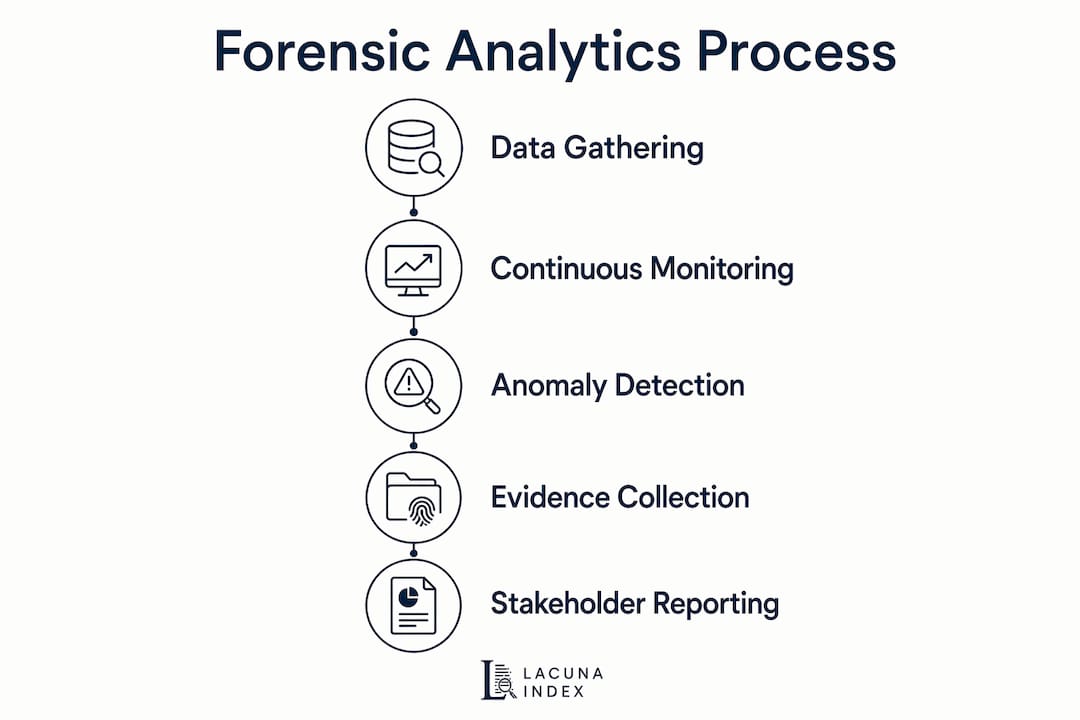
Forensic analytics is defined as the systematic application of data science, continuous monitoring, and evidence-based analysis to detect, prevent, and explain financial irregularities within corporate environments. Understanding how forensic analytics supports governance has become a boardroom-level priority, not merely a compliance function. Proactive risk intelligence frameworks using AI reduce risk detection times from 47 days post-event to as few as 9 days pre-event, with detection accuracy reaching 89–94%. That shift from reactive investigation to continuous surveillance is the defining governance development of 2026. Lacunaindex applies this same evidence-based logic to public company disclosures, measuring the gap between what companies claim and what they actually deliver.
How forensic analytics supports governance through core methodologies
Forensic analytics in governance operates through three primary mechanisms: continuous transaction monitoring, anomaly detection, and streaming analytics. Each mechanism addresses a specific failure point in traditional compliance oversight, which relied on periodic sampling and retrospective review. The industry term for this integrated approach is proactive risk intelligence, and it replaces the older model of forensic accounting as a purely investigative, post-fraud discipline.
Continuous transaction monitoring scans entire transactional populations rather than statistical samples. This matters because fraud and misrepresentation rarely appear in the transactions auditors select for review. Anomaly detection algorithms flag deviations from established behavioral baselines, surfacing patterns that human reviewers would miss across thousands of records. Streaming analytics frameworks processing one million events per second achieve 23% higher detection accuracy and 67% faster processing than traditional batch methods. That performance gap makes real-time monitoring a structural advantage, not an incremental improvement.

The role of AI and blockchain in this framework is specific and bounded. AI accelerates pattern recognition and reduces the time between data ingestion and alert generation. Blockchain provides immutable audit trails that support regulatory defensibility. Together, they shift governance support from analytics as a tool to analytics as infrastructure.
Key functions of forensic analytics in governance include:
- Continuous transaction monitoring: Analyzes full data populations, not samples, to detect irregularities at the point of occurrence.
- Anomaly detection: Identifies statistical outliers in financial flows, disclosure patterns, and executive communications.
- Streaming analytics: Processes real-time data from financial systems, SEC filings, and earnings call transcripts simultaneously.
- Disclosure opacity scoring: Quantifies the degree to which corporate language obscures material facts, a core Lacunaindex methodology.
- Audit trail generation: Creates defensible, timestamped records of every analytical step for regulatory review.
Pro Tip: Before deploying any monitoring framework, map your data sources to specific governance risk categories. A system that monitors transactions but ignores earnings call language will miss the most common form of corporate misrepresentation.
How does forensic analytics improve reporting quality and stakeholder outcomes?
Report quality is not a stylistic concern. It is a governance outcome with measurable consequences. High-quality forensic reports correlate with stakeholder outcomes at r = 0.83, with 91% client retention for high-index reports versus 54% for low-index reports. That 37-percentage-point gap in retention reflects the degree to which governance professionals and institutional investors rely on clear, evidence-backed analysis to make defensible decisions.
The mechanism connecting report quality to governance outcomes runs through what researchers call the stakeholder communication index. Reports that translate complex analytical findings into clear, structured narratives enable audit committees to act on risk signals rather than defer to management interpretation. Dynamic compliance integration cuts violation resolution time by 58% and reduces human error rates by 73%, directly improving audit committee oversight ratings.
| Reporting element | Governance impact |
|---|---|
| Stakeholder communication index | 91% retention for high-index vs. 54% for low-index reports |
| Dynamic compliance dashboards | 58% reduction in violation resolution time |
| Human error reduction | 73% decrease through automated compliance integration |
| Audit committee oversight rating | Significant improvement with real-time risk visualization |
Lacunaindex applies this reporting logic to public company disclosures by generating execution scores that measure delivery against stated commitments. The score is derived entirely from public records, including SEC filings, proxy statements, and earnings call transcripts. That methodology eliminates the subjectivity that undermines most governance assessments.
Pro Tip: Require every forensic report delivered to your audit committee to include a stakeholder communication index score. Reports without one are optimized for the analyst, not the decision-maker.
What are the challenges of integrating AI-driven forensic analytics in governance?
AI adoption in forensic analytics carries specific governance risks that organizations consistently underestimate. The core problem is not technical failure. It is the misallocation of trust, where governance professionals accept AI outputs without the validation protocols that make those outputs defensible under regulatory scrutiny.
AI accelerates misconduct detection and investigation speed, but must be paired with professional judgment and governance controls. Legal experts at Foley & Lardner emphasize that transparency, model validation, and human oversight remain non-negotiable for regulatory compliance. Human-in-the-loop validation is not optional. Investigators must verify AI outputs, adjust inputs, and maintain detailed records of every AI-supported analytical step.
Best practices for integrating AI-driven forensic analytics within governance frameworks:
- Establish model validation protocols. Every AI model used in forensic analysis requires documented validation against known outcomes before deployment in governance contexts.
- Implement bias monitoring. AI models trained on historical financial data inherit the biases of that data. Periodic bias audits prevent systematic blind spots in risk detection.
- Require explainability standards. Explainability in AI forensic analytics enables audit committees to make defensible choices based on trend shifts and risk concentrations rather than opaque algorithmic outputs.
- Maintain human review at decision points. AI flags anomalies. Trained forensic professionals determine materiality and recommend action.
- Document every AI-assisted step. Regulatory bodies including the SEC require that analytical processes used in governance decisions be fully reconstructable. Undocumented AI steps create legal exposure.
- Conduct periodic framework reviews. Governance frameworks governing AI use require scheduled reassessment as model behavior drifts over time.
The corporate transparency imperative in 2026 means that AI-assisted forensic analysis must meet the same evidentiary standards as traditional forensic accounting. Governance professionals who treat AI as a black box will find their conclusions challenged in both boardrooms and regulatory proceedings.
How can organizations implement forensic analytics to strengthen investor confidence?
Practical implementation of forensic analytics begins with data infrastructure, not technology selection. Moving beyond reactive sampling to analyze entire transactional populations requires clean, centralized data access. Organizations that underestimate this foundational requirement consistently experience delays and reduced analytical effectiveness. The most common implementation failure is deploying sophisticated monitoring tools on fragmented, inconsistent data.
A tiered adoption framework serves most governance contexts effectively:
- Tier 1 (Foundation): Centralize all financial transaction data, SEC filings, and earnings disclosures into a single governed repository. Establish data quality standards and access controls before any analytical layer is added.
- Tier 2 (Monitoring): Deploy continuous transaction monitoring and anomaly detection across the centralized data environment. Set alert thresholds calibrated to your organization's specific risk profile.
- Tier 3 (Intelligence): Integrate streaming analytics and disclosure opacity scoring to generate real-time risk dashboards for audit committees and institutional investors.
- Tier 4 (Reporting): Standardize forensic report formats using stakeholder communication index criteria. Ensure every output includes an execution score and a clear narrative linking data signals to governance implications.
Forensic visibility is becoming as critical to boardrooms as financial performance. That shift strengthens audit evidence, improves risk anticipation, and sustains stakeholder trust over time. Institutional investors increasingly use accountability scoring frameworks to evaluate whether a company's governance infrastructure matches its public commitments.
Performance benchmarks from recent research confirm that organizations implementing full-tier forensic analytics frameworks achieve compliance resolution time reductions of 58% and financial misstatement reductions of 47%, with average ROI of 83%. Those figures represent the measurable return on governance investment, not theoretical projections.
Key Takeaways
Forensic analytics supports governance most effectively when proactive intelligence frameworks replace reactive investigation, combining AI-driven monitoring with rigorous human oversight and standardized reporting.
| Point | Details |
|---|---|
| Proactive risk intelligence | AI frameworks reduce detection time from 47 days post-event to as few as 9 days pre-event. |
| Report quality drives retention | High-index forensic reports achieve 91% client retention versus 54% for low-quality reports. |
| Human oversight is non-negotiable | AI accelerates detection but requires human validation at every governance decision point. |
| Data infrastructure comes first | Clean, centralized data access is the prerequisite for effective forensic analytics deployment. |
| Explainability enables action | Forensic dashboards must translate complex outputs into clear narratives for audit committees to act. |
The governance gap that most boards still haven't closed
The research on forensic analytics is clear. The implementation reality is not. After reviewing governance frameworks across multiple sectors, the pattern that stands out is not a technology deficit. It is a translation deficit. Boards receive forensic data. They do not receive forensic intelligence.
The distinction matters. Data tells you that an anomaly occurred. Intelligence tells you what it means for your governance posture, your regulatory exposure, and your credibility with institutional investors. Most organizations stop at data. They deploy monitoring tools, generate alerts, and hand the output to an audit committee that lacks the forensic context to act on it. The result is a governance process that looks rigorous from the outside and functions reactively on the inside.
The shift I find most significant in 2026 is not AI adoption. It is the growing recognition that forensic financial analysis belongs in the boardroom as a standing capability, not a crisis response. Companies that treat forensic analytics as an investigation tool activate it after the damage is done. Companies that treat it as a governance asset use it to prevent the conditions that produce damage in the first place.
The aspiration-to-execution gap that Lacunaindex measures in public company disclosures is the same gap that governance frameworks are designed to close. The difference is that most governance frameworks measure process compliance. Forensic analytics measures outcome delivery. That is the distinction that institutional investors are beginning to price into their assessments, and boards that recognize it early will hold a structural credibility advantage over those that do not.
— Glen
Lacunaindex and the forensic analytics standard for governance
Lacunaindex applies the forensic analytics principles covered in this article to public company disclosures at scale. The platform mines SEC filings, earnings call transcripts, proxy statements, and press releases to generate execution scores and sector benchmarks that measure delivery against stated commitments.
For governance professionals and institutional investors who need objective evidence of corporate accountability, Lacunaindex provides sector benchmarks and analytics built entirely on public records. No insider access. No management interviews. No subjective weighting. The platform's methodology aligns directly with the proactive risk intelligence frameworks and stakeholder communication standards described throughout this article. Governance decisions grounded in Lacunaindex data reflect the same evidence-based rigor that regulators and audit committees increasingly require.
FAQ
What is forensic analytics in governance?
Forensic analytics in governance is the application of continuous data monitoring, anomaly detection, and evidence-based analysis to detect financial irregularities and verify corporate accountability. It shifts governance from periodic review to real-time risk intelligence.
How does forensic analytics support regulatory oversight?
Forensic analytics supports regulatory oversight by generating audit-ready evidence trails, reducing compliance resolution time by 58%, and enabling audit committees to identify risk concentrations before they become violations.
What role does AI play in forensic analytics for governance?
AI accelerates anomaly detection and investigation speed, but requires human-in-the-loop validation, model documentation, and bias monitoring to produce outputs that are defensible under regulatory scrutiny.
How do forensic reports affect stakeholder confidence?
High-quality forensic reports with clear stakeholder communication indices achieve 91% client retention versus 54% for low-quality reports, demonstrating a direct link between report clarity and governance credibility.
What is the first step in implementing forensic analytics?
The first step is building clean, centralized data infrastructure. Organizations that skip this foundation consistently experience delays and reduced effectiveness when deploying monitoring and analytics tools.