
A guidance credibility assessment is a forensic, public-record audit that measures whether a company's promotional and operational claims hold up against documented evidence, expressed as a single exportable, audit-traceable scorecard. The recommended deliverable is not a narrative memo. It is a scorecard carrying provenance links back to source filings, a substantiation grade for every claim reviewed, and an exposure score quantifying regulatory, litigation, and market risk. Lacuna Index builds this deliverable using only public sources, cross-referenced against frameworks like SBTi and GRI, because insider access defeats the entire point of an audit-traceable process.
The stakes are not abstract. A retrieval-augmented verification framework testing corporate claims against audited disclosure data found that only about 5 to 7% of promotional claims could be substantiated against independently verified evidence.
A working assessment answers three questions for every material claim a company makes:
- Does documented evidence exist, and can it be traced to a primary source?
- Does that evidence fully, partially, or contradict the claim as stated?
- What regulatory, litigation, or reputational exposure follows if the claim is challenged?
Pro Tip: Before commissioning a full inventory, run a targeted proof test on the ten highest-impact claims in the most recent 10-K and earnings call. If more than two fail substantiation, the systemic gap is large enough to justify a full audit before you spend budget on comprehensive mapping.
The value of a credibility assessment is not the score itself. It is the provenance trail behind the score, because that trail is what makes the finding defensible in a stewardship meeting, an editorial review, or a regulatory inquiry.
Key Takeaways
A guidance credibility assessment works because it replaces narrative trust with a documented, provenance-linked scorecard that any reviewer can independently verify.
| Point | Details |
|---|---|
| Substantiation rates run low | Only about 5 to 7% of promotional claims hold up against audited evidence, so assume most claims need scrutiny. |
| Follow the five-step process | Inventory, map, grade, score exposure, and remediate, in that order, to keep findings reproducible. |
| Grade with explicit rules | Use fully, partially, none, or contradicted, and always record the rationale and source document. |
| Prioritize hidden cues | Audit adjustments and contradicted disclosures often signal problems before public restatements do. |
| Lacuna Index provides the deliverable | Lacuna Index produces audit-traceable scorecards and free sector benchmarks built on public-record evidence alone. |
Table of Contents
- Why Institutional Users Need a Forensic Credibility Assessment Now
- The Five-Step Forensic Credibility Audit Process
- How Do You Build a Reproducible Substantiation Rubric?
- Which Public Sources Should You Check First?
- Operationalizing Credibility Assessments Inside Governance Workflows
- What Lacuna Index Brings to Guidance Credibility Analysis
- Get an Audit-Traceable Scorecard From Lacuna Index
- Frequently Asked Questions
- Sources
Why Institutional Users Need a Forensic Credibility Assessment Now
Guidance credibility analysis has moved from a nice-to-have research exercise to a functional requirement for anyone making decisions on corporate claims. Portfolio managers price in growth guidance. Proxy advisors write vote recommendations based on governance narratives. Journalists build investigative pieces on promises that may never have had supporting data behind them. Each of these functions inherits risk when a claim turns out to be aspirational rather than executed.
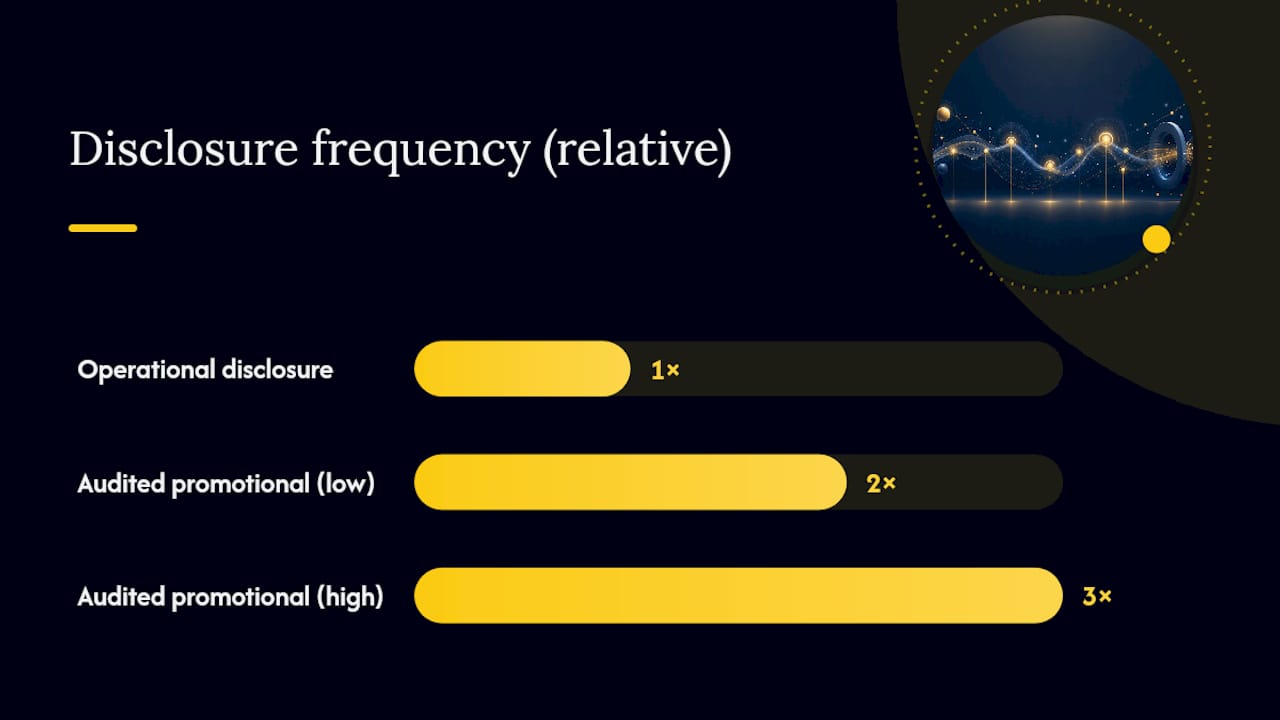
The evidentiary gap is wider than most institutional processes assume. Audited promotional disclosure appears two to three times more often than operational disclosure in the same reporting cycle, meaning companies talk about outcomes far more than they document the mechanics behind them.
Assurance standards have also shifted what counts as proof. Under frameworks like ISSA 5000 and CSRD guidance, a calculation trail and assumptions register are now baseline expectations, not optional extras. That raises the bar for what a "verified" claim actually means, and it changes what your assessment should demand before assigning a favorable grade:
- Stewardship escalation decisions increasingly require documented evidence, not narrative confidence.
- Litigation exposure follows contradicted claims more than ambiguous ones.
- Vote recommendations built on unverified governance claims carry reputational risk for the advisor, not just the company.
The Five-Step Forensic Credibility Audit Process
A reproducible audit does not start with an opinion. It starts with an inventory, and it ends with a documented recommendation that another analyst could reconstruct from the evidence trail alone.
Step 1: Inventory. Scope every material claim across channels, filings, earnings call transcripts, investor decks, fund or product names, ESG labels, and web copy. Assign an owner to each claim, meaning the internal function (investor relations, sustainability, legal) that would need to defend it if challenged. Claims without an identifiable owner are themselves a finding worth flagging.
Step 2: Map evidence. Every claim gets linked to its underlying data source, calculation methodology, assurance statement, or supplier attestation. This is where most assessments break down, because companies frequently make claims their own data architecture cannot support. Investigative analysis has documented this pattern directly: many environmental and operational claims outpace the data infrastructure that would prove them, and evidentiary distance, not the wording of the claim, tends to drive enforcement outcomes when regulators investigate.
Step 3: Grade substantiation. Apply a consistent rubric, fully substantiated, partially substantiated, none found, or contradicted, and record the rationale in writing alongside the supporting files. A grade without a documented rationale is not audit-traceable; it is an opinion with a label attached.
Step 4: Score exposure. Quantify regulatory, litigation, and reputational exposure using a likelihood times impact grid, the same logic enterprise risk management teams already use for other risk categories. A contradicted claim tied to a material fund name or headline metric scores differently than a vague aspirational statement buried in a sustainability report appendix.
Step 5: Remediate and monitor. Recommend one of four actions: withdraw the claim, revise its scope, pursue third-party assurance, or monitor for the next reporting cycle. Set a re-audit date. Credibility is not a one-time score; companies revise language, and yesterday's "partially substantiated" claim can quietly become today's "contradicted" one if underlying performance slips.
An evidence-mapping template should capture, at minimum: claim text, channel, owner, source URL, the specific document extract, the data lineage behind any figure cited, the assurance level attached (if any), and the grading justification. Institutional teams building their own version of this template can review the format used in corporate disclosure integrity analysis for a working structure.
Pro Tip: Run the sample proof test on your top five to ten highest-impact claims before committing to a full inventory. It surfaces systemic evidence gaps in hours instead of weeks, and it tells you whether the company's disclosure culture is generally rigorous or generally aspirational before you invest in the complete audit.
| Step | Primary output |
|---|---|
| Inventory | Complete claim list with assigned owners |
| Evidence mapping | Source links and data lineage per claim |
| Grade substantiation | Rubric-based grade with written rationale |
| Score exposure | Likelihood x impact exposure index |
| Remediate & monitor | Recommended action and re-audit date |
How Do You Build a Reproducible Substantiation Rubric?
A substantiation rubric only works if the decision rules are explicit enough that two analysts reviewing the same evidence would reach the same grade. Vague standards produce inconsistent scorecards, and inconsistent scorecards are indefensible in front of an investment committee.
- Fully substantiated: independent assurance, a documented calculation trail, and no contradicting disclosure elsewhere in the public record.
- Partially substantiated: some supporting data exists, but assurance is absent, scope is narrower than the claim implies, or the calculation trail has gaps.
- None found: no traceable evidence exists in filings, transcripts, or supplier disclosures despite a reasonable search.
- Contradicted: a separate public disclosure, audit adjustment, or third-party registry entry conflicts with the claim as stated.
Exposure scoring combines three drivers, regulatory risk (does the claim touch a disclosure rule with enforcement history), litigation risk (has the claim been referenced in shareholder communications or marketing that could support a securities claim), and market reaction risk (would a credible challenge to this claim move the stock or bond price). A single exposure index, typically low, moderate, high, or severe, lets a reader compare exposure across dozens of claims at a glance.
A single scorecard row might read: claim type promotional; evidence source 10-K supply chain disclosure; substantiation grade partially; exposure score moderate; recommended action monitor. The provenance field must name the exact document, page or section, and retrieval date, because assurance quality genuinely differs from audit quality, and outcome-focused assurance for non-financial claims requires specialist expertise that a standard financial audit does not provide. Where evidence is thin or a calculation assumption is uncertain, flag it explicitly rather than rounding up to a cleaner grade.
Which Public Sources Should You Check First?
Public-only assessment has a discipline built into it: if you cannot point to a document, the claim does not get a favorable grade. Start with SEC filings, the 10-K, 8-K, and proxy statements, since these carry legal liability for inaccuracy that voluntary disclosures do not. Earnings call transcripts reveal guidance language hedging and euphemisms in earnings calls that written filings often smooth over. Press releases, supplier disclosures, and assurance statements round out the primary evidence base, and registries like SBTi, GRI, and CDP let you check whether a company's public commitments match what it has actually registered.
- Pull the claim inventory from filings and transcripts first, since these are legally binding statements.
- Cross-reference against registry disclosures (SBTi, GRI, CDP) for any claim involving climate or sustainability targets.
- Build a retrieval-augmented pipeline: claim extractor, document retriever, evidence matcher, human review, recorded verdict.
Automation helps at scale but does not replace judgment. OCR'd disclosures, transcript parsers, and document search indexes speed up retrieval, but a human reviewer still has to confirm that matched evidence actually supports the claim rather than merely mentioning the same keywords. The retrieval-augmented framework tested against a benchmark of over 34,000 brand-criterion judgments found substantiation rates in the single digits for promotional claims, a result that should set expectations: assume a high false-negative rate on manual review alone, and build automation to catch what a single analyst would miss.
Operationalizing Credibility Assessments Inside Governance Workflows
A credibility assessment only creates value if it reaches the right desk before a decision gets made. That requires a governance owner, a claim inventory refreshed on a fixed cadence, an evidence register, an assurance gate for material claims, and a re-audit schedule tied to reporting cycles.
- First-line: the claim owner (investor relations, sustainability, legal) maintains the evidence file.
- Second-line: compliance and risk review substantiation grades before external release.
- Third-line: internal audit tests the process itself, not just individual claims.
Certain findings should trigger immediate escalation regardless of where they surface: a contradicted claim, missing provenance on a high-impact statement, an assurance scope narrower than the claim implies, or audit adjustments that suggest opaque controls. That last category matters more than most teams assume. Audit adjustments communicated privately to boards are meaningful nonpublic signals of reporting quality that correlate with subsequent board action, including CFO turnover, and a forensic assessment should weight them as early warning indicators when they surface in proxy disclosures or restatement history.
Pro Tip: When presenting findings to an investment committee or editorial desk, lead with the provenance links, not the score. A number without a traceable source invites debate; a number with a document trail invites a decision.
What Lacuna Index Brings to Guidance Credibility Analysis
Lacuna Index approaches guidance credibility assessment as a public-record discipline first and a scoring exercise second. Every forensic report the platform produces traces back to a filing, a transcript, or a registry entry, never to inference or insider knowledge. The methodology sorts companies into archetypes, earned, borrowed, or undervalued, based on how execution scores compare to market valuation, which gives institutional users a fast read on whether a stock's price already reflects its delivery record or is still running on narrative.
A reader should commission Lacuna Index output when the decision at hand, a vote recommendation, a portfolio allocation, an investigative story, demands a defensible, third-party scorecard rather than an internal working document. Running an internal assessment still makes sense for a narrow, single-issue review; Lacuna's sector benchmarks and forensic reports are built for the recurring, comparative work that governance and investment functions do every quarter.
Get an Audit-Traceable Scorecard From Lacuna Index
Building the five-step process described above internally takes real analyst hours, especially the evidence-mapping and provenance-recording steps that make a scorecard defensible rather than opinion-based. Lacuna Index runs this process at scale across sectors, so instead of assembling a claim inventory from scratch, you start from a forensic report that already carries the provenance links, substantiation grades, and exposure scores your committee or editorial desk needs.
The platform's capabilities map directly onto the workflow covered in this guide:
- Audit-traceable scorecards with document-level provenance for every graded claim.
- Free sector benchmarks for comparing execution against valuation across an industry.
- Narrative-versus-delivery analytics that quantify the gap between what a company says and what its filings support.
- Subscription access to full company-level forensic reports for institutional teams, sponsors, and research desks.
Start with the free sector benchmark to see where a company sits against its peers, then request full company-level access through the Lacuna Index platform for the complete scorecard and provenance trail.
Frequently Asked Questions
What is the difference between guidance credibility assessment and standard financial analysis? Standard financial analysis evaluates reported numbers for internal consistency. A guidance credibility assessment tests whether the narrative claims surrounding those numbers, growth targets, sustainability commitments, governance promises, are backed by traceable public evidence, regardless of whether the underlying financials look sound.
How often should an institutional team re-run a credibility assessment? Align re-audits with reporting cycles, typically quarterly for actively monitored holdings and annually at minimum for broader coverage lists, with an immediate re-audit triggered by a contradicted claim, restatement, or major guidance revision.
Can a public-only assessment ever be fully certain? No. Public-record evidence has limits, and a rigorous assessment surfaces those limits explicitly through confidence flags and documented assumptions rather than presenting a false sense of certainty. Treat "none found" as absence of public evidence, not proof of wrongdoing.
What is the difference between assurance and audit in this context? An audit provides reasonable or limited assurance over financial statements under established accounting standards. Assurance for non-financial claims, such as emissions targets, often follows a different standard, like ISSA 5000, and can vary widely in scope, meaning "assured" does not automatically mean "fully substantiated" under a credibility rubric.
This article is general information, not a substitute for advice from a qualified financial advisor. Consult a qualified financial professional about your own circumstances before acting on anything here.
Sources
- How to avoid greenwashing through audits (Rethinking Performance Initiative, Said Business School, Oxford)
- Auditor-provided nonpublic signals of misreporting and CFO dismissal (Review of Accounting Studies)