
The strongest governance failure early warning signals visible in public records cluster into ten categories: hedge proliferation in MD&A prose, sentence inflation with falling information density, cross-channel divergence between earnings-call tone and 10-K language, auditor resignation or unexpected rotation, disclosed material weaknesses, repeated restatements or 10-K/10-Q amendments, unusual related-party transactions, clustered insider sales via Form 4, unexplained turnover of key accounting executives, and anomalous non-GAAP metric timing. Each is measurable from SEC EDGAR filings without insider access. The checklist below maps each signal to an appropriate response tier.
Public-record early-warning checklist:
- Hedge proliferation (Item 7 MD&A, Risk Factors) — Investigate
- Sentence inflation / specificity loss (MD&A, press releases) — Investigate
- Cross-channel divergence (earnings call vs. 10-K tone) — Escalate
- Auditor resignation or unexpected rotation (8-K Item 4.01) — Immediate red flag
- Disclosed material weaknesses (Item 9A, auditor attestation) — Immediate red flag
- Repeated restatements or amendments (8-K Item 4.02, amended filings) — Immediate red flag
- Unusual related-party transactions (proxy Schedule 14A, footnotes) — Escalate
- Clustered insider sales (Form 4, Section 16) — Escalate
- Key accounting executive turnover (8-K Item 5.02) — Investigate
- Anomalous non-GAAP metric clustering (press releases, earnings calls) — Investigate
Pro Tip: Signals compound. A single hedge count spike is noise; hedge proliferation coinciding with an auditor rotation and clustered Form 4 sales in the same quarter is a cluster requiring immediate escalation.
Key Takeaways
A composite early-warning index combining cross-channel divergence, topic-driven NLP, and sector-normalized financial signals, applied to EDGAR public records, provides materially earlier detection of governance failure than financial ratios alone.
| Point | Details |
|---|---|
| Monitor cross-channel divergence | Tone gaps between earnings calls and concurrent 10-K/10-Q filings predict post-disclosure return patterns. |
| Prioritize clustered signals | Two or more signals in the same quarter warrant escalation; isolated signals require peer comparison first. |
| Use topic-driven NLP models | Bayesian topic models added up to 59% improvement in misreporting detection in out-of-sample tests. |
| Calibrate by sector baseline | Normalize all scores against rolling sector distributions; pharmaceutical hedge baselines differ structurally from technology. |
| Document with audit-traceable links | Every signal must carry an EDGAR permalink and timestamp to support engagement, proxy votes, or publication. |
| Lacunaindex for production monitoring | Lacunaindex delivers EDGAR-ingested, audit-traceable composite scoring with public sector benchmarks and subscription-gated forensic reports. |
Table of Contents
- How governance failure signals appear in filings, transcripts, and proxy statements
- Reproducible measurement techniques for detecting early warnings
- Designing an early-warning score: combining signals and backtesting
- How to interpret signals prudently and avoid false positives
- Practical next steps when signals appear
- How Lacunaindex operationalizes these signals
- Lacunaindex: forensic narrative analytics for institutional oversight
- Sources
How governance failure signals appear in filings, transcripts, and proxy statements
Each signal has a characteristic textual fingerprint. Recognizing it requires knowing which filing section to read and what linguistic pattern to expect.
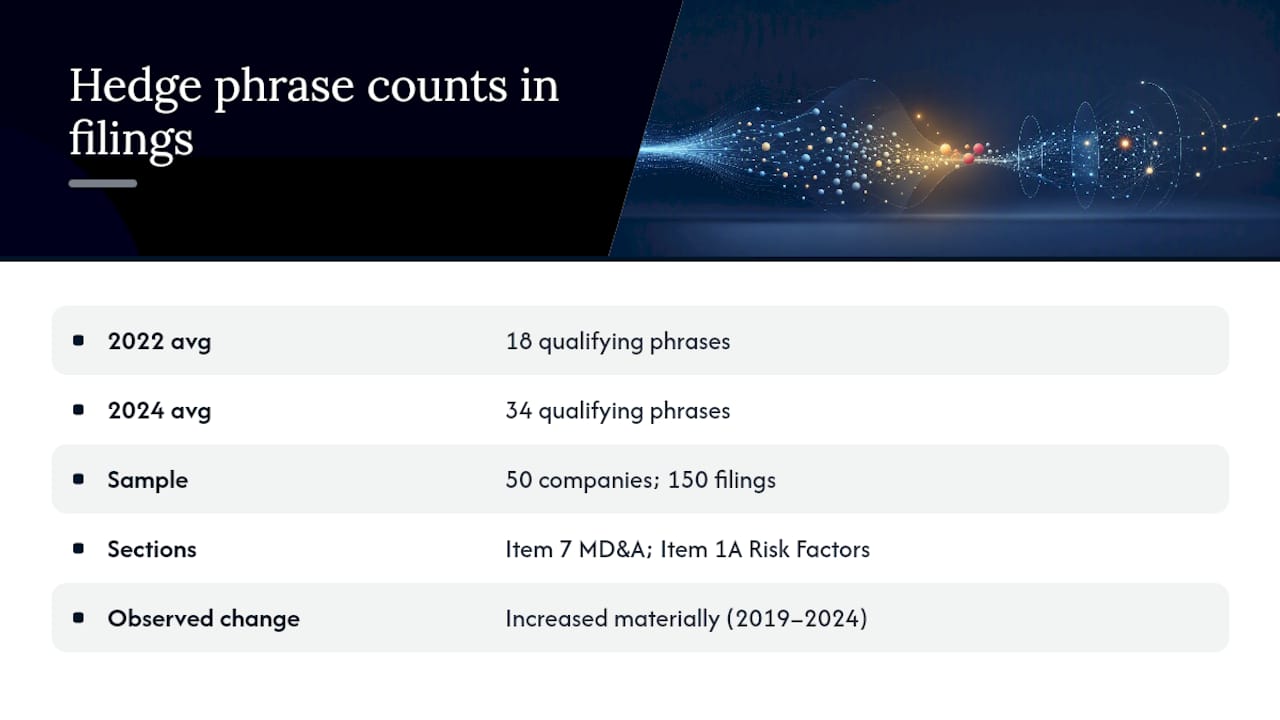
Hedge proliferation manifests as a rising count of qualifying phrases ("subject to," "may be affected by," "cannot be assured") in Item 7 MD&A and Item 1A Risk Factors. A company that used 18 such phrases in its 2022 10-K and 34 in its 2024 10-K has measurably shifted its disclosure posture. Corporate disclosure prose drift analysis documented this pattern across 50 companies and 150 filings, finding that hedge accumulation and sentence inflation increased materially between 2019 and 2024.
Sentence inflation appears as rising average sentence length alongside falling information density: the same paragraph conveys fewer verifiable claims per 100 words. In press releases, this often surfaces as broad aspirational language replacing quantified targets. In MD&A, it appears as multi-clause sentences that qualify every assertion before completing it.
Cross-channel divergence is the gap between the optimistic register of an earnings call and the hedged language of the concurrent 10-K or 10-Q. Research applying Loughran–McDonald dictionaries to 22,366 matched disclosure pairs across 1,762 firms found that tone and complexity divergence between calls and filings predicted post-disclosure return patterns, with complexity divergence producing persistent effects consistent with investor processing frictions.
Compliance with SEC formatting requirements does not equal transparency. Firms can satisfy every disclosure rule while obscuring material risk through dense, generic footnotes. Evaluating how disclosure quality evolves over time is more predictive than checking whether a disclosure exists at all.
Auditor changes require reading 8-K Item 4.01 for the specific language of departure: a resignation differs materially from a routine rotation. Proxy Schedule 14A discloses related-party transactions in the "Certain Relationships" section; unusual counterparty structures or non-arm's-length pricing warrant cross-referencing with the footnotes in the annual report.
Pro Tip: When reviewing proxy statements, map related-party transaction counterparties against the beneficial ownership table. Overlapping names between transaction counterparties and major shareholders are a documented precursor to governance crises.
Reproducible measurement techniques for detecting early warnings
A mixed textual-financial model combining topic models, FinBERT-family embeddings, hedging and readability features, and financial ratios materially improves detection over financials alone. The forensic financial analysis methodology for building such a pipeline follows a defined sequence.
- Bayesian topic models on 10-K narratives. Topic content adds incremental predictive power beyond financial ratios and stylistic variables. Out-of-sample tests showed up to a 59% improvement in misreporting detection for certain categories when topic features were added to baseline models.
- FinBERT / TDFSA embeddings. Topic-Driven Financial Sentiment Analysis (TDFSA) integrates FinBERT embeddings with topic-level sentiment context. Tested on firms flagged in SEC Accounting and Auditing Enforcement Releases (AAERs) from 2014 to 2024, TDFSA achieved higher fraud-detection accuracy and lower detection cost than dictionary-based or generic deep-learning baselines.
- Loughran–McDonald sentiment and tone dispersion. Tone dispersion, the spread of tone words across a narrative, correlates with current and future performance and management reporting choices. Include it as a formal feature alongside net-positive-word counts.
- Hedging counts and readability. Coh-Metrix readability features (syntactic complexity, referential cohesion) and sentence-length metrics quantify specificity loss. BERT-based models trained on MD&A linguistic indicators — positivity, inconsistency, and readability — show improved fraud-prediction performance versus several traditional approaches.
- Aggregate Attribute Index (AAI). Composite scoring that weights each textual and financial feature by its marginal contribution to out-of-sample detection, then normalizes by sector baseline, produces an audit-traceable single score per filing period.
- Cost-sensitive learning. Prioritize minimizing false negatives (missed fraud) over false positives, because the asymmetric cost of missing a governance failure exceeds the cost of a false alarm in most institutional contexts.
- Out-of-sample validation. Use AAERs and restatement events as outcome labels; hold out the most recent two years as a test set and report precision-recall curves rather than accuracy alone.
Research shows that topic-driven models capturing both topic and sentiment information, combined with financial ratios, reduce false negatives when detecting financial statement fraud — improving the balance between detection accuracy and the cost of false alarms.
Designing an early-warning score: combining signals and backtesting
A composite index weighted by predictive contribution and adjusted for sector baselines is the most operationally defensible approach. The methodology follows five steps.
- Feature standardization. Convert all raw features (hedge count, sentence length, tone dispersion, topic probability vectors) to sector-normalized z-scores using rolling three-year historical distributions.
- Marginal AUC weighting. Assign each feature a weight proportional to its marginal improvement in area under the precision-recall curve when added to the model sequentially; cross-channel divergence and topic-model scores typically carry the highest marginal weights.
- Time-decay adjustment. Apply exponential decay to signals older than four quarters so that persistent, recent signals dominate the composite score.
- Sector calibration. Normalize composite scores against sector peer distributions; a hedge-count z-score of +2.1 in the pharmaceutical sector carries different weight than the same score in technology, where regulatory language is structurally different.
- Backtest against AAER and restatement labels. Use a three-year pre-event window; firms with disclosed material weaknesses restate at materially higher rates, making material-weakness disclosures reliable backtest labels alongside formal AAER designations.
| Feature | Normalization | Calibration note |
|---|---|---|
| Hedge count (Item 7) | Sector z-score, rolling 3-year | Pharmaceutical baseline is structurally higher |
| Sentence length (MD&A) | Sector z-score, rolling 3-year | Compare within SIC code |
| Tone dispersion | Raw dispersion score, sector-adjusted | Use Loughran–McDonald word lists |
| Cross-channel divergence | Delta score (call minus 10-Q) | Flag when delta exceeds +1.5 SD |
| Topic-model probability | Posterior probability of misreporting topic | Retrain annually on updated AAER labels |
| AAI composite | Weighted sum, sector-normalized | Threshold at 75th sector percentile for alert |
How to interpret signals prudently and avoid false positives
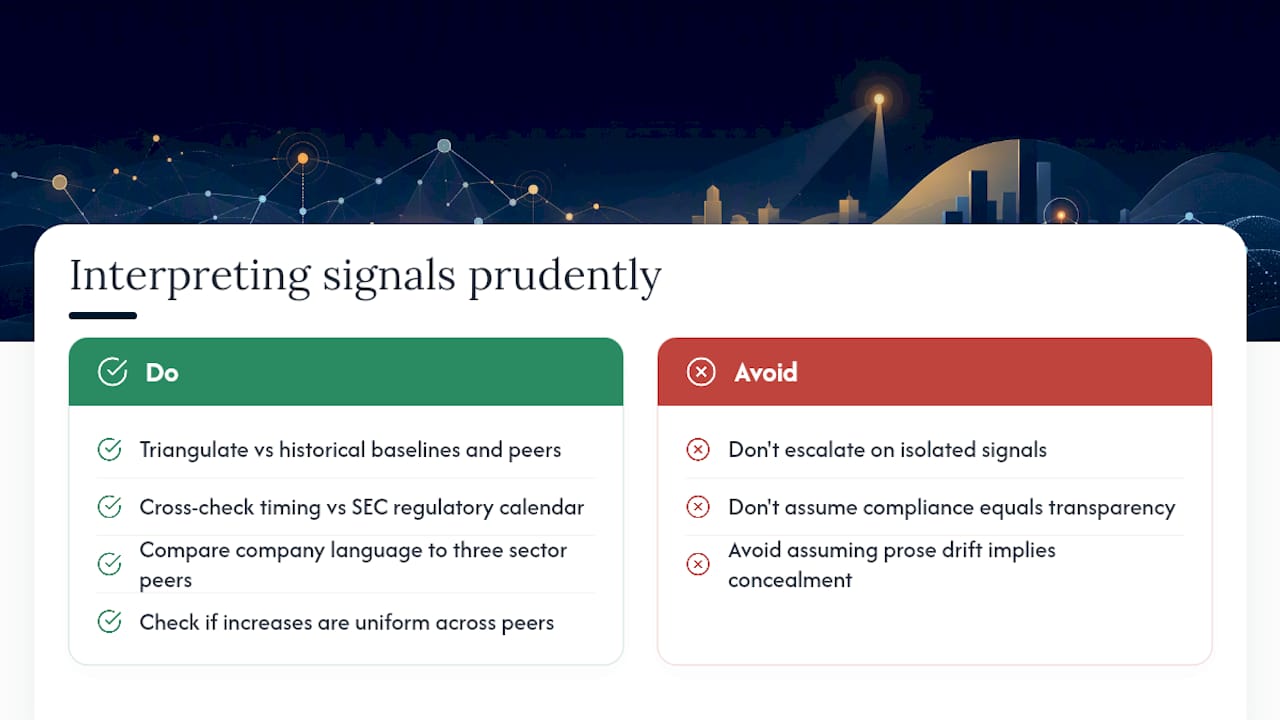
Many signals have benign explanations. Triangulation against historical baselines and peer comparisons is necessary before escalation. Compliance does not equal transparency: a firm can increase hedge counts in direct response to new SEC disclosure guidance rather than as a concealment strategy.
Common benign causes include: new SEC rulemaking that mandates additional risk-factor language, routine auditor rotation under PCAOB independence requirements, industry-specific non-GAAP conventions (adjusted EBITDA in real estate, FFO in REITs), and AI-assisted drafting tools that produce measurable prose drift without any intent to obscure. Prose drift analysis found that editorial governance differences explain variance across firms, meaning some drift is a drafting artifact rather than a governance signal.
Pro Tip: Before escalating a hedge-count spike, cross-check its timing against the SEC's regulatory calendar. If a new disclosure rule took effect in the same quarter, compare the company's language against three sector peers. Uniform increases across peers indicate regulatory compliance; an idiosyncratic spike warrants further investigation.
When to pause vs. escalate: Pause when a signal appears in isolation, aligns with a known regulatory change, or is reversed in the subsequent filing. Escalate when two or more signals cluster in the same period, when the company's pattern diverges from sector peers, or when management remediation statements are absent despite a prior-period flag.
Practical next steps when signals appear
The operational response follows a structured escalation sequence.
- Evidence capture. Download and timestamp the specific filing pages (EDGAR permalink, section, page number). Log the exact signal: hedge count, divergence score, or filing event type.
- Peer and sector comparison. Score three to five sector peers on the same signals for the same period. Idiosyncratic divergence from peers elevates the signal's significance.
- Management query. Draft a precise, documented question set tied to specific filing language. For investors, this is the engagement letter; for journalists, this is the formal comment request with a response deadline.
- Audit committee or fiduciary counsel alert. If the signal involves a material weakness, restatement, or auditor departure, notify the audit committee chair directly or alert fiduciary counsel, depending on the institutional mandate.
- Escalation to monitoring or public action. Unanswered queries after a reasonable period warrant placement on a short-list watchlist (investors), a vote-recommendation review (proxy advisors), or a documented public inquiry (journalists).
Role-specific escalation paths:
- Institutional investors: Adjust position sizing, initiate formal engagement, and document governance concerns in the voting record.
- Proxy advisors: Flag for vote-recommendation review on director elections and auditor ratification; update issuer governance score.
- Financial journalists: File a formal comment request with the company's investor relations contact; document the non-response or response for publication.
How Lacunaindex operationalizes these signals
Lacunaindex implements cross-channel narrative analytics, topic-driven scoring, and an audit-traceable pipeline to surface the checklist signals automatically for subscribers, without requiring insider access or proprietary data feeds.
Core platform features:
- EDGAR ingestion covering 10-K, 10-Q, 8-K, DEF 14A, and Form 4 filings
- Earnings-call transcript alignment with concurrent filings for cross-channel divergence scoring
- AAI-style composite scoring weighted by marginal predictive contribution
- Evidence links to original filing pages, preserving audit traceability
- Sector benchmarks for score calibration and peer normalization
- Execution and narrative scores classifying companies into archetypes (earned, borrowed, or undervalued)
Sector benchmarks are publicly accessible; full company-level forensic reports and narrative-versus-delivery analytics require a subscription. The platform's methodology is grounded in the same forensic corporate analysis framework described throughout this article.
Pro Tip: Use the public sector benchmarks to calibrate your own threshold expectations before subscribing. If a company's public execution score sits two standard deviations below its sector median, that alone justifies a deeper forensic review.
Why narrative analytics have become operationally necessary
The volume of public disclosure has grown faster than any manual review capacity. Quarterly 10-Q filings, daily 8-Ks, earnings-call transcripts, and proxy statements generate thousands of pages per company per year. Financial ratios alone capture governance deterioration only after it has already affected reported numbers. Narrative analytics, applied systematically to the same public records regulators and investors already receive, surface the aspiration-to-execution gap before it becomes a restatement or an enforcement action. For institutional users operating under fiduciary mandates, that lead time is the operational value. Lacunaindex is positioned to deliver it at scale, with the audit traceability that institutional and journalistic workflows require.
Lacunaindex: forensic narrative analytics for institutional oversight
Institutional investors, proxy advisors, and financial journalists who have worked through this checklist face a practical constraint: running the full pipeline manually across a portfolio of public companies is not operationally feasible at scale.
Lacunaindex delivers the complete forensic workflow described here as a production platform. Subscribers receive EDGAR-ingested forensic reports with execution scores, narrative scores, cross-channel divergence analysis, and evidence links to the original filings, all calibrated against sector benchmarks. The platform classifies companies into earned, borrowed, or undervalued archetypes based on the gap between narrative claims and measured delivery. Sector benchmarks are available publicly at Lacunaindex. For full company-level forensic reports and ongoing signal monitoring, subscription details are available at Lacunaindex.
This article is general information, not a substitute for advice from a qualified financial advisor. Consult a qualified financial professional about your own circumstances before acting on anything here.
Sources
The monitoring pipeline draws from six primary source types, each with a distinct ingestion cadence.
Source inventory:
- What Are You Saying? Using topic to Detect Financial Misreporting
- Off Script: When Earnings Calls and Filings Tell Different Stories
- 10-K red flags checklist
- Tone dispersion and narrative structure
Monitoring workflow: