
Misuse defeats the PSLRA safe harbor in exactly two circumstances: the cautionary language accompanying the statement is not "meaningful," or the plaintiff proves the defendant possessed actual knowledge the statement was false. Every fatal pattern that follows traces back to one of those two failures, whether the vehicle is a boilerplate legend, a known adverse fact recast as a hypothetical risk, or an unsupported claim about the reasonableness of a projection's methodology.
TL;DR:
- Boilerplate legends that fail to address specific known risks or are reused without updating undermine the meaningfulness requirement for safe harbor protection.
- Courts scrutinize whether cautionary language genuinely relates to materialized risks and not just generic warnings, especially when disclosures are repeated over multiple cycles.
- Reaffirming guidance without a current, documented basis or making unsupported claims about projection methodology can strip away PSLRA safe harbor defenses.
- Oral statements during earnings calls are unprotected unless explicitly flagged as forward-looking and linked to a publicly available, specific written cautionary statement.
- Forensic analysis of public disclosures over time can reveal narrative-delivery gaps, exposing companies that reaffirm guidance without basis or reframe known issues as future risks.
Table of Contents
- Understanding Forward-Looking Statement Misuse Under the PSLRA Framework
- How the Safe Harbor Operates in Practice, and Where It Breaks Down
- Recognizable Misuse Patterns and How Courts Have Responded
- Building Forward-Looking Disclosures That Actually Hold Up
- Forensic Perspective: Detecting Narrative-Delivery Gaps in Public Records
- Practical Checklist for Preserving Safe Harbor Protection
- What the Safe Harbor Debate Gets Wrong
- A Complementary Resource for Monitoring Narrative Risk
- Primary Sources and Practitioner Guidance Worth Bookmarking
- Sources
Understanding Forward-Looking Statement Misuse Under the PSLRA Framework
The Private Securities Litigation Reform Act of 1998 built a deliberately narrow structure. Congress wanted companies to share projections and plans without inviting a securities suit every time a forecast missed, but it did not want a free pass for reckless or knowingly false statements. 15 U.S.C. § 78u-5 codifies that balance with two independent paths to protection.
A written or oral forward-looking statement is protected if it is identified as forward-looking and accompanied by "meaningful cautionary statements" identifying important factors that could cause actual results to differ materially. Separately, even without that cautionary language, a defendant escapes liability unless the plaintiff proves the statement was made with actual knowledge that it was false. Satisfying either prong ends the inquiry. Miss both, and the statement stands unprotected against a securities fraud claim.
The SEC's implementing rules operationalize this statutory language for specific filing contexts. 17 C.F.R. § 230.175 (under the Securities Act) and 17 C.F.R. § 240.3b-6 (under the Exchange Act) deem certain forward-looking statements made in filings or specified documents not fraudulent, unless the statement was made or reaffirmed without a reasonable basis, or was disclosed other than in good faith. These parallel rules matter because they extend coverage to specific filing contexts and clarify how reaffirmation of an earlier forecast is treated. A company that repeats last quarter's guidance without updating its basis can find itself outside the rule's protection even when the original statement was fine.
What actually counts as forward-looking? The statutory and regulatory definitions cover several overlapping categories:
- Projections and forecasts: revenue, earnings, capital expenditure, or other financial figures for future periods.
- Management plans and objectives: statements about future operations, strategic initiatives, or business plans.
- MD&A-linked statements: forward-looking assertions tied to the trends and uncertainties disclosed in the Management's Discussion and Analysis section.
- Disclosed assumptions: the underlying premises identified as supporting a projection or plan.
The categories sound clean on paper. In practice, the line between a forward-looking statement and a statement of present or historical fact gets blurred constantly, particularly on earnings calls, where an executive answering a live question can slide from "here's what happened last quarter" into "here's what we expect" within the same sentence. Only the second half gets safe harbor consideration, and only if it is properly flagged.
How the Safe Harbor Operates in Practice, and Where It Breaks Down
Safe harbor protection is not a status a company earns once and keeps. It is tested statement by statement, and the mechanics differ depending on whether the statement is written or spoken.
For written statements in filings, a PSLRA legend typically appears near the forward-looking content, cross-references a risk factors section, and identifies the specific categories of uncertainty relevant to that particular disclosure. For oral statements, the PSLRA permits a shorter form: the speaker can state that the particular statement is a forward-looking statement, that actual results may differ materially, and that additional information is available in a "readily available written document" identified by the speaker. That last requirement trips up more companies than any other. Referring vaguely to "our SEC filings" without naming the specific document, or failing to make that document genuinely accessible, has been enough for courts to find the oral safe harbor inapplicable.
Several statutory limits narrow the harbor further:
- Excluded transactions. The PSLRA does not cover forward-looking statements made in connection with certain transactions, including going-private transactions and tender offers, where Congress judged the risk of manipulation too high to extend protection.
- Financial statements are excluded. Statements contained in financial statements prepared under generally accepted accounting principles fall outside the safe harbor entirely, regardless of how they are labeled.
- Reaffirmation without basis. Under Rule 230.175 and Rule 240.3b-6, reaffirming a prior projection without a continuing reasonable basis for it strips the protection from the reaffirmed statement, even if the original projection was properly protected.
- IPO and blank-check exclusions. Certain issuers, including those in their first public offering, do not get PSLRA coverage for forward-looking statements at all.
Courts test "meaningfulness" by asking whether the cautionary language actually addresses the risks that materialized, not whether a legend exists somewhere in the document. Practitioner analysis from Paul Weiss makes clear that courts increasingly demand substantive, company-specific language tied to a statement's actual assumptions, rather than a generic list of industry risks copied across filings for years. A legend warning about "general economic conditions" does little when the actual cause of the miss was a customer concentration risk the company knew about and never disclosed. Timing compounds the problem: a caution that accompanied last year's 10-K does not automatically travel with a live statement made on this quarter's earnings call unless it is actually incorporated into that specific communication.
Pro Tip: Never staple a PSLRA legend onto disclosure language that contains no forward-looking statement at all. Recent guidance from Venable warns that plaintiffs have cited over-applied legends as evidence the company understood it was in risk territory and tried to paper over it with boilerplate, rather than as evidence of good-faith compliance.
Recognizable Misuse Patterns and How Courts Have Responded
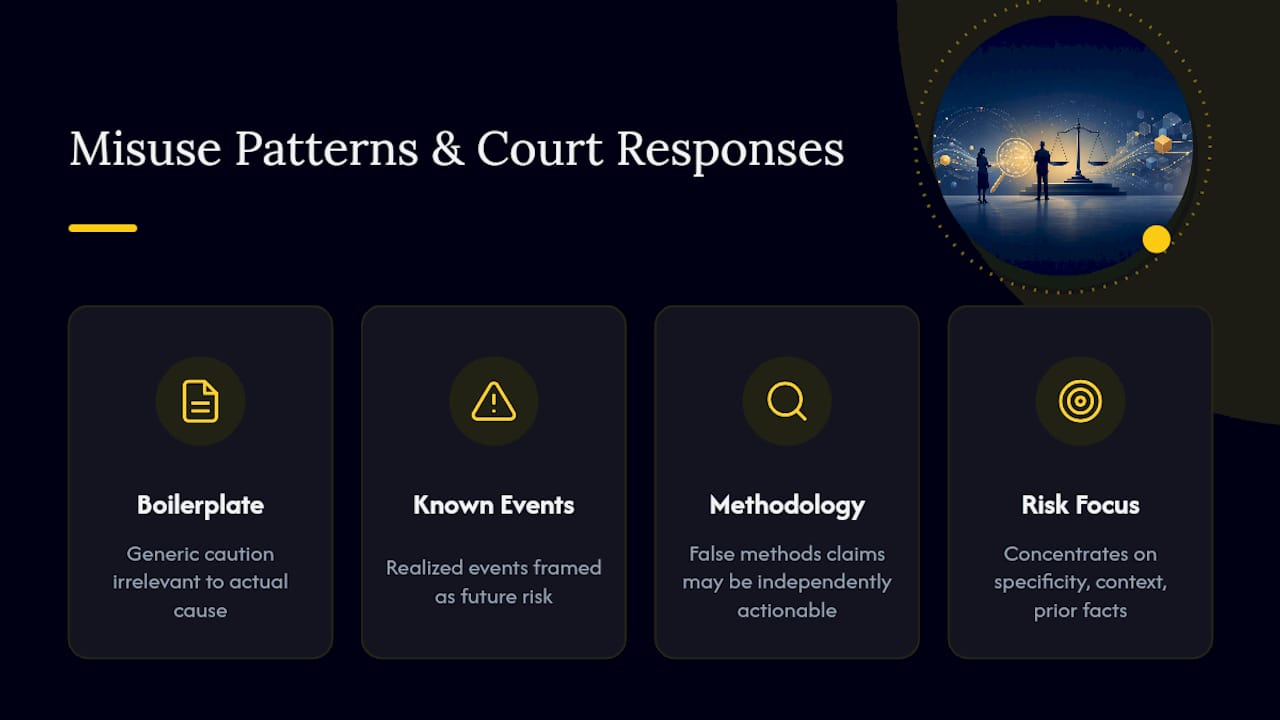
Three patterns account for most of the litigation risk tied to forward-looking statement misuse, and each maps directly to one of the two ways a safe harbor defense collapses.
Boilerplate legends that never engage with the actual risk. A cautionary paragraph that lists ten generic macro risks, unchanged quarter after quarter, fails the meaningfulness test the moment the actual cause of a shortfall was something the company already knew about and omitted, such as a departing key customer or a known supply disruption. The legend was never wrong on its face; it was simply irrelevant to what actually happened, which courts have treated as functionally equivalent to no cautionary language at all.
Known adverse events dressed up as speculative risks. This is the most damaging pattern because it converts a disclosure document into affirmative misdirection. If a company has already lost a major customer relationship or already knows a product defect is causing returns, describing that outcome in the future tense as something that "could" happen is not caution, it is concealment. Practitioner guidance on this point is unambiguous: presenting an already-realized event as a mere potential risk removes the cautionary language's ability to give investors a realistic picture, because the risk described no longer resembles the risk that actually exists.
Unsupported claims about projection methodology. A statement asserting that a forecast is "based on reasonable assumptions" or that underlying data has been "rigorously validated" can be independently actionable if the speaker held contrary information at the time. Analysis from Levi & Korsinsky notes that courts scrutinize these methodological assurances separately from the projection itself. Even when the underlying number stays protected, a false claim about how that number was derived can stand on its own as securities fraud.
Litigation risk for forward-looking statements is not evenly distributed across every qualitative disclosure a company makes. Academic research published in The Accounting Review found no strong average association between qualitative forward-looking disclosures and subsequent litigation, which cuts against the instinct to over-hedge every sentence. The risk concentrates instead around specificity, context, and whether the statement diverges from facts the company already possessed, not around the mere presence of forward-looking language.
That finding should reshape how compliance teams triage review effort. Generic optimism about "strong momentum going into next year" rarely draws a suit on its own. A specific numeric guidance range issued alongside undisclosed knowledge that a key contract was at risk is a different animal entirely, and it is the animal that ends up in enforcement actions and shareholder complaints.
Building Forward-Looking Disclosures That Actually Hold Up
Defensible forward-looking statements are built, not bolted on after the fact. The work happens before the press release goes out, not in litigation two years later.
- Tie every projection to a documented, disclosed assumption. If guidance assumes a certain input cost, customer retention rate, or macro condition, name that assumption in the accompanying cautionary language rather than relying on a generic risk factor that happens to be adjacent to the topic.
- Write cautionary language specific to the statement it accompanies. A single master legend recycled across every filing invites the boilerplate challenge described above. Draft modular cautionary language mapped to the actual risk categories relevant to each disclosure, an approach Venable's compliance guidance recommends specifically for reducing exposure in unscripted contexts.
- Maintain contemporaneous documentation of the basis for every projection. Sign-offs, the underlying model, the data inputs, and the identity of who approved the final figures should exist in a retrievable form before the statement is public, not reconstructed after a subpoena arrives.
- Pre-script the scope of earnings call Q&A and social media exposure. Executives fielding live questions routinely drift from historical fact into forward-looking territory without flagging the shift. Predefining likely topics and preparing short, substantive cautionary responses reduces the risk of an unprotected oral statement, an issue explored in more detail in why companies overpromise on earnings calls.
- Build a defined process for updating, reaffirming, or withdrawing guidance. Reaffirmation without a continuing reasonable basis strips protection under Rule 230.175 and Rule 240.3b-6, so silence is often safer than a stale reaffirmation issued out of habit.
For channels where a full legend is impractical, such as a brief social media post or a short television interview quote, practitioner guidance from The Corporate Counsel increasingly recommends a prominent hyperlink to the company's written cautionary statement rather than attempting to compress the full legend into a character-limited format. The link preserves the "readily available written document" element the PSLRA oral safe harbor requires, without pretending a tweet can carry the full text of a risk factors section.
Pro Tip: Build a standing internal record of who reviewed and approved each set of guidance assumptions, dated and retained separately from the earnings materials themselves. If a plaintiff later alleges actual knowledge of falsity, that contemporaneous record is often the single most persuasive rebuttal counsel can produce, because it shows what the company genuinely believed at the time, not what it claims in hindsight.
Getting the internal governance right also means aligning disclosure timing with what the risk factor language in the 10-K and 10-Q actually says, so a live statement on an earnings call never contradicts the written record filed weeks earlier.
Forensic Perspective: Detecting Narrative-Delivery Gaps in Public Records
Every misuse pattern described above leaves a paper trail across multiple disclosure cycles, and that trail is exactly what forensic public-record analysis is built to surface. Lacuna Index's methodology draws on SEC filings, earnings call transcripts, press releases, and proxy statements to compare what a company claims it will deliver against what it subsequently reports, using only information already public.
That comparison across time is where narrative-versus-delivery gaps become visible in ways a single filing rarely reveals on its own. A handful of signals recur often enough to function as early warnings of weak safe-harbor posture:
- Repeated guidance reaffirmation with no corresponding change in disclosed assumptions, suggesting the reaffirmation may lack the reasonable basis Rule 230.175 requires.
- Optimistic language on earnings calls that consistently outpaces the caution embedded in the same quarter's risk factors, a divergence that can indicate the oral remarks were not meaningfully tied to written cautionary material.
- Unexplained restatements following periods of confident public guidance, a pattern that invites scrutiny of whether management held contrary information at the time projections were made.
- Reassurances about methodology or data quality that recur across quarters without documentation ever surfacing in filings.
Forensic analysis of this kind has found repeated narrative promises that fail to convert into delivery across successive reporting cycles, a pattern worth treating as elevated litigation exposure rather than routine corporate optimism. For counsel and disclosure teams, these patterns function as a diagnostic layer that sits on top of the statutory analysis, pointing toward exactly which prior statements deserve the closest review before the next earnings cycle.
Practical Checklist for Preserving Safe Harbor Protection
Counsel reviewing a draft press release, earnings script, or investor presentation can apply the following sequence before anything goes public.
- Confirm every forward-looking statement is explicitly identified as such, in the surrounding text, not buried in a footer legend.
- Match cautionary language to the specific assumptions underlying that statement, not a recycled generic list.
- Verify the cautionary language addresses risks the company actually knows about, including any already-realized adverse facts.
- Confirm reaffirmed guidance still has a documented, current basis before it goes out again.
- Retain contemporaneous records of who approved the projection and what data supported it.
- Prepare oral-remarks scripts for earnings calls and interviews with pre-linked references to the written cautionary document.
- Establish a clear internal trigger for updating or withdrawing guidance when the underlying facts change materially.
| Checklist item | Why it matters | Statutory anchor |
|---|---|---|
| Identify statement as forward-looking | Required for the first safe-harbor path | 15 U.S.C. § 78u-5 |
| Company-specific cautionary language | Generic legends fail the meaningfulness test | § 78u-5; Venable guidance |
| Contemporaneous documentation | Rebuts allegations of actual knowledge | § 78u-5 actual-knowledge prong |
| Reasonable basis for reaffirmation | Reaffirmation without basis voids protection | 17 CFR § 230.175, § 240.3b-6 |
| Linked oral-statement legends | Satisfies "readily available written document" | § 78u-5(c)(2) |
The actual-knowledge inquiry deserves particular attention because it is where discovery gets aggressive. Preserve drafts, internal emails discussing projection assumptions, and any dissenting analysis that questioned a figure before it went public. Deleting or failing to retain that material does not make the knowledge disappear; it just makes the eventual reconstruction of what the company knew, and when, entirely dependent on whatever plaintiffs' counsel can subpoena from third parties.
What the Safe Harbor Debate Gets Wrong
Most compliance training treats the PSLRA safe harbor as a drafting exercise: get the legend right, attach it consistently, and move on. That framing misses the actual mechanism of failure. Courts are not primarily punishing companies for bad legends. They are punishing companies for a mismatch between what a legend claims to warn about and what management actually knew at the time it spoke.
The pattern shows up most clearly in reaffirmation. A company that reaffirms guidance quarter after quarter, using the same cautionary paragraph each time, is not committing a drafting error. It is signaling that its internal review process treated the legend as a formality rather than a live assessment tied to current facts. That is precisely the gap forensic analysis of public disclosures is designed to expose: not whether the legend exists, but whether the narrative behind it has kept pace with what the company's own filings, calls, and restatements reveal over time. Reviewing patterns across governance failure signals tends to surface the same companies again and again, and it is rarely the companies with aggressive projections. It is the ones whose cautionary language never changes no matter what happens.
Institutional investors who treat a clean legend as proof of low litigation risk are reading the wrong signal. The safe harbor was built to protect honest forecasting accompanied by honest warning, not to protect a boilerplate ritual repeated regardless of what management actually knew.
— Glen
A Complementary Resource for Monitoring Narrative Risk
Legal review catches drafting problems in a single disclosure. It rarely has the bandwidth to track whether a company's cautionary language and guidance claims have actually matched delivery across six, eight, or twelve consecutive reporting cycles. That longitudinal view is where Lacunaindex fits, not as a replacement for counsel's statutory analysis, but as the evidence layer that tells you where to point that analysis first.
Lacunaindex builds forensic reports that quantify the gap between what a public company claims on earnings calls, in press releases, and in proxy statements, and what its subsequent filings show it actually delivered, using only public records. Each report produces an execution score and a narrative score, so counsel and institutional investors can see, in one place, which companies have a pattern of reaffirming guidance without a documented basis, or reframing known problems as speculative risks. Sector benchmarks are free to review and offer a useful starting point for spotting which companies in a given industry show the widest narrative-to-delivery gaps. Visit the Sector Benchmarks page to see sample reports, or reach out to Lacunaindex to discuss a tailored forensic report on a specific issuer before your next disclosure review or investment decision.
Primary Sources and Practitioner Guidance Worth Bookmarking
- 15 U.S.C. § 78u-5: the PSLRA statutory text establishing both the meaningful-cautionary-statement and actual-knowledge paths to safe harbor.
- 17 C.F.R. § 230.175: the Securities Act rule implementing safe harbor protection for statements in filings.
- 17 C.F.R. § 240.3b-6: the parallel Exchange Act rule covering issuer statements and reaffirmation contexts.
- Venable's 2024 safe harbor compliance guidelines: practitioner analysis of common pitfalls in oral and unscripted disclosure settings.
- Paul Weiss guidance on cautionary statement drafting: analysis of what courts require for a legend to be "meaningful."
- The Accounting Review study on qualitative disclosure litigation: empirical evidence on which qualitative statements actually draw suits.
This article is general information, not a substitute for advice from a qualified lawyer. Consult a qualified legal professional about your own circumstances before acting on anything here.
Sources
- 15 U.S. Code § 78u-5 - Application of safe harbor for forward-looking statements | Legal Information Institute
- 17 CFR § 230.175 - Liability for certain statements by issuers | Legal Information Institute
- 17 CFR § 240.3b-6 - Liability for certain statements by issuers | Legal Information Institute
- Forward-Looking Statements: Safe Harbors Compliance Guidelines | Venable