
Corporate forward guidance operates inside a defined regulatory architecture, and it is narrower than most issuers imply. The Private Securities Litigation Reform Act (PSLRA) creates a safe harbor for forward-looking statements, but only when they are identified as such and paired with meaningful cautionary language. SEC Rules 175 and 3b-6 extend related protection to filed projections, and Regulation FD forces broad, simultaneous disclosure rather than selective tips to favored analysts. None of this amounts to blanket immunity.
- PSLRA safe harbor: protects identified, cautioned forward-looking statements from certain private securities suits.
- Rules 175/3b-6: extend good-faith protection to projections when a reasonable basis exists and backup is filed or available.
- Regulation FD: bars selective disclosure of material guidance ahead of public release.
Pro Tip: Treat every guidance statement as a testable claim. Pull the original 8-K, the earnings call transcript, and the next quarter's 10-Q side by side before forming a view on management credibility.
The immediate action for institutional investors: start a forensic checklist against EDGAR filings and transcripts now, rather than after a miss reveals the gap.
Key Takeaways
Forward guidance accountability rests on verifying disclosed assumptions against public filings, since PSLRA and Regulation FD protections are conditional, not absolute.
| Point | Details |
|---|---|
| Safe harbors are conditional | PSLRA and Rules 175/3b-6 require identification, cautionary language, and a reasonable basis, not just a legend. |
| Boilerplate legends often fail | Courts favor tailored, dynamic cautionary language tied to specific disclosed assumptions over generic risk lists. |
| Discovery stay drives strategy | Invoking the safe harbor pauses discovery during a motion to dismiss, shaping settlement dynamics regardless of merits. |
| Use a six-point checklist | Test specificity, disclosed assumptions, MD&A linkage, consistency, approval evidence, and dissemination timing. |
| Lacunaindex operationalizes this | Its execution and narrative scores apply the same public-record checklist systematically across sector benchmarks. |
Table of Contents
- What Regulatory Protections Cover Forward Guidance Accountability?
- Why Boilerplate Cautionary Language Often Fails In Court
- What Public Records Should You Check For Guidance Accuracy?
- How Do You Measure Whether Guidance Was Delivered?
- How Lacuna Index Turns Public Filings Into Accountability Scores
- How Should Companies Write Cautionary Language That Actually Protects Them?
- What Enforcement Cases Reveal About Guidance Accountability
- What Role Do the SEC and DOJ Play In Policing Guidance?
- What Remedies Exist When Guidance Turns Out To Be False?
- How Does This Accountability Standard Shape Board Oversight?
- Are There New Regulatory Changes Affecting Forward Guidance?
- Why Forensic Discipline Beats Trusting the Legend
- Ready to Apply This Checklist Systematically?
- Sources
What Regulatory Protections Cover Forward Guidance Accountability?
Forward guidance accountability regulatory explained simply: three overlapping regimes govern what companies can say about the future and how they must say it. Each has a specific scope, and each has a specific loophole issuers exploit.
The PSLRA safe harbor, codified at 15 U.S.C. § 78u-5, protects a "forward-looking statement" (projections of revenue, income, capital expenditures, plans for future operations, and similar estimates) when it is identified as forward-looking and accompanied by cautionary language identifying important factors that could cause actual results to differ. Importantly, the statute applies to issuers already subject to Exchange Act reporting, which means it does not cover initial public offerings, blank-check companies, or issuers that have settled certain SEC enforcement actions.
Rules 175 and 3b-6 operate alongside the PSLRA. They shield a projection made "in good faith and with a reasonable basis" even outside the specific statutory categories, and they let oral statements piggyback on protection if the underlying assumptions are filed or "readily available," according to SEC concept release guidance. That "readily available" standard is where a lot of disputes concentrate.
Regulation FD adds a separate obligation: when a company discloses material nonpublic information to analysts or select investors, it must simultaneously (for intentional disclosure) or promptly (for unintentional disclosure) make that information public through a method reasonably designed to reach the broader market, per SEC Regulation FD.
| Protection | What it covers | Key limitation |
|---|---|---|
| PSLRA safe harbor | Identified forward-looking statements with cautionary language | Excludes IPOs, penny stocks, issuers under certain enforcement orders |
| Rules 175 / 3b-6 | Projections made in good faith with reasonable basis | Requires filed or readily available supporting assumptions |
| Regulation FD | Public dissemination of material information | Only covers selective disclosure; does not immunize false statements |
Why Boilerplate Cautionary Language Often Fails In Court
Materiality determines whether a misstatement even matters legally. The standard test asks whether a reasonable investor would have viewed the omitted or misstated fact as significantly altering the total mix of available information. For guidance specifically, the SEC's Corporation Finance interpretations note that reaffirmations near quarter-end can themselves become material events, since timing signals what management already knows about the coming close.
Scienter, the required mental state for securities fraud claims, is the second hurdle. Plaintiffs generally must plead facts giving rise to a strong inference that executives knew (or were severely reckless in not knowing) that a statement was false or misleading when made. A stale safe-harbor legend does not defeat this inquiry by itself.
Courts assess reasonableness and good faith at the time statements were made, and boilerplate legends that fail to evolve with new risk information frequently do not survive scrutiny, according to research on Regulation FD and financial disclosure.
Practice notes on this point are consistent:
- Generic, unchanged cautionary legends carried across multiple quarters signal a compliance-by-template approach.
- Courts and the SEC favor cautionary language tied to the specific forecast and updated as new risks emerge.
- Documented internal projection processes, sometimes called projection binders, help demonstrate good faith.
Where the PSLRA does help issuers procedurally is discovery. Invoking the safe harbor triggers an automatic stay of discovery while a motion to dismiss is pending, a procedural advantage that reduces settlement pressure regardless of the case's ultimate merits. That is precisely why sophisticated defense counsel push safe-harbor motions early and why investors should not read a dismissal at that stage as a merits ruling.
What Public Records Should You Check For Guidance Accuracy?
A forensic review of forward guidance does not require insider access. It requires discipline in reading public filings against each other. Work through this sequence for any company under review:
- Pull the original guidance statement. Locate the Form 8-K or press release announcing the guidance and note the exact figures, ranges, and qualifying language used.
- Check for disclosed assumptions. Search the earnings call transcript and the MD&A section of the 10-Q or 10-K for the specific assumptions (input costs, unit volumes, macro conditions) underlying the forecast.
- Test consistency across sources. Compare the press release language to the transcript and to the risk factors section; inconsistent framing across documents is a red flag.
- Verify management approval evidence. Look for references to board or audit committee review of guidance methodology in the proxy statement.
- Confirm dissemination timing. Check whether guidance was released via broad channels (EDGAR, webcast, press release) consistent with Regulation FD, or first appeared in analyst notes before a public filing.
- Log every citation. Record the filing type, date, and page or timestamp for each data point pulled, per accountability benchmarking practice.
Escalate to governance committees or reporters when you find guidance that was reaffirmed shortly before a miss, assumptions that vanish between quarters, or language that shifts from specific figures to vague qualitative outlook without explanation. Our guide on accountability-focused earnings coverage walks through how reporters build these findings into publishable analysis.
How Do You Measure Whether Guidance Was Delivered?
Turning a qualitative impression ("management overpromises") into a defensible finding requires metrics applied consistently across quarters. Five measures do most of the work.
- Guidance delta: the percentage difference between original guidance and actual reported results for the same metric.
- Variance trend: whether the delta is widening, narrowing, or stable across four or more consecutive quarters.
- Miss frequency: how often guidance falls outside the disclosed range versus within it or above it.
- Reaffirmation cadence: how often management reaffirms guidance between initial issuance and the reporting date, and whether reaffirmations precede a miss.
- Execution score concept: a composite that weights delta, trend, and frequency into one comparable figure across companies in a sector, an approach detailed in disclosure gap analysis.
Timing matters as much as the numbers. A company that knows results will miss guidance and stays silent until the scheduled earnings date, rather than issuing an interim update, raises a materiality question the SEC's own interpretive guidance addresses directly. Extract evidence with precision: capture the EDGAR filing date and accession number, and note the exact transcript timestamp for verbal guidance statements, so the record can withstand later scrutiny.
How Lacuna Index Turns Public Filings Into Accountability Scores
Lacunaindex operationalizes this exact checklist. Its methodology mines earnings calls, SEC filings, press releases, and proxy statements exclusively from public records, without insider access, to quantify the gap between what a company says and what it delivers.
- Execution and narrative scores translate qualitative impressions into comparable, audit-traceable figures.
- Sector benchmarks let institutional users see whether a company's guidance discipline is typical or an outlier for its industry.
- Reports classify companies into archetypes, distinguishing performance that is earned from performance that is borrowed against optimistic narrative.
Governance teams use these outputs to flag proxy season questions; investigative journalists use them as sourcing leads, building on the same disclosure gap patterns that analysts track manually. The scoring method mirrors the checklist above but applies it systematically across a full public-company universe rather than one filing at a time.
How Should Companies Write Cautionary Language That Actually Protects Them?
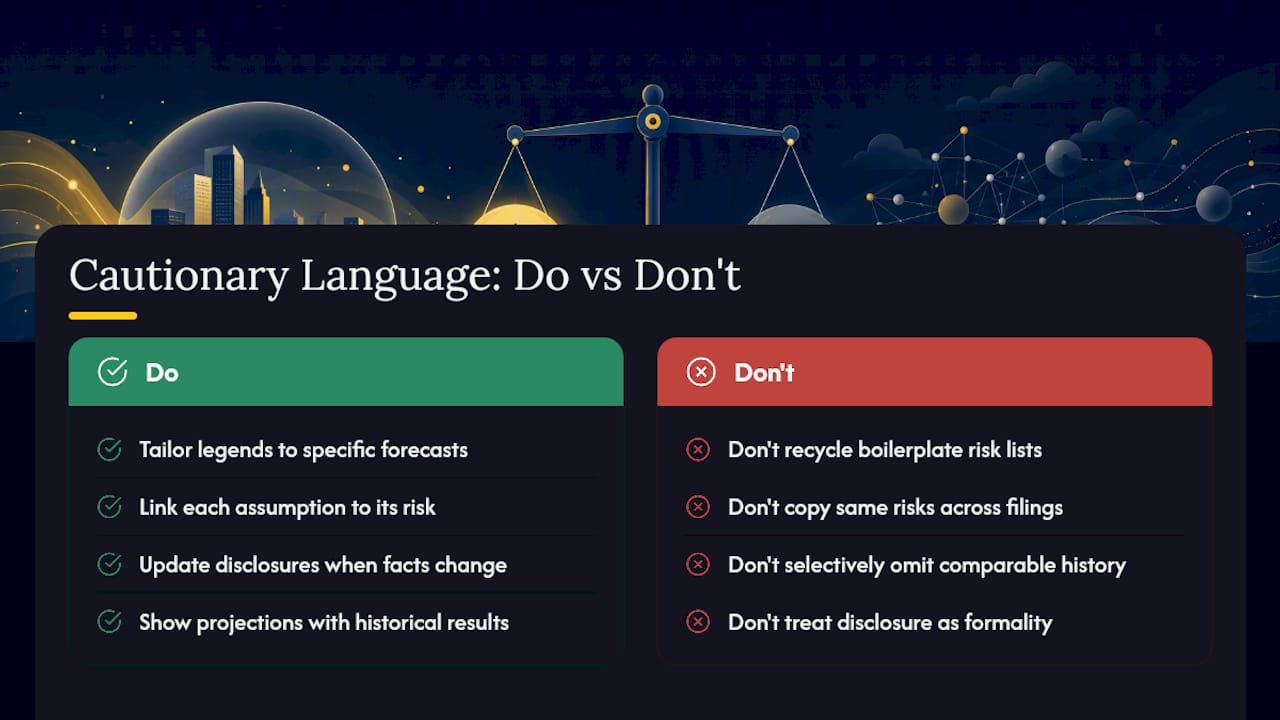
Cautionary language that merely lists generic risks, competition, economic conditions, regulatory change, rarely survives a well-pleaded complaint intact. Practice guidance on this point is blunt: legends must be tailored to the specific forecast being made, not recycled from the prior quarter's filing.
Effective cautionary disclosure links each material assumption behind a forecast to the specific risk that could invalidate it. If guidance assumes a certain input cost or unit volume, the cautionary language should name that assumption and the factors that could move it, according to practice notes on giving good guidance. A static list of macro risks copied across ten consecutive 10-Qs signals the opposite: cautionary language treated as a compliance formality rather than a genuine disclosure.
Dynamic disclosure also means updating language as circumstances change intra-quarter. If a company learns of a supply disruption two weeks after issuing guidance, courts and the SEC expect the risk language accompanying any subsequent public statement to reflect that new information, not the boilerplate drafted before the disruption occurred.
Item 10(b) of Regulation S-K guidance pushes issuers toward presenting projections alongside historical results rather than isolated, favorable-looking figures, a standard Venable's compliance guidance treats as central to what counts as a reasonable basis for a forecast. Selective presentation, showing only the metrics trending favorably while omitting comparable historical figures, undermines the good-faith argument even when a cautionary legend is technically present.
For institutional readers, this is a screening tool: guidance accompanied by specific, assumption-linked cautionary language deserves more credibility than guidance wrapped in identical risk factors quarter after quarter.
What Enforcement Cases Reveal About Guidance Accountability
Enforcement history around forward guidance rarely produces a single dramatic case; it accumulates through a pattern of SEC actions and private litigation where the safe harbor either held or collapsed under scrutiny. The common thread across failures is not that companies missed guidance, missing guidance alone is not fraud, but that internal documents contradicted public statements at the time they were made.
Cases that survive dismissal typically share fact patterns where plaintiffs obtained (often through parallel regulatory investigation) internal emails or board materials showing executives privately doubted the guidance figures they published. Cases that succeed for defendants typically show a documented, reasonable basis existed at the time, even if circumstances later changed unfavorably.
Regulation FD enforcement follows a different pattern: cases usually turn on discrete, identifiable disclosure events, an executive comment on an unscripted call, a private conversation with an analyst, rather than on the underlying accuracy of the guidance itself. The SEC's own dissemination guidance has pushed companies toward standardized quarterly call formats with advance public notice specifically to reduce this exposure.
For governance professionals building an accountability case, enforcement history teaches a specific lesson: the strongest evidence rarely comes from the guidance figure itself. It comes from timing, internal consistency, and whether cautionary language demonstrably tracked the risks management actually knew about.
What Role Do the SEC and DOJ Play In Policing Guidance?
The SEC holds primary civil enforcement authority over forward guidance disclosure, operating through its Division of Corporation Finance, which issues interpretive guidance and reviews filings, and its Division of Enforcement, which investigates potential securities fraud tied to false or misleading projections.
Corporation Finance's role is largely preventive and interpretive: it publishes compliance and disclosure interpretations clarifying how Regulation FD, Rules 175 and 3b-6, and the PSLRA safe harbor apply to specific disclosure scenarios, including the treatment of guidance confirmations near quarter-end. Enforcement's role is reactive and adversarial, pursuing civil penalties, disgorgement, and officer bars when investigations substantiate that guidance was issued with scienter rather than a good-faith reasonable basis.
The Department of Justice enters when conduct crosses from civil securities fraud into criminal territory, typically requiring evidence of willful deception rather than negligence or an overly optimistic but good-faith forecast. DOJ actions tied to forward guidance are less common than SEC civil cases and usually accompany broader accounting fraud allegations rather than standing alone on a guidance miss.
For institutional investors, this division matters practically. An SEC comment letter referencing forward-looking disclosure is a lower-severity signal worth monitoring, not necessarily a precursor to enforcement. A parallel SEC and DOJ inquiry into the same guidance statements signals a materially higher risk profile and should accelerate any internal governance review already underway.
What Remedies Exist When Guidance Turns Out To Be False?
Investors harmed by materially false or misleading forward guidance have several potential paths, though each carries distinct procedural hurdles shaped directly by the protections discussed above.
Private securities fraud claims under Section 10(b) and Rule 10b-5 remain the primary vehicle, but the PSLRA's heightened pleading standard requires plaintiffs to specify each misleading statement and the reasons it was misleading, then separately plead facts supporting a strong inference of scienter. This is a materially higher bar than ordinary civil pleading, and it is precisely why the safe harbor's discovery stay matters so much strategically: plaintiffs often cannot access internal documents until they clear this pleading threshold on the public record alone.
Class action mechanisms under the PSLRA also govern lead-plaintiff selection, typically awarding that role to the investor with the largest financial stake, which shapes how institutional investors with large concentrated positions can drive litigation strategy rather than remain passive class members.
Beyond private litigation, investors can file complaints with the SEC's Office of the Whistleblower or petition through shareholder proposals and proxy access mechanisms to demand governance changes around guidance practices, even absent actionable fraud. Books-and-records demands under state corporate law (Delaware Section 220 being the most litigated) offer another avenue to obtain internal documents before committing to a full securities fraud complaint, often used specifically to test whether a scienter case is viable before filing.
How Does This Accountability Standard Shape Board Oversight?
Board audit committees increasingly treat guidance methodology as a governance function rather than purely a management prerogative. That shift shows up in proxy disclosures describing board involvement in reviewing forecasting assumptions before public release.

This matters for a specific reason: documented board or audit committee review of guidance methodology directly supports the "reasonable basis" and good-faith elements required by Rules 175 and 3b-6. A board that can point to minutes showing it questioned management's assumptions before a guidance release strengthens the company's legal position and gives investors a concrete signal of oversight quality.
Proxy advisors and governance professionals increasingly ask a specific question during engagement season: does the audit committee charter explicitly reference oversight of forward-looking disclosure, or is guidance treated purely as an investor-relations function with no board touchpoint? Companies with the former structure tend to show more disciplined, assumption-linked cautionary language, following the same pattern practice guides recommend for legal defensibility.
For institutional investors conducting proxy analysis, the presence or absence of documented guidance oversight in committee charters and meeting disclosures functions as a leading indicator, often visible before any guidance miss occurs, for how seriously a board treats accountability as a governance discipline rather than a legal afterthought.
Are There New Regulatory Changes Affecting Forward Guidance?
Regulation S-K Item 10(b), governing what constitutes a reasonable basis for projections, has been the focus of ongoing SEC staff attention regarding how issuers present projections alongside historical results. Recent compliance guidance emphasizes that issuers should avoid presenting only favorable projected metrics while omitting comparable historical figures, a practice regulators view as inherently more likely to mislead even when a cautionary legend is technically present.
The SEC's long-running concept release process on forward-looking information continues to inform staff interpretation, particularly around the "readily available" standard for supporting documentation behind oral guidance statements, per the SEC's own concept release. No wholesale statutory overhaul of the PSLRA safe harbor is currently in force, but interpretive guidance continues to narrow ambiguity around specific scenarios, particularly guidance confirmations near period end and the treatment of AI-related or other emerging-technology forward statements.
Market-structure debates elsewhere in securities regulation, including ongoing discussion of rules like the pattern day trader rule, illustrate a broader regulatory trend: rules originally built for one market condition get revisited as trading behavior and technology evolve, and forward guidance disclosure rules face the same pressure as AI-generated forecasts and algorithmic guidance tools become more common among issuers.
Why Forensic Discipline Beats Trusting the Legend
Safe harbors exist because Congress wanted companies talking to investors, not because Congress wanted boilerplate legends treated as an accountability substitute. The gap between those two outcomes is exactly where mispricing accumulates, and where the discipline of checking assumptions against filings pays off most.
What gets underestimated is how rarely investors actually pull the underlying transcript timestamp or the prior year's identical risk factor language side by side. That single habit, treating every guidance statement as a claim requiring public-record verification, does more for accountability than any statutory reform likely will.
Ready to Apply This Checklist Systematically?
Building the checklist above manually, quarter after quarter, across a full coverage list is exactly the friction that keeps most guidance-accountability analysis anecdotal rather than systematic. Lacunaindex's Sector Benchmarks give institutional investors a free, standing reference point: how a company's execution and narrative scores compare against sector peers, built entirely from the same public records the checklist above tells you to pull.
For readers ready to move from spot-checking individual filings to a structured workflow, the User Guide walks through how to read a full Lacuna report, from execution score composition to how archetype classifications translate into governance or investment action. Start with the sector benchmarks for the companies already on your watchlist, then use the guide to interpret what the scores mean for your next engagement or coverage decision.
Sources
- Congress
- Giving good guidance — law firm practice note
- Forward-Looking Statements: Safe Harbors Compliance Guidelines | Venable LLP