
A fact pattern timeline for corporate disclosures is a citation-linked chronology that pairs each management claim with its dated source filing and its later reported outcome. Its purpose is narrow but decisive: it lets a governance researcher, proxy advisor, or analyst determine whether a company's narrative matches what it actually delivered, with every entry traceable back to a 10-K paragraph, an earnings call timestamp, or an 8-K accession number.
TL;DR:
- Building a verified fact pattern timeline requires exact claims, precise locators, and linkage to the original filings to withstand legal scrutiny in audits.
- Automating the process involves rule-based extraction and NLP-assisted detection, but human validation remains essential for accurate classification and conflict resolution.
- Sampling focused on significant claims, combined with exception queues, helps scale timeline construction across large portfolios without overwhelming resources.
- Tracking wording shifts, such as modality softening or KPI redefinitions, can signal quietly dropped commitments or shifting company narratives before formal disclosures reveal them.
- Incorporating source metadata and preserving original filings, including amendments, ensures a solid audit trail that supports both internal analysis and external validation.
Table of Contents
- When Should You Build a Fact Pattern Timeline?
- How Do You Build an Audit-Traceable Timeline?
- Can You Scale Fact Pattern Timelines Across a Full Portfolio?
- What Wording Changes Signal Inconsistent Delivery?
- How Do You Preserve a Defensible Audit Trail?
- How Do You Resolve Conflicting Dates in a Timeline?
- What Visualization Formats Work Best for Fact Pattern Timelines?
- What Tools Handle Fact Pattern Timeline Construction?
- What Do Fact Pattern Timelines Look Like in Practice?
- How Do Fact Pattern Timelines Fit Into Broader Investigative Work?
- Why Rigorous Timelines Change Investment and Governance Outcomes
- How Lacuna Index Supports Audit-Traceable Timelines
- Sources
- FAQ
When Should You Build a Fact Pattern Timeline?
Institutional monitoring generally follows a two-track cadence: a scheduled annual baseline review and an event-triggered ad-hoc rebuild whenever a material disclosure lands. Governance literature and corporate-disclosure research support this rhythm, recommending yearly reconciliation of management promises against reported performance in filings like the 10-K and 10-Q, supplemented by immediate reviews after earnings misses, restatements, or a material 8-K.
The annual pass establishes a full-year fact pattern. The event-triggered pass tests a single claim against a single disclosure, often within days of the filing hitting EDGAR.
Building either version starts with the same source checklist:
- 10-K and 10-Q filings for audited results, risk factors, and MD&A language
- 8-K filings for material events, leadership changes, and guidance revisions
- Earnings call transcripts for verbal claims and analyst-question responses
- Proxy statements for compensation ties to performance metrics
- Investor presentations and press releases for forward-looking targets
- SEC comment letters for regulator-flagged disclosure gaps
For each item, record the filing accession number, the filing date, the transcript timestamp or paragraph locator, and the exact quoted language. Skipping any one of these fields turns a strong timeline into an unverifiable one the moment someone challenges a date.
How Do You Build an Audit-Traceable Timeline?
Building a defensible timeline is a four-stage process. Each stage produces an artifact that feeds the next one, and skipping a stage is usually what produces timelines that collapse under scrutiny.
- Scope the claim and the window. Define exactly what management asserted (a margin target, a product launch date, a capital allocation commitment) and the calendar window over which delivery should be assessable. A vague scope, "the company's growth story," produces an unfalsifiable timeline; a scoped one, "gross margin expansion to 42% by Q4," produces a testable one.
- Collect verbatim claims with exact locators. Pull the precise sentence from the filing or transcript, not a paraphrase. Note the accession number, page or paragraph, and transcript timestamp. This is the step where most institutional research already fails, because analysts summarize instead of quoting.
- Map each claim to its reported outcome. Locate the subsequent filing or call where the company reports actual results against that specific claim, then classify delivery status (met, partially met, missed, silently abandoned).
- Record provenance and generate dual outputs. Log who extracted the item and when, then produce both a machine-readable table (for portfolio-wide querying) and a human-readable narrative (for a proxy memo or published report).
Pro Tip: Classify "silently abandoned" claims as their own category. A target that simply disappears from subsequent filings without acknowledgment is often a stronger signal than one the company explicitly missed and disclosed.
A structured provenance field for every extracted item, who pulled it, when, and the exact locator, is what separates a defensible timeline from an internal memo. Practitioner guidance on building an audit trail for institutional investors treats this metadata as a legal-defensibility requirement, not an optional courtesy, and reviewers preparing material for counsel or a proxy advisor should treat it the same way.
Can You Scale Fact Pattern Timelines Across a Full Portfolio?
Manually building a full audit-traceable timeline for every holding in a diversified portfolio is not operationally realistic, and institutional monitoring research treats capacity limits as a structural constraint rather than a solvable staffing problem. Scaling requires automation layered under human judgment, not a replacement for it.
Three approaches handle most portfolio-scale needs:
- Rule-based extraction pulls standard fields (dates, accession numbers, guidance figures) from filing text using consistent patterns, which works well for structured items like revenue targets.
- NLP-assisted event detection flags likely claim language ("we expect," "on track to," "targeting") for human review rather than attempting full automated classification.
- Standardized evidence templates enforce the same locator and provenance fields across every analyst, so outputs from different reviewers stay comparable.
Full manual timelines still make sense for a top-tier holding or an activist campaign target. A lighter sampling pass, checking a handful of headline claims per filing cycle, covers the rest of the portfolio and escalates to a full build only when a sampled claim looks inconsistent. Exception queues and cadence rules keep this sustainable: flagged items go to a human validator, and nothing closes the queue until a reviewer signs off on the classification.
What Wording Changes Signal Inconsistent Delivery?
Semantic shift, a change in phrasing between reporting periods rather than a change in substance, is one of the more reliable early indicators that a company is quietly walking back a prior commitment. FINRA's examination guidance on risk monitoring specifically recommends tracking wording changes in risk factors across filing cycles rather than reading each filing in isolation.
Watch for these patterns:
- Risk-factor modality softening from "will" to "may" or "could," often without an accompanying explanation
- KPI redefinitions, where a metric's calculation basis changes quietly between quarters
- Guidance language shifting from specific figures to qualitative ranges ("strong growth" replacing a numeric target)
- Clustered disclosures, where several ambiguous items land in the same filing window, sometimes timed around lower-scrutiny periods
One structural trap deserves its own callout: the partial-restatement problem. Comparing a company's current financials against a "latest" restated filing, instead of the originally filed figures each claim was measured against, can quietly corrupt a multi-year comparison. Forensic guidance on this issue recommends anchoring every timeline entry to the originally filed version and marking any subsequent restatement as a separate, linked event rather than overwriting history.
How Do You Preserve a Defensible Audit Trail?
A timeline entry is only as strong as its citation. Every entry needs five fields at minimum, and dropping any one of them weakens the entry's usefulness in front of counsel or a skeptical editor.
- Filing type and accession number. The exact document identifier from EDGAR, not a description of the filing.
- Filing date, separate from event date. A press release dated one day and referencing an event from another needs both dates recorded distinctly.
- Paragraph or transcript timestamp. A locator precise enough that a second reviewer can find the exact sentence in under a minute.
- Exact quoted language. Not a paraphrase. Paraphrasing is where most timeline disputes originate.
- Extractor identity and extraction timestamp. Who pulled this, and when, so the chain of custody holds up.
Archive practice matters as much as the citation format. Store a snapshot, a PDF or screen capture, of the original filing at the moment of extraction, along with a checksum where possible. Filings occasionally get amended or repaginated on EDGAR after the fact, and a saved snapshot is the only way to prove what the document said on the date you cited it. Investor.gov's own alerts on verifying regulator communications underscore the same principle from the other direction: confirm authenticity through official channels before treating any document as settled fact.
Pro Tip: Build the evidence appendix before the narrative summary, not after. Reviewers who write the story first and backfill citations later are the ones who end up with unsupported claims in the final draft.
A complete evidence appendix maps every timeline entry to its source, in the same document a proxy advisor or editor will eventually receive. A validation checklist for public disclosures is a useful cross-check for this final step before publication.
How Do You Resolve Conflicting Dates in a Timeline?
Conflicting dates usually come from one of three sources: a press release issued before the corresponding 8-K, a transcript timestamp that doesn't match the filed date, or a restated figure competing with the original. The fix in each case is the same rule, always defer to the formally filed document over the press release, and always retain the original-filed version alongside any restatement rather than replacing it.
When two filings genuinely disagree on a date or figure, log both and flag the discrepancy explicitly in the entry rather than silently picking one. That flag itself becomes useful signal. A cluster of date discrepancies around a single reporting period often points to disclosure controls under strain, which is worth noting even when each individual conflict resolves cleanly.
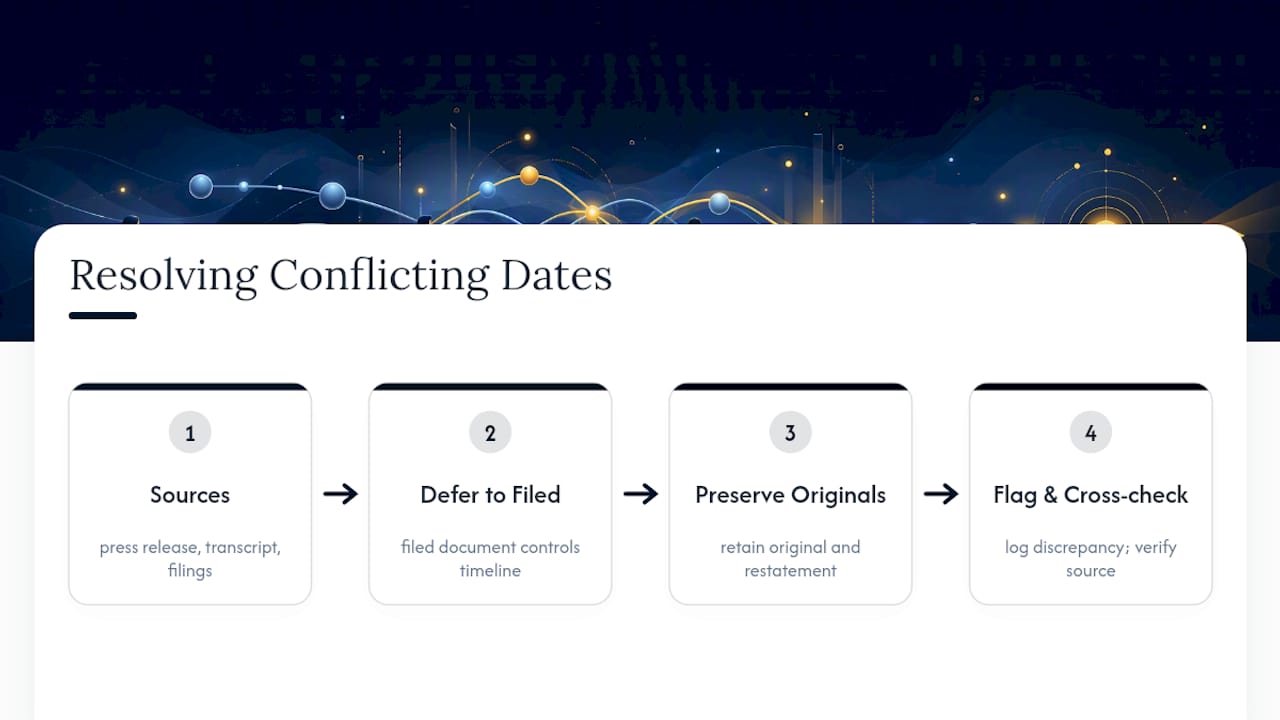
Cross-referencing against a second independent source helps too. If an earnings call transcript states a figure that doesn't match the subsequently filed 10-Q, the 10-Q controls for audit purposes, but the discrepancy between the two is itself worth recording as a timeline entry. The CFA Institute's FACTS framework, built around Fees, Access, Complexity, Taxes, and Search, offers a useful complementary discipline here: it pushes reviewers toward diagnostic questions about a claim's structure rather than accepting a headline figure at face value, which is exactly the instinct that catches most date conflicts before they make it into a published report.
What Visualization Formats Work Best for Fact Pattern Timelines?
A linear chronology table works for most single-issuer reviews: date, source, claim, outcome, status, in that column order, sorted oldest to newest. It is the format least likely to obscure a gap, since every row demands an outcome entry or an explicit "pending" marker.
Gantt-style charts earn their place when a claim spans a defined delivery window, a product launch promised for a specific quarter, a cost-reduction program with a stated completion date. The chart makes overrun visually obvious in a way a table row does not.
Flowcharts suit claims with branching outcomes, where a single commitment ("we will divest the segment or restructure it") resolved into one of several paths. Mapping the decision points helps a reader see where management's options narrowed over time.
Layered timelines, stacking narrative claims above a second row of actual reported results on the same horizontal axis, are the most useful format for direct narrative-versus-delivery comparison, and it is the closest visual analog to what a forensic execution score is measuring underneath.
Whichever format you choose, keep the underlying citation table as the source of truth. The visualization is a communication layer; the table with accession numbers and locators is the audit record, and the two should never diverge.
What Tools Handle Fact Pattern Timeline Construction?
Spreadsheet-based tracking (a structured table with fixed columns for date, source, quote, and locator) remains the baseline tool for single-issuer timelines, and it is often sufficient for a targeted proxy-season review. Its limitation shows up at scale: nothing enforces consistent tagging across dozens of analysts working different holdings.
Standardized evidence templates solve part of that problem by fixing the fields every reviewer must populate, but they still depend on manual extraction and manual cross-referencing between claim and outcome. That is the operational gap that forensic analytics platforms are built to close. A platform like Lacuna Index applies a standardized methodology across covered companies specifically so that claim-to-filing links, execution scoring, and sector benchmarking stay comparable across an entire coverage universe rather than depending on how carefully one analyst filled in a spreadsheet.
For readers building citation chains that may eventually support a valuation dispute or an appraisal-adjacent claim, documentation practices from adjacent fields are worth borrowing. Real-estate research on documenting appraised values for investors applies the same underlying discipline, evidence trails that hold up to independent scrutiny, even though the subject matter differs.
Regardless of tool, the SEC's own filing infrastructure remains the primary source of record for every accession number and filing date a timeline cites. No third-party tool should be treated as authoritative over the original EDGAR filing itself.
What Do Fact Pattern Timelines Look Like in Practice?
A guidance-tracking timeline for a mid-cap industrial issuer might chart four consecutive quarters of margin-expansion commitments made on earnings calls, each mapped against the subsequently filed 10-Q's actual gross margin, with status flags for "met," "narrowly missed," and one quarter reclassified as "redefined" after the company changed how it calculated the metric.
A governance-focused timeline ahead of a proxy vote might chart executive compensation commitments from a prior year's proxy statement against realized pay disclosed in the following year's filing, which is precisely the kind of comparison proxy advisors build into voting recommendations.
A restatement-driven timeline for a company under SEC comment-letter scrutiny would chain the original filing, the comment letter, the company's response, and the eventual restated figures as linked but distinct entries, never collapsed into a single "corrected" data point.
Each of these differs in subject matter but shares the same backbone: dated claim, dated outcome, exact source, explicit status. A financial journalist writing a governance story and an institutional analyst screening a portfolio holding are running the same underlying process; only the claim being tested changes.
How Do Fact Pattern Timelines Fit Into Broader Investigative Work?
A timeline is rarely the final analytical product. It is the evidentiary layer that other frameworks draw on. A forensic corporate analysis uses the timeline as its raw material, converting a sequence of dated claims and outcomes into a scored assessment of execution reliability. A narrative-risk review, examining how engineered disclosure language affects valuation, depends on the same semantic-shift entries the timeline already flagged.
At portfolio scale, a forensic analytics framework layers sector benchmarking on top of individual-issuer timelines, letting a reviewer see whether one company's pattern of guidance misses is idiosyncratic or common across its sector. That layered structure, timeline as evidence, framework as interpretation, benchmark as context, is what turns a single chronology into something a proxy advisor or editor can actually act on.

Why Rigorous Timelines Change Investment and Governance Outcomes
The value of a rigorous timeline rarely shows up in the obvious cases, the outright fraud that everyone eventually catches. It shows up in the gray zone: the company that hits every headline number while quietly redefining what the number measures. A well-built timeline surfaces that kind of drift months before it becomes visible in a stock price or a governance vote.
Transparency in sourcing is what makes a timeline usable by counsel or a proxy advisor rather than merely persuasive to the analyst who built it. A claim without a locator is an opinion. A claim with an accession number and a paragraph reference is evidence, and that distinction determines whether the work survives a challenge.
The trade-off institutions manage is time against coverage. Full manual timelines for every holding are not realistic, so the discipline is knowing when sampling suffices and when a claim's stakes justify the full build.
— Glen
How Lacuna Index Supports Audit-Traceable Timelines
Building claim-to-filing timelines by hand across dozens of holdings is a coverage problem most research teams eventually lose to volume. Such forensic analytics platforms apply a standardized, evidence-cited methodology across companies, linking every claim in a forensic report back to its original filing, producing execution scores comparable across sectors rather than dependent on individual analyst spreadsheets.
Per-company forensic reports typically pair a narrative score against an execution score, with underlying claim-to-filing links preserved to enable verification. Free sector benchmarks let you compare an issuer's execution pattern against its peers before committing to a subscription, and institutions monitoring a full portfolio can move to Cohort Pulse or Sector Sweep for scale monitoring beyond a single-issuer review. Start with the sector benchmarks for your coverage universe, then request access to the full per-company methodology from there.
Sources
- Managing the narrative: investor-relations officers and corporate disclosure (Harvard Law/Corpgov)
- Institutional monitoring and the limits of scale (Columbia scholarship)
- FINRA examination risk monitoring program report
- U.S. Securities and Exchange Commission (SEC)
- Investor
FAQ
What Is a Fact Pattern Timeline in Corporate Research?
It is a citation-linked chronology that pairs each corporate claim, from a filing, call, or press release, with its dated source and its later reported outcome. The goal is to let a reviewer test whether a company's narrative matches its actual delivery, with every entry traceable to a specific accession number or transcript timestamp.
How Often Should Institutions Update Fact Pattern Timelines?
Most institutions run an annual baseline review supplemented by event-triggered updates after earnings releases, restatements, or material 8-Ks, a cadence supported by governance research on disclosure monitoring. A single missed guidance target usually warrants an immediate ad-hoc rebuild rather than waiting for the next scheduled cycle.
What Is the Biggest Mistake in Building These Timelines?
The most common failure is paraphrasing a claim instead of quoting it verbatim with an exact locator, which makes the entry unverifiable later. A close second is the partial-restatement trap, comparing current figures against a "latest" restated filing instead of the originally filed version each claim was originally measured against.
Does Lacuna Index Offer Pre-Built Fact Pattern Timelines?
Lacuna Index's per-company forensic reports include claim-to-filing links and execution scores built from the same audit-traceable methodology described here, available through the per-company analysis and sector benchmarks. Pricing for portfolio-scale plans like Cohort Pulse and Sector Sweep is listed on the pricing page.
Can Automation Fully Replace Manual Timeline Construction?
No. Rule-based extraction and NLP-assisted event detection can flag likely claims and pull structured fields at scale, but classifying delivery status and resolving date conflicts still requires human validation. Institutional monitoring research treats this as a structural capacity constraint that automation eases rather than eliminates.