
Fact checking investor relations means tracing any material IR statement back to its primary filing and running measurable narrative-versus-fundamentals checks, not simply reading a press release and taking its framing at face value. The recommended approach combines primary-source verification through SEC EDGAR filings, particularly the MD&A and Risk Factors sections, with textual metrics that flag manipulation before it shows up in earnings. Done correctly, the process produces a supported, unsupported, or ambiguous verdict backed by an auditable evidence chain, the same standard forensic tools apply systematically across sectors.
TL;DR:
- Verifying IR claims requires cross-checking exact language in filings like the 10-K, 10-Q, and 8-K exhibits to ensure accuracy and consistency.
- Numeric reconciliation between GAAP and non-GAAP figures, especially cash flow and adjusted metrics, is essential for confirming earnings-related assertions.
- Textual signals such as boilerplate similarity and tone consistency can flag potential disclosure issues but need to be supported by primary-source evidence.
- Discrepancies between filings or third-party citations should be directly traced to original documents rather than relying on paraphrased summaries or outdated references.
- Prior sector benchmarks help identify outliers, ensuring verification focuses on claims that deviate from typical disclosure patterns within an industry.
Table of Contents
- What Documents Do You Need to Verify an IR Claim?
- How Do You Build an Audit-Traceable Verification Workflow?
- Which Textual Signals Actually Predict Disclosure Problems?
- What Tools Extract These Signals at Scale?
- How Lacuna Index Operationalizes Evidence-First Verification
- How Do You Verify Third-Party Data Cited in IR Communications?
- What Do You Do When Disclosures Are Ambiguous or Incomplete?
- What Do Successful Verification Cases Actually Look Like?
- Prioritizing Claims Under Time Pressure
- Get Sector Context Before You Verify a Single Filing
- Further Reading on Filing-Based Verification
- Sources
- FAQ
What Documents Do You Need to Verify an IR Claim?
Verification starts with assembling the right primary documents before evaluating a single sentence of narrative. Skipping this step is the most common reason institutional reviewers end up relitigating the same claim twice.
The minimum document set for any material IR statement includes:
- The 10-K, with particular attention to Item 7 (MD&A) and Item 1A (Risk Factors), where forward-looking assertions and hedging language concentrate.
- The most recent 10-Q covering the period referenced in the claim, to confirm the numbers haven't shifted between quarterly filings.
- 8-K exhibits, especially earnings release exhibits, which often contain the first version of a claim before it gets smoothed into later filings.
- The DEF 14A proxy statement, useful for cross-checking executive compensation claims against performance metrics management cites publicly.
- The earnings call transcript, ideally the raw version rather than a paraphrased summary, since tone and hedging patterns matter as much as content.
For each document, record the exact phrasing, the filing's accession number, the specific exhibit ID, the filing date, and the quoted excerpt verbatim. Treat every material claim as unverified until it clears a minimum corroboration bar: two independent primary sources pointing to the same conclusion. When a claim involves adjusted or non-GAAP metrics, pull the GAAP reconciliation table and compare it against operating cash flow, not just net income, since that comparison surfaces earnings-quality gaps that headline figures tend to obscure.
How Do You Build an Audit-Traceable Verification Workflow?
A verification exercise that can't survive a governance committee's follow-up questions isn't verification. It's an opinion with footnotes. Building an evidence chain that holds up under scrutiny requires the same five-step sequence every time, regardless of the company or the claim.
- Identify the claim precisely. Isolate the exact sentence or data point in question, not a paraphrase of it. Vague claims produce vague verdicts.
- Map the claim to its filing. Determine which 10-K, 10-Q, or 8-K exhibit should contain corroborating language or numbers, using EDGAR's full-text search to locate candidates quickly.
- Extract the exact text and supporting exhibits. Copy the precise excerpt, note character offsets if working programmatically, and save a screenshot alongside the text extraction as a redundancy check.
- Run the numeric checks. Reconcile any adjusted figure to its GAAP counterpart, and compare cash from operations against reported net income when the claim touches earnings quality.
- Run the narrative metrics and synthesize a verdict. Apply tone, hedging, and boilerplate-drift checks (covered below), then classify the claim as supported, unsupported, or ambiguous, with the evidence chain attached.
At each step, record metadata that would let a second reviewer reproduce your work independently: accession number, filing date, exhibit number, quote offsets, screenshot file names, and a timestamp. A reproducible pipeline that preserves exact excerpts and accession metadata is what separates an audit-traceable finding from a set of personal notes nobody else can check.
Decision rules matter as much as the steps themselves. An unsupported claim with material financial impact warrants a direct inquiry to investor relations before escalation. A pattern of unsupported claims across multiple filings warrants a governance agenda item. A conflict between two primary sources, such as an 8-K exhibit contradicting the subsequent 10-Q, warrants immediate flagging regardless of materiality, since internal inconsistency is itself a signal.
Pro Tip: Log every "ambiguous" verdict separately from "unsupported" ones. A cluster of ambiguous findings across consecutive quarters often precedes a restatement more reliably than any single unsupported claim does.
Which Textual Signals Actually Predict Disclosure Problems?
Not every red flag is created equal, and treating all of them as equally urgent wastes investigative capacity. Four measurable signals carry real empirical backing, and each one is computable without proprietary access.
- Tone-fundamentals gap. Compare the positivity or certainty of forward-looking language against contemporaneous financial performance. A persistent gap, where language stays upbeat while margins compress, is a residual worth documenting rather than dismissing.
- Boilerplate drift. Run cosine similarity on Item 1A risk factor text year over year. Unusually high similarity suggests recycled language rather than a genuine reassessment of risk, while an abrupt drop can signal a new, undisclosed problem being papered over with fresh wording.
- Forward-looking intensity and hedging patterns. Flag guidance statements that swing between unusually strong certainty and evasive hedging within the same filing. That inconsistency often indicates management is more confident about the narrative than the underlying numbers support.
- Readability and length. Longer MD&A sections and heavily positive tone sometimes correlate with lower transparency rather than more disclosure. Treat unusual length as a prompt to dig deeper, not as reassurance that management is being thorough.
These features correlate with enforcement-linked outcomes and restatements when validated against historical cases, which is what makes them useful triage tools. They are not, on their own, proof of misconduct. A separate line of research on narrative thematic bias and financial graph distortion found that companies coordinating optimistic language often coordinate misleading charts in the same filing, so a text-only check misses half the picture. Cross-checking the visual exhibits against the narrative is worth the extra ten minutes.
What Tools Extract These Signals at Scale?
SEC EDGAR's full-text search and XBRL structured filings remain the authoritative source for numeric extraction, and every pipeline should anchor to accession metadata pulled directly from there rather than a secondary aggregator.
- Use finance-specific dictionaries such as Loughran-McDonald wordlists instead of general-purpose sentiment models, which routinely misclassify hedged financial language as neutral or even negative.
- Apply TF-IDF scoring to flag novel language against a company's own filing history, catching genuine risk-factor changes that boilerplate similarity checks might smooth over.
- Reference open pipelines like the earnings-call-intelligence project, which extracts dozens of deterministic linguistic signals from transcripts and documents its calibration against historical outcomes.
- Build lightweight scripts for cosine similarity on risk-factor text and simple XBRL parsers for GAAP-to-non-GAAP reconciliation. These require no proprietary infrastructure, only discipline in maintaining them.
Cross-referencing filing data against independent data sources covering press releases, transcripts, and filings side by side helps confirm that a discrepancy is real and not an artifact of one dataset's parsing quirks.
How Lacuna Index Operationalizes Evidence-First Verification
Some forensic analytics platforms run EDGAR-based pipelines that parse Item 7 MD&A and Item 1A Risk Factors sections automatically, producing execution and narrative scores that quantify the gap between what a company claims and what its filings support. Ideally, every score traces back to a documented evidence chain rather than a black-box output, which matters when a governance committee asks how a conclusion was reached.
Some platforms validate textual signals against enforcement-linked outcomes and restatement proxies, the same category of validation this article's step-by-step workflow recommends building manually. They compute boilerplate drift, tone residuals, and forward-looking intensity reproducibly across sectors, then export underlying evidence for governance reporting.
All of this relies solely on public records, no insider access, no proprietary data feeds. Sector benchmarks may be made freely available; detailed, company-level forensic reports with execution and narrative scoring often require a subscription. This tiered access provides comparative context before committing to deeper per-company analysis.
How Do You Verify Third-Party Data Cited in IR Communications?
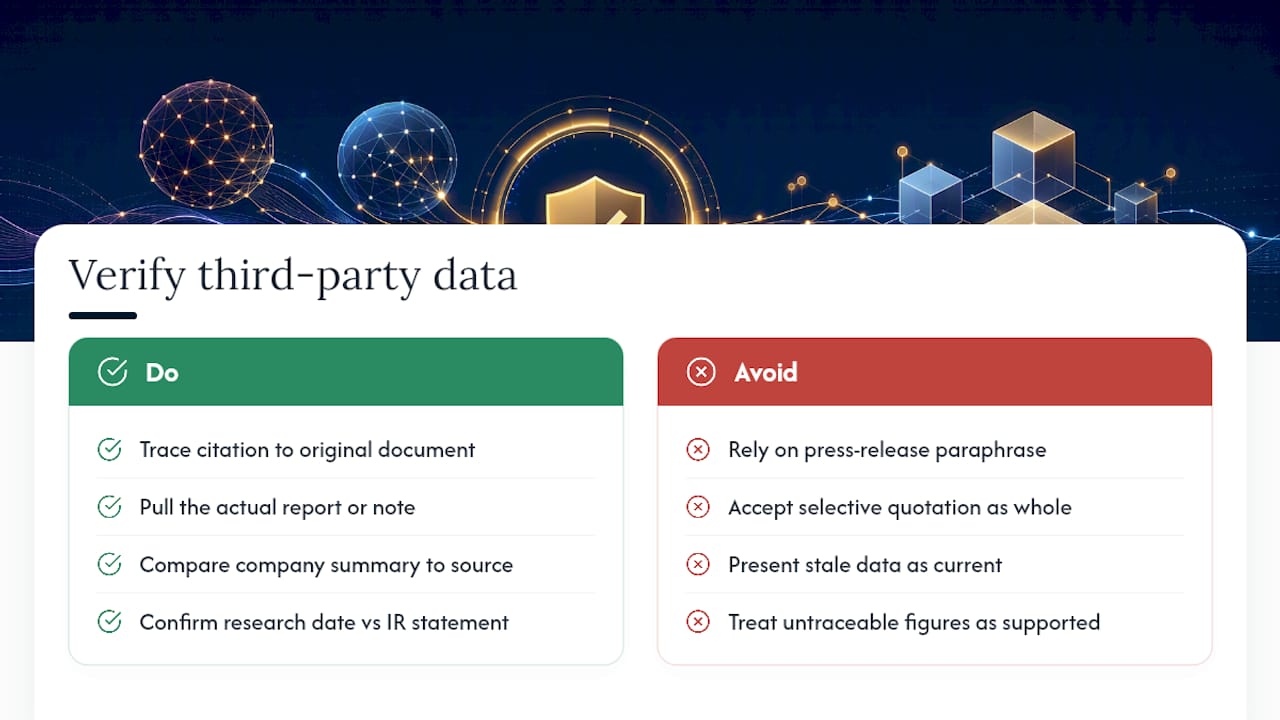
Companies frequently cite analyst reports, industry research, or third-party rankings inside earnings materials to lend outside credibility to their own narrative. The verification standard here is identical to primary-source checking: trace the citation to its original document, not the paraphrase a press release offers.
Pull the actual analyst report or research note referenced, and check whether the company's summary matches the source's actual conclusion or has quietly reframed a mixed finding as unambiguous praise. Selective quotation, citing the favorable sentence from an otherwise cautious report, is one of the more common distortions in earnings materials. Confirm the date of the cited research against the date of the IR statement; stale data presented as current is a frequent and easy-to-miss problem. Where a ranking or index is cited (a "top provider" designation, an industry award), verify the methodology and eligibility criteria behind it, since some such recognitions are pay-to-play rather than independently earned. When a third-party figure can't be traced to its original source at all, treat the underlying claim as unsupported until it can be, regardless of how confidently it's presented.
What Do You Do When Disclosures Are Ambiguous or Incomplete?
Not every claim resolves cleanly to supported or unsupported. Filings often use qualifying language, "we believe," "management estimates," "subject to market conditions", that makes a definitive verdict genuinely difficult, and forcing a binary conclusion onto genuinely ambiguous language produces false precision.
The right response is to classify the claim as ambiguous explicitly, rather than defaulting to either extreme, and to document exactly what evidence would resolve it. Ambiguity itself is information: a claim that has stayed vague across three consecutive filing cycles, when a more specific disclosure would have been easy to provide, is a pattern worth flagging on its own. Distinguish ambiguity from omission. A claim referencing "improved customer retention" without a defined metric is ambiguous; a claim about revenue growth from a segment the company stopped reporting separately last quarter is closer to omission, and it deserves a stronger flag. When incomplete information blocks a verdict entirely, the correct documentation is "insufficient evidence to verify," paired with a specific list of what a resolution would require, not a guess dressed up as a finding.
What Do Successful Verification Cases Actually Look Like?
The strongest fact-checking outcomes share a common shape: a specific, material claim, traced through at least two primary sources, with a numeric reconciliation that either confirms or contradicts the narrative.
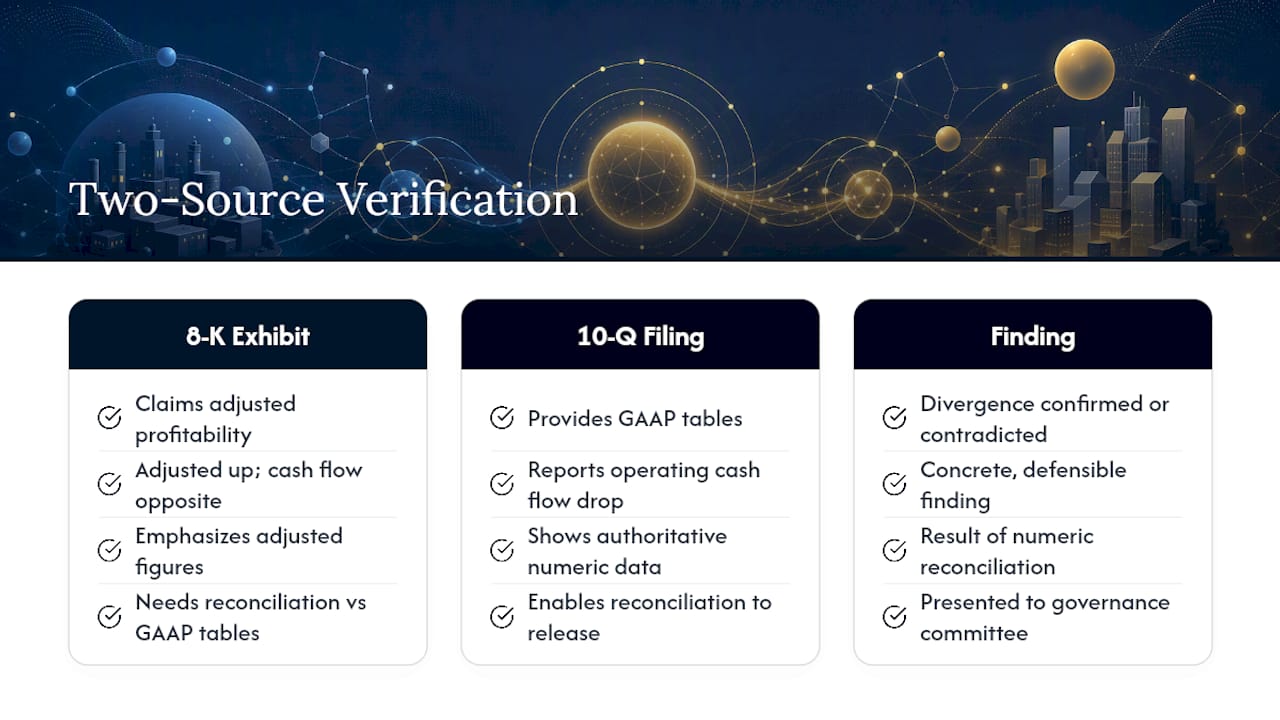
A useful pattern involves comparing an 8-K earnings release exhibit against the subsequent 10-Q. When a press release emphasizes an adjusted profitability figure while operating cash flow moved in the opposite direction, that divergence, once reconciled against the GAAP tables, produces a concrete, defensible finding rather than a hunch. Another recurring pattern involves risk-factor boilerplate drift: a company reporting a new operational risk for the first time in a filing, while its Item 1A language otherwise shows near-identical cosine similarity to the prior year, suggests the new risk factor may have existed longer than the disclosure timeline implies. In each case, the finding didn't come from a single dramatic discrepancy. It came from applying the same primary-source and numeric-reconciliation discipline consistently, then letting the evidence chain speak for itself in front of a governance committee.
Prioritizing Claims Under Time Pressure
Triage by materiality first: claims tied to earnings guidance, non-GAAP adjustments, or executive compensation deserve verification before softer narrative claims about culture or strategy. Escalate immediately when primary sources conflict, when documentary evidence is simply absent for a material claim, or when narrative metrics show repeated anomalies across filing cycles rather than a single outlier.
When presenting findings to a committee, resist the urge to over-explain. A one-line verdict, three supporting evidence items, and a recommended next step outperform a lengthy memo every time. Committees act on clarity, not thoroughness for its own sake.
— Glen
Get Sector Context Before You Verify a Single Filing
Verification works faster when you already know what "normal" looks like for a company's peer group, and that's the gap Lacunaindex's Sector Benchmarks close before you open a single 10-K.
The benchmarks give institutional users a free, public valuation reference for how a sector's execution and narrative scores typically distribute, so an outlier claim stands out immediately instead of getting buried in an unfamiliar filing. Some subscriber services offer access to forensic reports on individual companies, with execution and narrative scores and evidence exports built for governance use, providing structured, reproducible documentation resembling what this guide recommends assembling by hand. If your team is verifying IR claims across a coverage list rather than one company at a time, start by checking your sector's benchmark page, then request a demo to see how the full company-level reports compare against your current workflow.
Further Reading on Filing-Based Verification
For deeper methodology context, see how narrative-versus-delivery gaps get measured and how to spot engineered disclosure patterns in risk-factor language, along with the EDGAR filing types cheat sheet for direct lookups.
This article is general information, not a substitute for advice from a qualified financial advisor. Consult a qualified financial professional about your own circumstances before acting on anything here.
Sources
A minimum of two independent primary sources, such as an 8-K exhibit cross-checked against the following 10-Q, before treating a material claim as supported.
- Generative AI and U.S. Financial Reporting Integrity: Detecting Narrative Manipulation, Risk Disclosure Gaming, and Fraud Signals in 10-K Filings
- How to Verify Investment Information
- How to Analyze a 10-K Filing Step by Step 2026 | Minalyst Blog
- Study on MD&A length/tone and transparency (2026)
FAQ
What Does Fact Checking Investor Relations Actually Involve?
It means tracing a specific IR claim to primary filings on EDGAR, running numeric reconciliations against GAAP figures, and applying textual signals like boilerplate drift to reach a documented, auditable verdict.
Which SEC Filings Matter Most for Verification?
The 10-K's MD&A and Risk Factors sections, the most recent 10-Q, 8-K earnings exhibits, and the DEF 14A proxy statement together cover most material IR claims.
Can Textual Signals Alone Prove Manipulation?
No. Tone, boilerplate drift, and length metrics correlate with enforcement-linked outcomes as triage signals, but they require numeric reconciliation and cross-source corroboration before supporting a firm conclusion.
How Does Lacuna Index Fit Into This Workflow?
Some platforms automate EDGAR-based section parsing and produce execution and narrative scores with an audit-traceable evidence chain, complementing manual verification steps for institutional coverage at scale.