
Comparing forensic corporate analytics tools is difficult when each vendor uses different disclosure sources and scoring frameworks. Many platforms restrict users to opaque aggregate indexes or model outputs that cannot be traced back to the original documents, limiting auditability for governance and compliance teams. This comparison details disclosure sources, scoring transparency, evidence auditability, and integration demands so decision makers can select a tool that supports documented, reproducible analytics.
Table of Contents
Lacuna Index

At a Glance
Measures the gap between corporate claims and actual delivery using only public records. The platform generates reproducible scores and verdicts across sectors from filings, earnings calls, press releases, and proxy statements. Those scores highlight where narrative consistency diverges from documented performance. The output aims to surface mispricing driven by engineered disclosures.
Core Features
Lacunaindex performs public-record sourced forensic analysis across SEC filings, earnings transcripts, press releases, and proxy materials. The service applies a standardized scoring methodology to produce execution scores, sector benchmarks, and company verdicts. Results include archetype classifications such as earned, borrowed, or undervalued, and they come with reproducible evidence trails tied to source documents.
Key Differentiator
Scores the gap between what companies claim and what they actually deliver using purely public-record sources. That single mechanism drives both the scoring engine and the report structure. The focus on public documents removes reliance on insider tips or private feeds. The method forces comparability across companies and sectors by anchoring evaluations to the same evidence set.
Pros
The analysis relies exclusively on documented disclosures, so findings are reproducible and auditable against original filings and transcripts. Lacunaindex structures assessments to quantify the degree of delivery versus narrative, which helps investors adjust valuation assumptions. The platform standardizes comparisons through sector benchmarks and execution scores, enabling governance teams to prioritize engagements based on evidence gaps.
Cons
- Pricing information is temporarily unavailable, which makes cost forecasting and procurement planning difficult.
Who It's For
Institutional investors seeking a forensic signal to refine valuation models will find this work useful. Governance advocates can use the standardized evidence trails to support engagement agendas. Financial journalists receive a methodical way to test corporate narratives against public disclosures. The tool fits teams that prefer reproducible, document-backed assertions over anecdotal insight.
Unique Value Proposition
Reproducible execution scores and archetype classifications derived solely from public disclosures. That output converts narrative assessment into numeric signals investors can plug into models or screening workflows. The evidence-first format reduces interpretation drift across analysts and creates a repeatable workflow for monitoring disclosure quality. The economic implication is clearer prioritization of research resources and more disciplined decision triggers.
Real World Use Case
A hedge fund screens midcap names for overstated growth narratives by comparing management assertions to the public-record scorecard. The fund narrows its watchlist to names with large execution gaps and then allocates analyst time to those targets. Engagements and short research are guided by the documented evidence cited in each report.
Pricing
Pricing is not publicly listed. Access to detailed reports and sector benchmarks likely requires a subscription or institutional license. Procurement will need to request a commercial proposal from the vendor to learn specific tiers and data access terms.
Website: https://lacunaindex.com
Integrum ESG
At a Glance
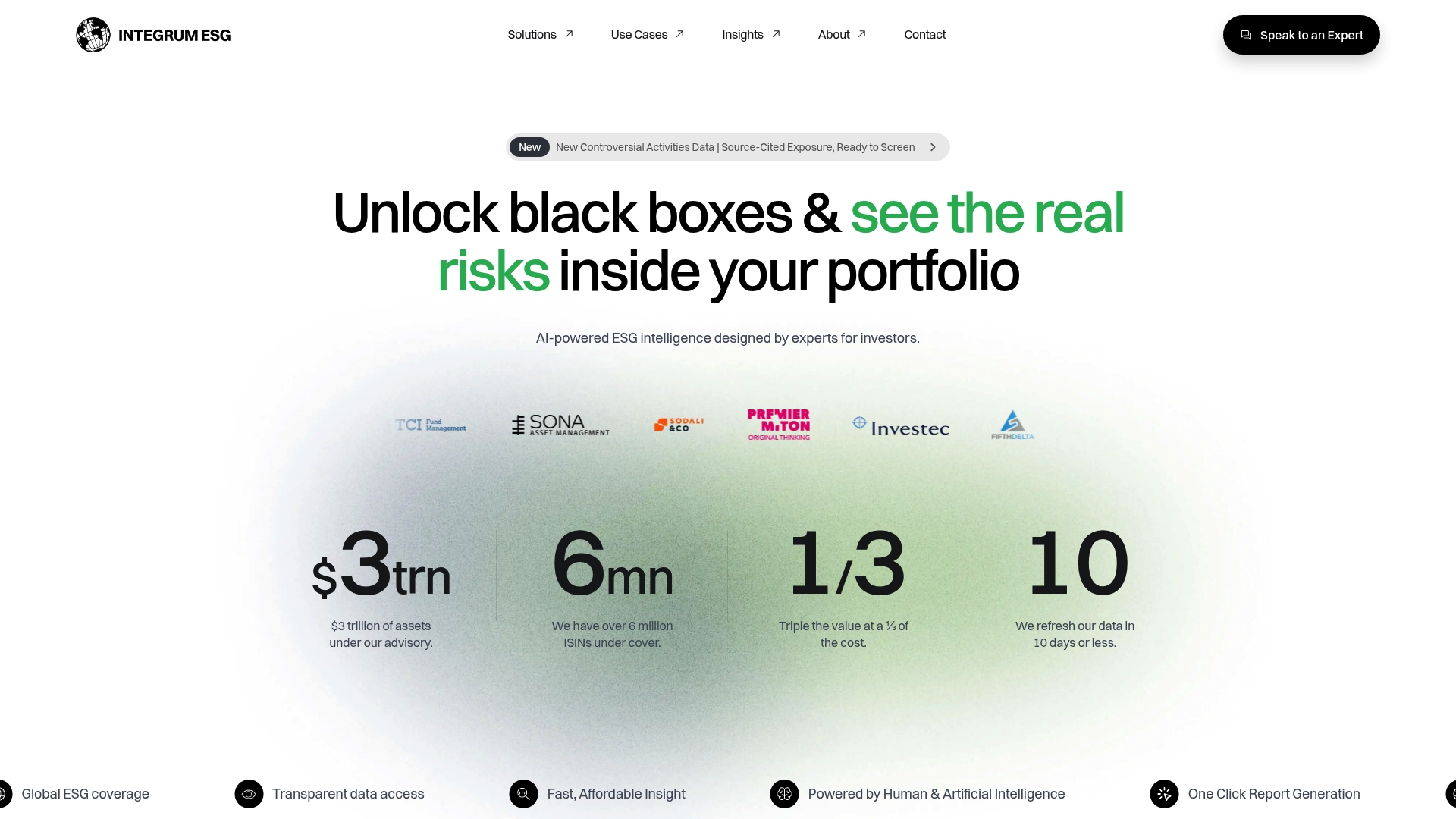
Integrum ESG reports coverage of over 60,000 companies and 250,000 funds, with data refreshed within 10 days. The platform pairs automated extraction with human validation to reduce false positives and contextual errors. That coverage and refresh cycle aim to support institutional due diligence and regulatory reporting.
Core Features
Integrum offers source-linked, transparent data that traces every datapoint back to the original disclosure and document. It applies logic based, rules driven scoring and supports one click generation of SFDR, TCFD, and bespoke reports. AI automation operates alongside human ESG review to flag interpretation issues and maintain auditability.
Key Differentiator
The distinguishing element is the platform's emphasis on glass box data where each score links to its evidentiary source. Integrum pairs that transparency with rule based scoring and human review to produce explainable outputs. This design targets buyers who require traceable, defensible ESG conclusions rather than opaque aggregate indexes.
Pros
The platform surfaces transparent, auditable datapoints so analysts can verify how a score was derived and what filings support it. That coverage supports coverage across markets and sectors while the human review layer reduces algorithmic noise and contextual mistakes. The vendor reports a 10 day refresh cycle which suits quarter to month level oversight and regulatory filing timelines.
Cons
-
Some purchasers report the data requires expert interpretation; users new to ESG frameworks may need onboarding or advisory support.
-
The roughly 10 day refresh cycle limits use cases that demand intra day or real time trading signals.
-
Full engagement with the platform's transparency features requires familiarity with scoring frameworks and evidence review.
When It May Not Fit
Buyers requiring intra day market signals will find the refresh cadence restrictive. Teams without in house ESG expertise may underuse the platform because the outputs assume familiarity with frameworks and disclosure types. Organizations that prefer simple, index style indicators rather than evidence linked scoring will likely prefer a different vendor.
Who It's For
Institutional investors, asset managers, and compliance teams that need traceable ESG evidence and regulatory ready reporting benefit most. Private markets and private equity groups using due diligence workflows gain from source linked scoring and report templates. Firms that invest in internal ESG competency will extract the most value.
Real World Use Case
An asset manager uses Integrum ESG to run preinvestment due diligence across mid cap targets. Analysts pull evidence linked scores, generate an SFDR report in one click, and feed findings into the investment committee memo. The human review layer catches disclosure nuances that pure automation would miss.
Pricing
Pricing is not specified publicly and appears to follow an enterprise SaaS subscription model with customized licensing and onboarding. Expect commercial negotiations to reflect coverage scope, number of seats, and report generation volume.
Website: https://integrumesg.com
Accord Analytics
At a Glance
Accord reports a nonprofit in Australia recovered over $10 million after using its analysis and recovery process. That figure is presented as a vendor case study. The listing frames recovery as coming from payroll and procurement inefficiencies found without accessing live systems. Readers will see emphasis on ongoing visibility and a fee tied to reclaimed dollars.
Core Features
The listing highlights secure data extraction via one time extracts that require no system integration or downtime. It combines payroll review with vendor and procurement spend analysis to surface overpayments, contract issues, and low value renewals. Continuous monitoring then flags new inefficiencies while the fee model charges a percentage of reclaimed value.
Key Differentiator
The single differentiator is no system access or disruption required, which lets analysts work from extracted records rather than live system connectors. That approach reduces operational coordination and preserves production systems while the site documents ongoing recovery opportunities. The listing positions this as a practical option when internal access cannot be granted.
Pros
Simple intake reduces project overhead because records are extracted without connectors and without scheduled downtime. The vendor advertises a results based fee that charges only a share of reclaimed value, aligning incentives between the consulting team and the client. Real time monitoring and experienced analytical models provide visibility into recurring waste, contract renewal risk, and payroll overpayments. The editorial profile stresses mission reinvestment, showing how reclaimed funds reenter operating budgets.
Cons
-
Limited detail on analytical methods, making it hard to evaluate model assumptions or scenario sensitivity.
-
Potential limitations with highly complex or non standard financial systems that may need bespoke integration work.
-
The offering targets large organizations, so smaller entities may lack the scale to justify the engagement.
When It May Not Fit
This listing will not fit smaller organizations that lack complex spend systems or scale to recover meaningful dollars. Entities with highly customized ERPs and payroll stacks could require direct connectors that the extract based method avoids. Public sector units with strict audit or procurement rules may prefer internal audits or formal procurement reviews.
Who It's For
Decision makers at large nonprofits, government agencies, and corporates with complex payroll and procurement spend will benefit from this profile. Financial controllers and procurement committees evaluating recovery opportunities will find the ongoing monitoring claim relevant to budget planning. Readers focused on redeploying recovered funds into program work can use the listing to assess potential upside.
Real World Use Case
A nonprofit in Australia used Accord to identify and reclaim hidden payroll and vendor costs. The recovery figure cited above came from that case description. According to the listing, the reclaimed dollars were redirected to program budgets and staff expansion.
Website: https://accordanalytics.com
EG Metrics

At a Glance
The vendor advertises a proven accuracy of 96% for its predictive organizational risk signals. ORCA converts behavioral and operational signals into early warnings before performance reports reflect problems. That early focus positions the tool to detect organizational stressors that precede investment outcomes.
Core Features
ORCA uses AI and machine learning to analyze behavioral signals and operational data and generate organizational risk assessments. The platform produces high level rankings with drill down data on underlying drivers and supports tailored platforms for research, reporting, and oversight. It ingests public filings, social media, and proprietary datasets to build a multi source view of firm health.
Key Differentiator
EG Metrics turns qualitative cues into structured signals to forecast organizational risk well ahead of traditional metrics. That capability emphasizes behavioral drivers and control weaknesses rather than short term performance. The result is a forward looking signal set intended to inform selection, monitoring, and oversight decisions.
Pros
The platform provides early predictive insights tied to organizational dynamics, allowing teams to act before market signals emerge. That accuracy claim supports confidence in the alerts, while the combined behavioral and operational inputs deliver a multi dimensional risk view. EG Metrics scales from regional RIAs to large asset managers and integrates multiple public and proprietary sources for oversight and fiduciary reporting.
Cons
- Implementation and data integration may require significant effort for firms with complex or unstructured internal data.
- The specialized nature of organizational diagnostics introduces a learning curve for investment teams unfamiliar with these measures.
- Public information on pricing is limited, so contracting timelines and total cost may vary by configuration.
When It May Not Fit
Firms without mature data infrastructure or centralized internal records will face higher setup costs and longer timelines. Buyers who require an out of the box, click and run screening tool may find the platform too configuration heavy. Organizations focused solely on market or factor risk rather than organizational risk will get limited value from this product.
Who It's For
Investment decision makers, risk managers, and compliance teams at institutional and boutique investment firms seeking organizational insight. Governance committees and operational due diligence teams that monitor manager health for client mandates will find the signal set relevant. Oversight bodies that need evidence based inputs for escalation and reporting will benefit from the platform.
Real World Use Case
A top ranked bond manager received elevated organizational risk flags from ORCA twelve months before a significant client exit. The alert allowed client teams to initiate governance reviews and operational remediation, reducing follow on exposure. The case illustrates how forward signals can create time for targeted interventions.
Pricing
Not specified — likely customized based on firm size and needs. Public materials do not list standard tiers, so contracting typically requires a discovery phase to define scope and data requirements.
Website: https://egmetrics.com
Comparison of alternatives
In the field of corporate analytical platforms, providers show clear differences in functionality and focus. Each solution presents unique features that cater to specific needs and preferences.
Transparency and traceability in reporting
Lacuna Index focuses on deriving execution scores solely from public-record sources, allowing for high levels of transparency and reproducibility. In contrast, Integrum ESG emphasizes source-linked data with detailed transparency for its ESG scoring, which is bolstered by AI alongside human validation. Accord Analytics employs a distinct methodology by refraining from requiring access to live systems, relying instead on data extracts to flag inefficiencies. For buyers prioritizing auditable lineage of scores and evidence, Lacuna Index and Integrum ESG present strong options depending on the scope of application.
Range of use case support
Integrum ESG excels with its broad coverage across 60,000 companies and its support for SFDR, TCFD, and customized reports, making it particularly suitable for organizations requiring alignment with regulatory frameworks. Conversely, Accord prioritizes cost recovery through its unique fee model tied to reclaimed assets, an aspect tailored to large-scale organizations. EG Metrics stands out by converting behavioral and operational data into predictive organizational risk insights, fulfilling the needs of decision-makers looking for forward-looking analytics. This variety illustrates tailored platforms addressing different priorities and contexts for institutional applications.
Best fit
- Institutional investors requiring analysis based solely on public filings for governance evaluations may rely on Lacuna Index for its specialized forensic scoring.
- Asset managers who require ESG-compliance features such as custom SFDR and TCFD report generation will benefit from Integrum ESG’s services.
- Large nonprofit organizations seeking budget reclamation while avoiding disruptions to IT systems can leverage Accord’s data extraction approach.
- Firms aiming for early detection of organizational risks via behavioral dynamics should consider EG Metrics for its ORCA predictive modeling.
Our pick
For teams prioritizing public disclosure-based scrutiny and reproducible analytics, Lacuna Index offers a customizable solution with forensic capabilities. Alternative platforms, such as Integrum ESG and EG Metrics, cater to specific needs such as regulatory reporting and predictive insights, making them better suited for organizations with those priorities. Where absolute alignment of corporate claims and documented proof is the main goal, Lacuna Index stands out as the premier option for bolstering evidence-based decision-making processes.
The table below compares several forensic corporate analytics platforms based on their highlighted features, unique advantages, and user focus.
| Product | Core Feature | Unique Differentiator | Best For | Pricing | Notable Limitation |
|---|---|---|---|---|---|
| Lacunaindex | Public-record sourced forensic analysis and execution scores | Focus on evidence-backed narrative gaps | Institutional investors needing valuation model refinement and evidence-based corporate insights | Price not published | Pricing details unavailable, requiring direct inquiry |
| Integrum ESG | Transparent, source-linked ESG scoring | Glass-box data traceable to evidentiary sources | Institutional investors needing regulatory-ready, evidence-based ESG reporting | Price not published | Requires ESG framework expertise and cannot provide intraday updates |
| Accord Analytics | Data extraction and continuous monitoring for inefficiencies | Recovery-focused process without system integration | Large organizations aiming to recover funds from procurement and payroll inefficiencies | Percentage of reclaimed value | Limited detail on analytical methods, potentially unsuitable for smaller organizations |
| EG Metrics | Multisource organizational risk assessments | Predictive signals from behavioral and operational data | Governance committees and oversight bodies monitoring organizational dynamics | Price not published | Requires data infrastructure and effort-intensive setup |
Addressing the Challenge of Verifying Corporate Claims with Objective Execution Scores
Institutional investors, governance advocates, and financial journalists face the critical challenge of distinguishing between corporate narratives and actual performance data when evaluating companies. Lacunaindex addresses this challenge by quantifying the gap between management’s claims and real delivery, relying exclusively on public disclosures such as SEC filings, earnings calls, and proxy statements. This approach produces standardized execution scores and evidence-backed verdicts that enhance comparability and reduce disclosure opacity.
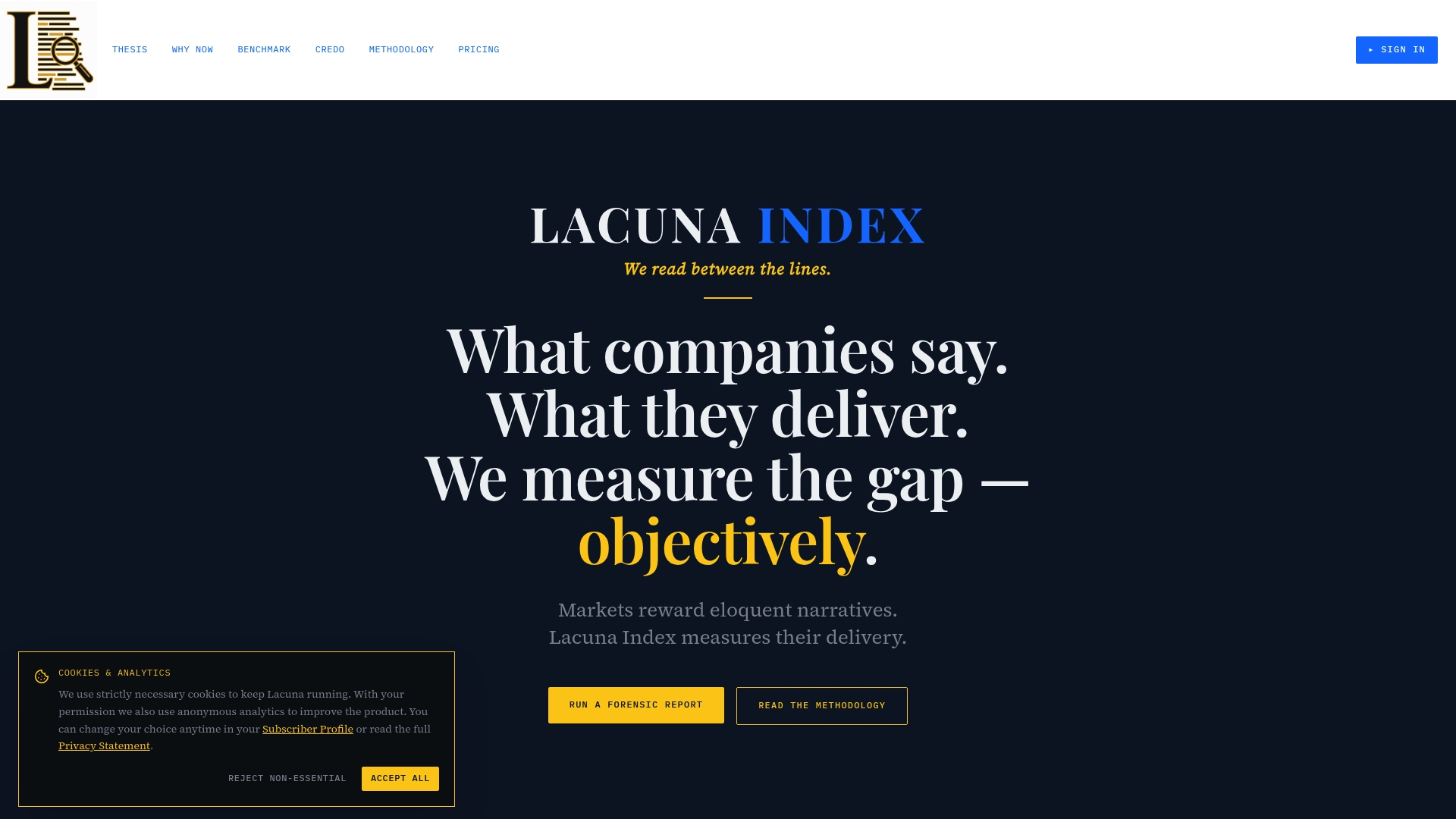
Gain precise, forensic insights into corporate accountability with Lacunaindex. Visit Lacunaindex to access detailed sector benchmarks and reproducible reports that support verification of corporate narratives against documented evidence. Import your company list and obtain execution scores that sharpen valuation models and governance engagement priorities.
FAQ
What unique feature does Lacunaindex offer for forensic corporate analytics?
Lacunaindex scores the gap between corporate claims and actual delivery using purely public records. This approach relies on SEC filings, earnings calls, and press releases to establish reproducible scores and verdicts. This means you can expect reliable analytics that highlight discrepancies in corporate narratives compared to documented performance.
How does Integrum ESG compare to Lacunaindex?
Integrum ESG emphasizes traceability with its glass box data, ensuring each score is linked to its evidentiary source. While Integrum provides strong transparency, Lacunaindex focuses on measuring the execution gap based exclusively on public records, making it the better choice when you need strictly documented forensic analysis.
How does the pricing structure of Lacunaindex work for users?
Pricing details for Lacunaindex are not publicly listed, which can make cost forecasting challenging. Potential users should contact the vendor directly to learn about subscription tiers and data access options, allowing for transparent procurement planning.
Can Lacunaindex assist governance teams in prioritizing engagements?
Yes, Lacunaindex structures its analysis to help governance teams prioritize engagements based on documented evidence gaps. This functionality allows users to focus their efforts where they can have the most impact based on factual discrepancies.
What can users expect from the evidence trails provided by Lacunaindex?
Users can expect reproducible evidence trails that link the execution scores to source documents. This transparency aids in understanding how conclusions are drawn and bolsters confidence in the insights provided, creating a reliable foundation for analysis and decision-making.