
Forensic disclosure sentiment versus returns measures the gap between what a company promises in its public filings and what it actually delivers, not the emotional tone of its language. That execution gap, tracked across earnings calls, SEC filings, and sustainability reports, creates measurable and often delayed mispricing because markets are slow to process the disconnect. The evidence, framework, and screening steps below show how to detect it before the market fully does.
TL;DR:
- Nearly 33% of corporate emissions targets are not publicly reported after being set, with no clear record of whether they were achieved or missed.
- Companies that fail to disclose outcomes for their targets tend to experience little immediate market penalty, with negative effects emerging only after long delays.
- Cross-channel consistency in disclosures, including filings and earnings calls, serves as a key indicator of whether promises are being kept or quietly abandoned.
- A rigorous process for measuring the disclosure-delivery gap requires documenting claims precisely, setting outcome windows, and verifying with independent sources.
- Using forensic analysis platforms can help investors systematically flag, monitor, and validate the integrity of corporate commitments across sectors.
Table of Contents
- Disclosure Sentiment vs. Returns: Narrative Analysis, Not Tone Analysis
- What Does the Evidence Say About Narrative-Delivery Gaps and Returns?
- How Do You Measure the Disclosure-Delivery Gap in Practice?
- Investor Playbook: Screening, Monitoring, and Trade Design
- Where the Approach Breaks Down and How to Verify Findings
- A Practitioner's Take on Chasing the Gap
- Access Lacuna Index's Sector Benchmarks and Forensic Reports
- Sources
Disclosure Sentiment vs. Returns: Narrative Analysis, Not Tone Analysis
Forensic narrative‑versus‑delivery analysis asks a binary question about every disclosed commitment: was it kept? Sentiment analysis, by contrast, scores whether management sounded optimistic or defensive on a call. The two produce different signals entirely. A CEO can sound confident while quietly abandoning a target, and a sentiment model will miss it every time.
The scope of what counts as a "promise" needs discipline. Lacuna Index's methodology tracks four disclosure channels systematically: SEC filings (10‑Ks, 10‑Qs, 8‑Ks), earnings call transcripts, press releases, and sustainability or proxy statements. Within those channels, the claims worth tracking fall into distinct buckets:
- Time‑bound targets with an explicit date or fiscal year attached
- Operational commitments (capacity, headcount, capital expenditure tied to a stated goal)
- Forward guidance issued with specific numeric ranges
- Governance claims (board composition changes, compliance commitments, remediation timelines)
For initial screening, three metrics matter more than any qualitative read: whether outcome disclosure exists at all for a prior claim, whether interim milestones were reported on schedule, and whether the same claim reads consistently across channels. A target mentioned in a proxy statement but never revisited in the following year's 10‑K is a data point, not an oversight.
What Does the Evidence Say About Narrative-Delivery Gaps and Returns?
The clearest empirical signal comes from corporate emissions targets, and it should unsettle anyone who takes disclosure at face value. Roughly one in three corporate emissions targets disappear from public records without the company ever reporting whether the goal was met. The pattern repeats across a related study sample.
The accountability gap in numbers: About 33% of corporate emissions targets vanish from public disclosure without outcome reporting, and failed targets that do surface generate almost no immediate market reaction. The three‑day cumulative abnormal return around a failed target's disclosure was negligible in the study sample, which means the penalty for missing a promise arrives late, if it arrives at all.
That silence is not neutral. Announcement benefits, favorable ratings, sympathetic media coverage, arrive at the moment a target is unveiled, while accountability for the outcome erodes over time. Firms that sign onto public commitment frameworks illustrate the same dynamic in a different register: signatories to pledges like the Business Roundtable's have shown worse compliance and violation records than non‑signatory peers, not better ones.
Narrative also moves markets independent of fundamentals. Textual features extracted from earnings calls carry incremental predictive power over accounting variables, and managerial framing can shift analyst forecasts even when the quantitative backing behind the claim is thin. Tonal inconsistency compounds the problem: firms whose disclosure tone diverges across channels, upbeat on the call, hedged in the filing, tend to show a slow negative drift over roughly the following 40 days, alongside heavier insider selling. Ownership structure shapes how much of this gets caught early. Higher institutional ownership correlates with longer, more detailed 8‑K filings, increasing disclosure length by about 4.7% around Russell index reconstitutions, which suggests concentrated institutional attention forces more disclosure, not necessarily more honest disclosure.
How Do You Measure the Disclosure-Delivery Gap in Practice?
A defensible measurement framework starts with extraction discipline, not judgment calls. Every signal needs a source, a date, and a channel before it means anything analytically.
- Log the claim verbatim. Record the filing type, the exact quoted language, and the date it was made, no paraphrasing.
- Set the outcome window. Define the expectation date stated in the disclosure, then flag the filing period where an outcome should logically appear.
- Check for outcome disclosure. Search the subsequent 10‑K, 8‑K, or sustainability report for explicit language confirming, revising, or abandoning the original claim.
- Run the cross‑channel consistency test. Compare how the same commitment is described on the earnings call versus the filing versus the press release; divergent framing is itself a signal.
- Score and file the audit trail. Weight the claim on four axes, coverage, outcome disclosure, third‑party corroboration, and timeline adherence, then attach the source URLs.
That fourth step deserves its own rubric. Coverage asks whether the claim was substantive or vague. Outcome disclosure asks whether a follow‑up exists at all. Corroboration asks whether an independent filing, media report, or regulatory record supports the claim. Timeline adherence asks whether milestones landed on the dates management originally set. Lacuna Index's approach to disclosure integrity formalizes this into a reproducible scoring model rather than a one‑off judgment call.
Not every operational claim is equally revealing. Disclosures tied to concrete operational improvements, specific capital expenditures, interim metrics, tied dates, correlate far more reliably with actual delivery than aspirational language does. Weight those disclosures more heavily in any scoring model.
Pro Tip: A missing outcome disclosure almost never means "no news." It usually means the target was quietly missed or abandoned. Treat silence past the stated deadline as a red flag worth escalating, not a data gap to shrug off.
Investor Playbook: Screening, Monitoring, and Trade Design
Turning the rubric into a working process means building screens that flag names automatically, not waiting for a scandal to surface them.
Screening checklist, run quarterly against every covered name:
- Any time‑bound target now past its stated deadline with no outcome language in the subsequent filing
- Cross‑channel tone divergence between the earnings call transcript and the corresponding 8‑K or press release
- A pattern of restated or quietly revised guidance without an explicit acknowledgment
- Elevated insider selling clustered near a disclosure with unresolved claims
Monitoring cadence and team responsibilities should split cleanly: governance teams own filing‑level extraction, research analysts own cross‑channel corroboration, and portfolio managers own the trade decision once a gap clears the corroboration bar.
For engagement, governance teams and journalists get more out of specific questions than open‑ended ones:
- What was the original outcome metric for this target, and where is it reported now?
- Why does the filing language differ from the call transcript on this specific claim?
- Who internally owns accountability for missed interim milestones?
On trade design, treat a confirmed narrative‑delivery gap as a slow‑moving signal, not an event trade. Size positions modestly given the delayed‑drift pattern in the evidence, avoid concentrated entries around the disclosure date itself since liquidity often thins immediately after, and confirm the gap through at least one independent corroborating source before acting on it. Lacuna Index's journalism methods guide walks through the same verification steps from a reporting angle, which is useful cross‑training for investment teams building the discipline internally.
Where the Approach Breaks Down and How to Verify Findings
Disclosure processing costs, the real effort required to monitor, retrieve, and interpret filings, are the mechanical reason gaps persist. Markets respond more slowly to disclosures that cost more to process, which is exactly why the drift window exists in the first place.
False positives cluster around a few predictable patterns:
- A target missed its stated deadline but falls under a voluntary framework with no binding disclosure obligation
- A benign explanatory footnote clarifies a timeline shift that looked like silence
- Reporting cadence differences (annual versus quarterly) create an apparent gap that closes at the next filing
Before publishing or trading on a suspected gap, require at minimum a timestamped source, the exact quoted claim, the subsequent filing showing outcome evidence or its absence, and one corroborating third‑party data point. Escalate ambiguous cases to a governance engagement conversation first; escalate to legal counsel only when the gap suggests a disclosure violation rather than a communications lapse.
A Practitioner's Take on Chasing the Gap
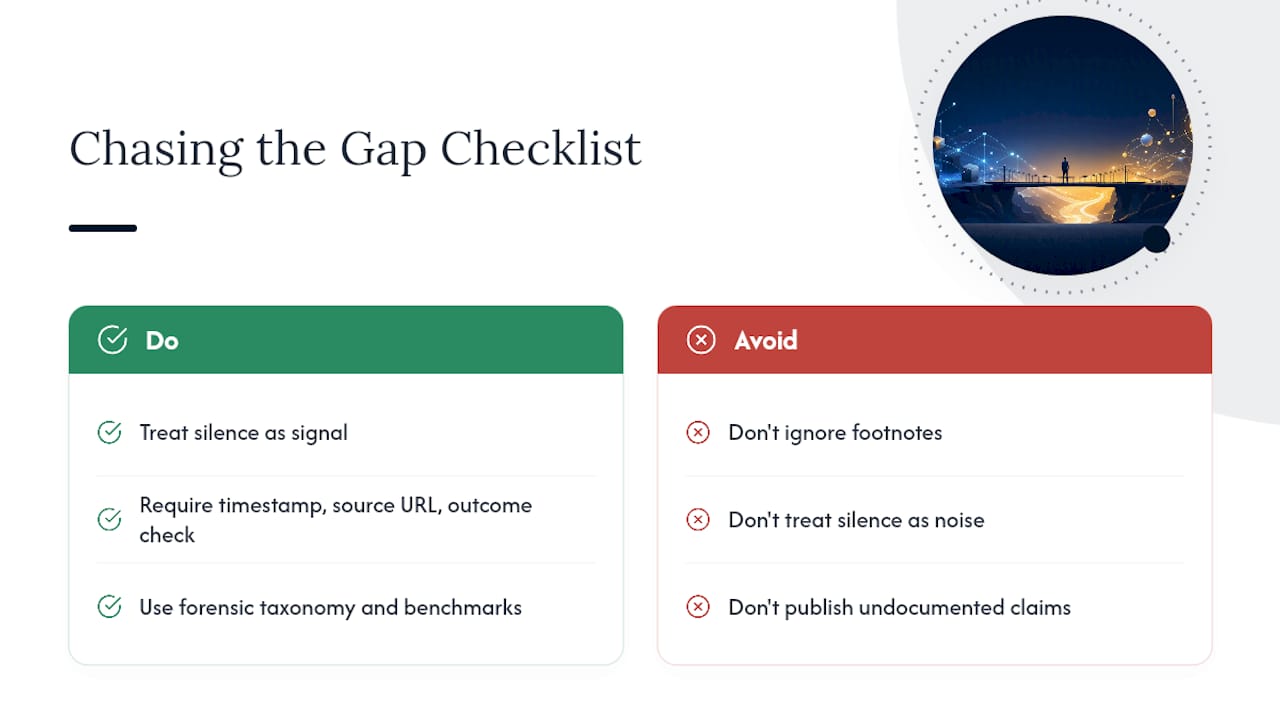
One pattern shows up often enough to matter: a target quietly buried in a footnote two years after its original launch, no press release, no earnings‑call mention, just a subordinate clause in a 10‑K. That single sentence has, more than once, changed which names a research team prioritized for engagement that quarter. The lesson holds regardless of sector: silence carries information, and treating it as noise is the more expensive mistake.
Reproducibility is what separates forensic analysis from speculation. Every claim needs a timestamp, a source URL, and a documented outcome check, or it should not survive into a published report or a trade decision. A forensic taxonomy and sector benchmarks can give that discipline a consistent structure across coverage, rather than reinventing the audit trail for every new name.
— Glen
Access Lacuna Index's Sector Benchmarks and Forensic Reports
A forensic analytics platform can provide access to narrative‑versus‑delivery evidence by mining public filings, earnings calls, press releases, and proxy statements to produce execution scores, sector benchmarks, and full forensic reports that quantify how much a company's public claims diverge from documented outcomes.
Institutions use these outputs three ways: as a first‑pass screen to flag names before deeper diligence, as documented evidence in governance engagement conversations, and as a corroborating input alongside internal research before sizing a position. Every score is built solely from public records and comes with an audit trail back to the source filing, which matters when a claim needs to hold up in a client memo or a published article. Governance professionals researching disclosure quality across an entire industry can also start with third‑party context, such as commentary on sustainability disclosure trends from outside the U.S. market, though sector‑specific benchmarking still requires the granularity a forensic platform provides.
Start by reviewing the free sector benchmarks for the industries you already cover, then request access to the full forensic reports for names that clear your initial screen.
Sources
- Limited accountability and awareness of corporate emissions target outcomes | Nature Climate Change
- Study: Nearly 40% of companies missed or abandoned 2020 climate targets — Haas News
- How processing costs drive market efficiency: review (Blankespoor et al., MIT Sloan review)
- Earnings call language and analyst reactions (arXiv preprint, 2025)