
If a single external customer accounts for 10% or more of consolidated revenue, that fact must be disclosed under ASC 280-10-50-42: the total revenue amount from that customer and the reporting segment(s) generating it. The customer's name is not required. That is the single most consequential threshold in customer concentration disclosure, and it drives almost everything else in this guide.
Two other triggers sit alongside it and get overlooked more often than they should. First, ASC 275 requires disclosure of any concentration, not just a revenue-generating customer, that creates a reasonably possible, near-term, and severe impact on the entity. That covers a dominant supplier, a single lender, or a major grant contributor just as readily as a major customer. Second, when concentration is material to liquidity or ongoing operations, the disclosure obligation extends beyond the footnote into MD&A and, frequently, the risk factors section of a Form 10-K.
The elements that a well-built disclosure needs to include:
- The dollar amount of revenue from each customer meeting the 10% threshold, plus the percentage of consolidated revenue it represents
- The reporting segment(s) associated with that revenue, per ASC 280's segment-reporting framework
- A multi-year trend where the concentration is persistent or growing, not just a single-period snapshot
- Accounts receivable concentration when a customer's outstanding balance is itself material to liquidity
- Narrative context in MD&A or risk factors when the concentration could plausibly affect the company's near-term financial condition
Get the math and the placement right, and most of the disclosure risk disappears. Get either wrong, and you invite an SEC comment letter or an uncomfortable audit conversation.
Key Takeaways
| Point | Details |
|---|---|
| Apply the 10% test correctly | Use consolidated revenue as the denominator, aggregate affiliates and government customers, and match periods exactly. |
| Disclose beyond revenue when relevant | ASC 275 covers supplier, lender, and other concentrations that could cause a near-term severe impact. |
| Keep placement consistent | Align the footnote, MD&A, and risk factors so percentages match across the 10-K and every 10-Q. |
| Make mitigation language specific | Tie diversification claims to measurable KPIs rather than boilerplate diversification statements. |
| Verify against public records | A platform like Lacunaindex helps cross-check disclosed customer percentages against transcripts, receivables trends, and prior filings for consistency. |
Table of Contents
- What Rules Govern Customer Concentration Disclosure?
- Where Should Customer Concentration Disclosure Appear?
- What Numbers Belong in the Disclosure?
- Model Language for Customer Concentration Notes
- How Do You Calculate Concentration Percentages Correctly?
- How Should Management Frame Mitigation Efforts?
- What Mistakes Trigger SEC Comment Letters?
- Verifying Disclosure Consistency With Public Records
- Why Conservative Math and Transparent Tables Beat Boilerplate
- Verify Your Own Disclosures Before Regulators Do
- Where to Read the Primary Rules and Real Filing Examples
- Frequently Asked Questions
- Sources
What Rules Govern Customer Concentration Disclosure?
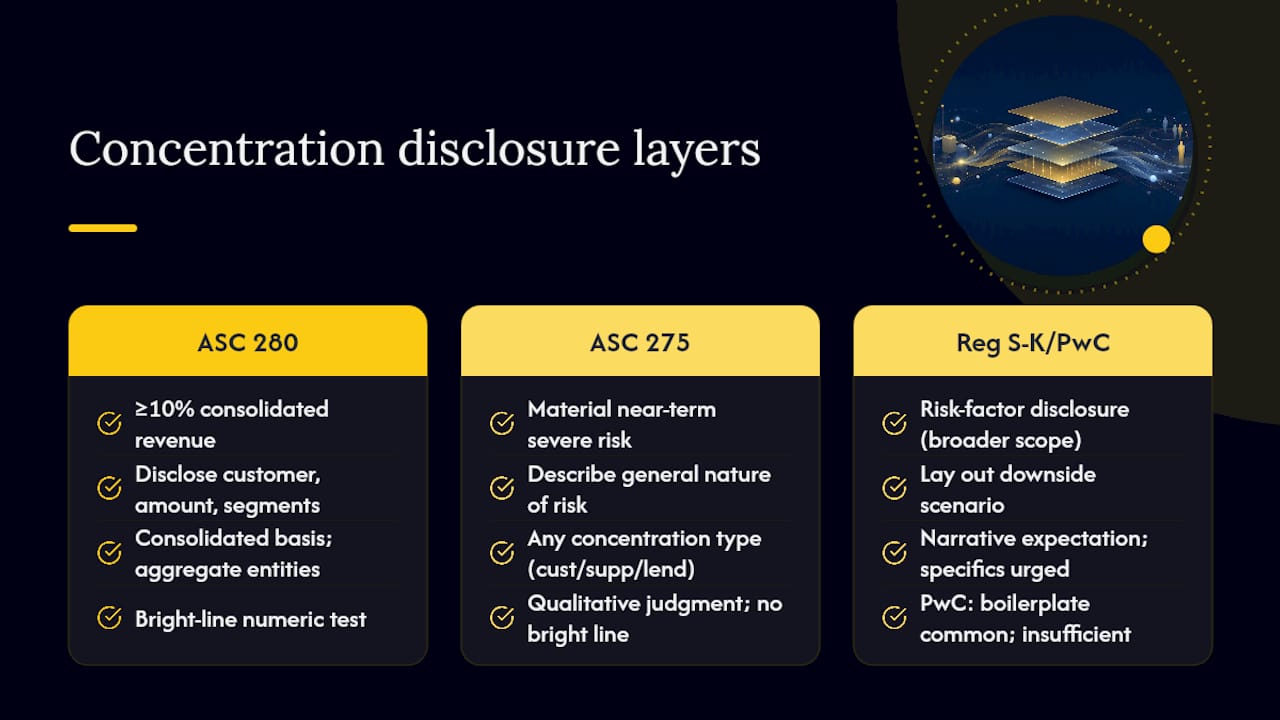
Two accounting standards do the heavy lifting, and they answer different questions. ASC 280 asks whether a customer is big enough to name in dollar terms. ASC 275 asks whether any concentration, customer or otherwise, is dangerous enough to warrant a qualitative warning.
ASC 280-10-50-42 requires that if 10 percent or more of the revenues from external customers are derived from a single customer, the public entity disclose that fact, the total amount of revenues from each such customer, and the identity of the segment(s) reporting the revenues.
The mechanics matter here. The 10% threshold applies to consolidated revenue, not segment revenue, which trips up preparers working from segment-level data. Entities under common control get aggregated and treated as a single customer for this test, and each government body, federal, state, or foreign, is likewise treated as one customer even when payments flow through multiple agencies or contracts.
ASC 275 operates on a different axis entirely.
Disclosure is required for concentrations that make an entity vulnerable to the risk of a near-term severe impact, and the disclosure should describe the general nature of the risk.
That standard doesn't care whether the concentration involves a customer, a supplier, or a lender. If losing that relationship could plausibly hurt the business badly within the next year, ASC 275 wants a plain description of why. Deloitte's own interpretive guidance treats this as a qualitative test, not a bright-line percentage, which means judgment plays a bigger role than it does under ASC 280.
Regulation S-K adds a third layer. Risk factors go further still, laying out the downside scenario. PwC's Viewpoint commentary notes that providing genuinely sufficient concentration disclosure is a persistent challenge in practice, largely because companies default to boilerplate instead of specifics.
Rule-following alone does not guarantee a clean disclosure. Research covering the interaction between customer concentration and forecasting behavior found a negative association between customer concentration and the frequency of management earnings and sales forecasts — when a large customer already has private access to a supplier's information, the incentive to communicate through frequent public forecasts drops. That's a structural reason concentrated companies sometimes look less transparent even when they are technically compliant.
Where Should Customer Concentration Disclosure Appear?
Placement inconsistency is one of the fastest ways to draw SEC attention, and it happens more than most preparers expect.
- The major-customer footnote, usually embedded in or adjacent to the segment reporting note, is the primary home for the ASC 280 disclosure: dollar amount, percentage, and segment.
- MD&A should discuss the concentration when it affects liquidity, revenue trends, or forward-looking uncertainty; this is where mitigation narrative belongs.
- Risk factors carry the disclosure when losing the customer could materially and adversely affect the business; this section states the downside scenario directly.
- Form 10-Q disclosures should mirror the 10-K's methodology exactly. A customer disclosed at 12% of annual revenue shouldn't vanish from the quarterly filing without explanation.
Whether to name the customer or use an anonymized label like "Customer A" is a judgment call ASC 280 leaves open, since the standard requires the revenue amount and the segment, not the name. Most companies anonymize unless a contractual or reputational reason exists to name the party, or unless the customer relationship is already public through a separate press release or 8-K.
Segment mapping deserves its own scrutiny. A customer that spans two reporting segments needs the revenue split disclosed by segment, not lumped into a single total, because ASC 280's segment framework is what the disclosure is built on top of. Quarterly and annual placement should track the same methodology so a reader comparing a 10-Q to the prior 10-K sees continuity rather than a shifting definition of what counts as "the customer."
What Numbers Belong in the Disclosure?
A complete customer concentration disclosure rests on a small set of numeric elements, and preparers who nail these rarely get a comment letter over the footnote itself.
- Total revenue dollars from each customer that meets or exceeds the 10% threshold
- That customer's revenue as a percentage of consolidated revenue for the period
- The reporting segment(s) tied to that revenue
- Accounts receivable concentration, when a customer's outstanding balance is itself material
- A two- or three-year trend line showing whether the concentration is rising, falling, or stable
Multi-year trend data earns its place because a single-period disclosure hides the trajectory. The second pattern is the kind of thing an SEC reviewer, an auditor, and a governance analyst all want to see spelled out rather than buried in a flat, single-year percentage.
A generic table format that fits most annual reports looks like this:
Preparers working with affiliated entities need to aggregate them under common control before running the percentage test, and every government counterparty, regardless of how many agencies or contracts are involved, counts as a single customer for aggregation purposes.
Model Language for Customer Concentration Notes
Three scenarios cover most real-world filings, and having model language ready saves a finance team from reinventing footnote wording every quarter.
Scenario B: Multiple customers meeting the threshold.
Revenue from the first customer was reported within the [Segment Name] segment, and revenue from the second customer was reported within the [Segment Name] segment.
Scenario C: Concentration material to liquidity, requiring MD&A narrative.
"Our largest customer has historically represented a significant portion of our revenue, and we expect this concentration to continue in the near term. A loss of this customer, or a material reduction in its purchasing volume, could adversely affect our liquidity, cash flow from operations, and results of operations. We continue to pursue diversification of our customer base as described under 'Risk Factors.'"
Real filings on EDGAR show similarly structured tables and language, and reviewing an actual SEC example is worth doing before drafting your own note, since the specific phrasing SEC staff has already accepted tends to be a safer starting point than language built from scratch.
For XBRL tagging, keep customer labels generic and consistent across periods (Customer A stays Customer A from quarter to quarter rather than being renumbered), and reconcile every customer revenue figure to the consolidated revenue line item it's a percentage of. Avoid embedding proprietary customer codes or internal account numbers in tagged labels, since those sometimes leak into public XBRL viewers.
How Do You Calculate Concentration Percentages Correctly?
The math itself is simple, but small choices in numerator, denominator, and period selection are where errors creep in.
- Set the numerator. Total revenue recognized from the customer during the reporting period, measured on the same basis (accrual, same revenue recognition policy under ASC 606) as consolidated revenue.
- Set the denominator. Consolidated revenue for the identical fiscal period, not segment revenue and not a subset like product revenue only.
- Match periods exactly. A trailing twelve months figure in the numerator paired with a fiscal-year denominator produces a distorted percentage; keep both on the same period basis.
- Aggregate related parties. Combine revenue across entities under common control before testing against the 10% threshold, and treat all government agency purchases from a single government body as one customer.
- Round consistently. Apply the same rounding convention (typically whole percentage points) across all periods presented so comparisons aren't distorted by inconsistent precision.
- Reconcile before filing. Confirm the sum of disclosed customer percentages plus "all other customers" equals 100% of consolidated revenue, and cross-check the dollar figure against the segment note.
A quick preparer checklist worth running every close:
- Does the numerator use the same revenue recognition basis as the denominator?
- Have affiliated entities been aggregated under common control?
- Has each government counterparty been treated as a single customer?
- Does the disclosed segment allocation tie back to the segment reporting note?
- Does the receivables concentration percentage, if disclosed, use the same customer grouping as the revenue percentage?
Because ASC 606 governs how and when revenue gets recognized, changes in contract structure, variable consideration, or performance obligations can shift a customer's recognized revenue between periods even when cash collections stay flat. That's worth flagging internally before a concentration percentage swings in a way that looks inexplicable to an outside reader.
How Should Management Frame Mitigation Efforts?
A concentration disclosure that states the exposure and stops there reads as incomplete. Investors and SEC staff alike want to know what management is actually doing about it, and vague language invites exactly the kind of follow-up question a comment letter is built from.
- Diversification strategy. Specific language on new account acquisition, new markets entered, or new product lines aimed at reducing reliance on the largest customer.
- Contract terms. Disclosure of minimum purchase commitments, contract length, or renewal terms that provide visibility into how durable the relationship is.
- Credit monitoring. A description of ongoing credit assessment practices for large customers, particularly where receivables concentration is material.
- Contingency planning. Concrete steps the company would take if the relationship ended, including cost structure flexibility or alternative revenue sources.
- Operational actions. Investments in capacity, geography, or channel expansion explicitly tied to reducing dependency.
The dividing line between language that satisfies reviewers and language that invites more questions usually comes down to specificity. "We continue to focus on diversifying our customer base" is boilerplate.
Dependency on a single large counterparty is a well-documented operational hazard, not just a disclosure technicality, and the same dynamics that create governance risk around supplier dependency apply in mirror image to customer dependency: leverage shifts to the larger party, pricing power erodes, and payment terms tend to stretch over time.

Pro Tip: Tie every mitigation claim to a number you can defend in an audit. If you write that you're "diversifying," attach a metric, percentage of revenue from accounts onboarded in the past 12 months, average customer tenure, or timeline estimate to replace lost revenue from your largest account. A mitigation sentence without a number is a sentence an SEC reviewer will ask you to support anyway.
What Mistakes Trigger SEC Comment Letters?
A handful of recurring errors account for most of the friction between preparers and the SEC on this topic.
- Using segment revenue instead of consolidated revenue for the 10% test, which understates or overstates the true concentration depending on how segments are structured.
- Inconsistent figures between MD&A and the footnote, where the narrative cites one percentage and the note discloses another for the same period.
- Omitting receivables concentration when a customer's outstanding balance is clearly material to liquidity, even though revenue concentration was disclosed.
- Vague mitigation language that repeats the same sentence quarter after quarter with no updated specifics.
- A customer disclosed one year and silently dropped the next without explanation, which reads as either a data error or a deliberate omission.
Auditors and sophisticated investors watch for a specific set of red flags: a customer's percentage jumping sharply year over year with no explanation, a previously disclosed customer disappearing from the note entirely, or payment terms lengthening in a way that suggests the buyer is extracting concessions. Industry commentary generally treats concentration above roughly 20% to 30% of revenue as a meaningful red flag for valuation and lender scrutiny, even though no single authoritative threshold exists beyond ASC 280's 10% disclosure trigger.
Pro Tip: The single easiest fix that prevents most auditor pushback is a visible cross-reference. Add a sentence in the footnote showing exactly how the disclosed customer dollar amount ties to the consolidated revenue line on the income statement. That one reconciliation step closes the most common gap between what's disclosed and what an auditor can independently verify.
Verifying Disclosure Consistency With Public Records
A disclosure can be technically compliant and still be quietly misleading if it doesn't square with what the company says elsewhere. Cross-checking a customer concentration note against other public evidence is where forensic analysis earns its keep.
A practical five-step workflow for a compliance officer during quarter-close review:
- Reconcile the disclosed customer percentage to the segment revenue note and confirm the dollar figures match.
- Pull the accounts receivable aging schedule and check whether receivables concentration mirrors revenue concentration, or diverges in a way that suggests extended payment terms.
- Search earnings call transcripts for references to "our largest customer," "Customer A," or similarly coded language, and compare the tone to the written disclosure.
- Check government contracting or procurement databases if the concentrated customer is a public sector entity, since award data is often independently verifiable.
- Compare the current filing's customer percentage against the prior three to four quarters to spot discontinuities that weren't explained in the narrative.
A short verification checklist worth running every quarter:
- Does the customer's disclosed share match across the 10-K, the most recent 10-Q, and MD&A?
- Do earnings call statements about "customer concentration" or "a large customer" match the magnitude implied by the written disclosure?
- Has the receivables balance for the concentrated customer grown faster than revenue from that customer, suggesting a collections or leverage problem?
- Are payment terms extending? A shift from net-30 to net-60 terms with a major customer is a documented early warning sign that leverage is shifting toward the buyer.
Disclosure-quality research outside the concentration context reinforces why this kind of cross-check matters: studies of principles-based disclosure regimes, including human capital disclosure trends tracked by Gibson Dunn, show enormous variation in specificity and numeric intensity across companies operating under similar rules. Customer concentration disclosure follows the same pattern. Tools built for analyzing disclosure inconsistencies across a company's filing history exist precisely because this gap between compliant and genuinely informative disclosure is common and hard to spot manually.
Why Conservative Math and Transparent Tables Beat Boilerplate
The instinct to minimize concentration disclosure, keep the percentage vague, skip the trend table, avoid naming a segment, is understandable and almost always counterproductive. A disclosure built on conservative math and a transparent multi-year table draws less scrutiny than a thin, boilerplate sentence, because reviewers and analysts read vagueness as something to investigate rather than something to trust.
The stronger approach starts with a written internal policy: a defined threshold test applied the same way every quarter, a standard reconciliation step tying customer revenue to the consolidated total, and a verification checklist run before every filing, not just the annual one. Companies that treat this as a recurring discipline rather than an annual scramble rarely end up explaining a sudden, unexplained jump in customer share to an SEC reviewer.
Publishing tangible mitigation metrics, not just diversification language but the actual percentage of new revenue coming from new accounts, is worth the internal effort it takes to track. It reduces investor uncertainty in a way vague language never will, and it gives management a credible answer the next time an analyst asks about dependency risk on an earnings call. Finance teams that build customer concentration monitoring into sales incentive structures, tying part of new-business compensation to reducing reliance on the largest few accounts, tend to produce cleaner disclosures almost as a byproduct, because the underlying business risk actually shrinks rather than just getting described more carefully.
Verify Your Own Disclosures Before Regulators Do
Most of the guidance above assumes the disclosure gets written correctly the first time. In practice, the harder problem is catching the moments when a company's own filings, earnings calls, and public statements quietly drift apart, a customer's share creeps up across three quarters without commentary, or MD&A language stops matching the footnote. Lacunaindex was built to mine exactly that gap using only public records: SEC filings, earnings call transcripts, press releases, and proxy statements, cross-referenced against each other to surface where a company's narrative and its actual disclosed numbers stop lining up.
For a compliance officer or analyst who wants to run that kind of cross-check on a specific company's customer concentration history rather than doing it manually against EDGAR and transcript archives, the Lacuna Index user guide walks through how the platform's reports flag inconsistencies across filing periods and score the gap between what's claimed and what's evidenced. Start there to see how a sample forensic report reads before applying the same verification logic to your own quarter-close review.
Where to Read the Primary Rules and Real Filing Examples
The most reliable starting points are the standards themselves and the practitioner guidance built around them. ASC 280's major-customer guidance covers the 10% threshold in full, while ASC 275's concentration disclosure requirements address the broader severe-impact test.
For real-world wording and table structure, SEC EDGAR filings remain the best source of language that has already passed regulatory review. PwC's Viewpoint commentary on risks and uncertainties offers additional practitioner interpretation worth reading alongside the standards themselves.
SEC comment-letter precedents on customer concentration are searchable directly through EDGAR's full-text search tool, and reviewing a handful of recent letters on this topic is often more instructive than any secondary summary, since they show exactly what language regulators pushed back on and how companies responded.
Frequently Asked Questions
Does customer concentration disclosure require naming the customer?
No. ASC 280 requires the revenue amount and reporting segment, not the customer's identity. Many companies anonymize the disclosure as "Customer A" unless a separate reason exists to name the party.
What threshold triggers customer concentration disclosure?
ASC 275 uses a qualitative, not percentage-based, test for other severe near-term risks.
Should accounts receivable concentration be disclosed separately from revenue concentration?
Yes, when the receivables balance from a concentrated customer is itself material to liquidity, even if the revenue percentage alone wouldn't suggest urgency.
Do private companies face the same customer concentration disclosure rules as public companies?
ASC 280's segment-based major-customer disclosure applies to public entities. ASC 275's concentration disclosure applies more broadly, though private companies without public debt or equity often face lighter enforcement and no MD&A or risk-factor requirement tied to SEC review.
How does ASC 606 affect customer concentration percentages?
Because ASC 606 governs when and how revenue is recognized, changes in contract terms or variable consideration can shift a customer's recognized revenue between periods independent of underlying business volume, which can move the concentration percentage in ways worth explaining internally before filing.
Sources
- 5.7 Information About Major Customers | DART – Deloitte Accounting Research Tool
- SEC filing (example major-customer disclosure)
- ASC 275 Risks and Uncertainties (research study) | ResearchGate
- 24.3 Risks and uncertainties—Disclosure - Viewpoint - PwC