
A corporate transparency metrics research framework is a structured collection of verifiable indicators designed to measure and improve accountability in corporate governance. The standard industry term for this practice is "accountability measurement framework," though "corporate transparency metrics research framework" accurately describes its applied research function. The Organizational Transparency Index (OTI) operationalizes this concept using 38 verifiable indicators across five weighted dimensions, deliberately avoiding perception surveys in favor of auditable documents and digital records. Executives and compliance officers who rely on disclosure volume alone consistently misread actual governance quality. The frameworks that produce defensible, reproducible results share one defining trait: they measure what companies do, not what they say.
What are the key components of effective transparency metrics frameworks?
Effective accountability measurement frameworks share a multidimensional structure that covers financial, governance, operational, and social or environmental aspects of corporate conduct. No single dimension tells the full story. A company can publish extensive sustainability reports while concealing material governance failures, which is why disclosure breadth must be separated from verifiable accountability at every stage of analysis.

The OTI's five dimensions illustrate this structure clearly. They span information access, decision traceability, stakeholder participation, accountability mechanisms, and institutional integrity. Each dimension carries a distinct weight and maps to specific, auditable evidence sources such as SEC filings, proxy statements, board meeting minutes, and published policies.
The distinction between indicator types is critical for any compliance officer building a framework:
- Verifiable indicators draw from auditable documents: financial statements, regulatory filings, third-party audit reports, and board resolutions.
- Perception-based indicators rely on surveys, reputation scores, or media sentiment. These introduce subjectivity and reduce reproducibility.
- Outcome indicators link disclosures to measurable results, such as linking a stated emissions target to actual Scope 1 and Scope 2 reductions over time.
- Process indicators confirm that governance mechanisms exist, such as whether an independent audit committee meets the required frequency.
| Framework dimension | Example verifiable indicator |
|---|---|
| Information access | Percentage of board decisions published with rationale |
| Decision traceability | Audit trail completeness in SEC 10-K filings |
| Stakeholder participation | Documented shareholder engagement frequency |
| Accountability mechanisms | Independent auditor attestation on internal controls |
| Institutional integrity | Anti-corruption policy coverage and enforcement records |
Pro Tip: Never weight a framework dimension based on data availability. Weight it based on governance priority for your sector, then build the data collection process to match.
How does recent research inform the selection of transparency metrics?
The 2026 research base on corporate accountability benchmarking has produced two findings that should reshape how executives select and apply transparency indicators. First, 88% of Scope 3 emissions remain unreported across corporate sustainability disclosures. That gap means any environmental accountability framework built on self-reported data will systematically understate actual exposure.
Second, an analysis of 1,477 ESG reports identified 34 distinct topics using structural topic modeling. The findings revealed a clear "word-action gap": specific environmental themes in narrative reports correlated with measurable KPI improvements, while broad commitment language showed no such correlation. This distinction is not academic. It means that a compliance officer reading a sustainability report cannot assume that the presence of a topic signals actual performance progress.
"The word-action gap shows that specific themes in corporate narrative reports correlate with actual KPI improvements while generic claims do not. Metrics should link narrative to quantitative KPIs to produce defensible accountability assessments."
The AIR framework for AI in research adds a third dimension to this picture. Transparency is defined there as adopting a standardized vocabulary across research stages, not simply producing more information. Applied to corporate governance, this means that a framework using inconsistent terminology across reporting periods produces incomparable results, regardless of how many indicators it tracks.
The ESG rating landscape compounds these challenges. Methodological inconsistencies across rating providers reduce comparability and create conditions where two firms with identical governance practices receive divergent scores. Effective frameworks address this by relying exclusively on publicly available data, applying penalties for non-disclosure, and enabling sector-specific sensitivity analysis to maintain reproducibility across reporting cycles.
Three research-informed principles follow directly from these findings:
- Link every narrative commitment to a quantitative KPI before including it as a framework indicator.
- Apply non-disclosure penalties rather than treating missing data as neutral.
- Use standardized indicator definitions across all reporting periods to maintain longitudinal comparability.
What practical methods support transparency benchmarking?
Operationalizing a corporate accountability benchmarking framework requires systematic data extraction, normalization, and handling of fragmented reporting. The CSRIndeX tool demonstrates this at scale. It automates extraction of CSR disclosures from SEC filings and computes normative benchmarks against firm profitability, separating disclosure breadth from normative spending targets. That separation is the methodological step most manual frameworks skip, and it is the primary reason many internal benchmarking efforts produce results that cannot be compared across firms or sectors.
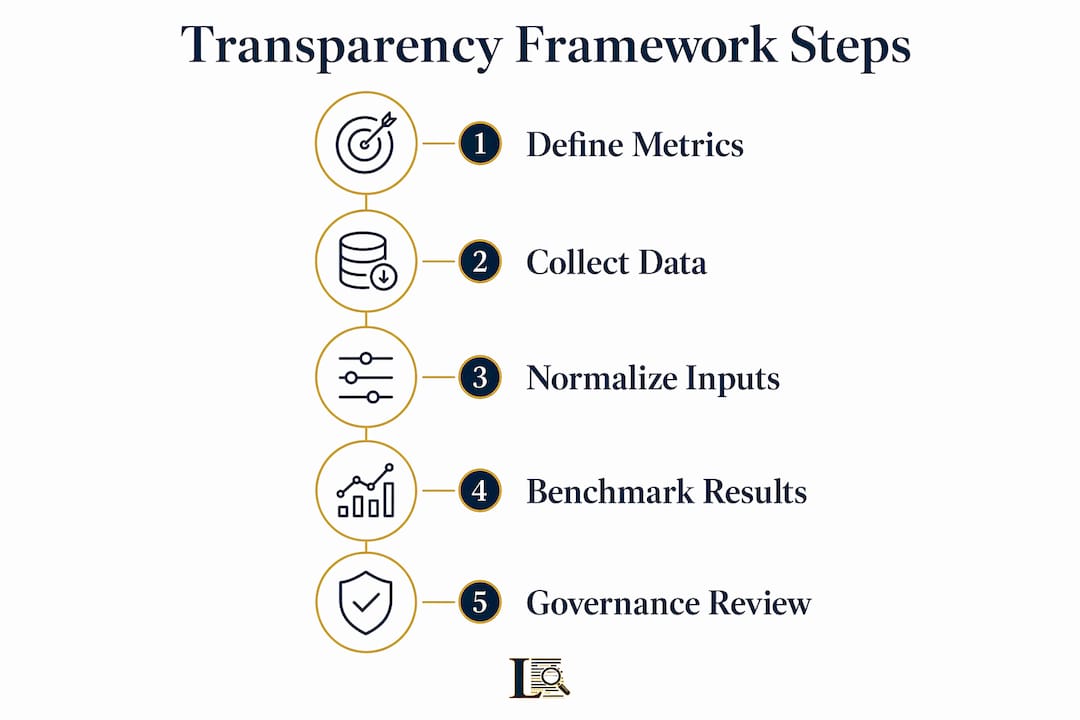
Automated data extraction is not optional for longitudinal research. Fragmented reporting across earnings calls, press releases, proxy statements, and regulatory filings creates data gaps that manual review cannot systematically address. Successful frameworks normalize spending against profitability and handle missing data through explicit rules, not ad hoc judgment.
A structured implementation sequence for executives building an accountability-driven research framework:
- Define the governance priority hierarchy. Identify which dimensions (financial, governance, operational, environmental) carry the highest regulatory and reputational risk for your sector before selecting indicators.
- Map indicators to auditable sources. Assign each indicator to a specific, retrievable document type. If no auditable source exists, the indicator does not belong in the framework.
- Establish non-disclosure rules. Decide in advance how missing data is treated. Penalizing non-disclosure produces more accurate accountability scores than treating gaps as neutral.
- Normalize against profitability. Raw spending or disclosure counts are not comparable across firms of different sizes. Normalize all quantitative indicators against a profitability baseline.
- Run sector-specific sensitivity analysis. Test whether your indicator weights produce stable rankings when applied to firms in the same sector. Unstable rankings signal weighting errors, not firm-level differences.
- Validate against external audits. Cross-reference framework outputs against independent auditor attestations and regulatory filings to confirm that scores reflect auditable reality.
Pro Tip: Avoid building your framework around indicators that are easy to collect. Build it around indicators that are hardest to manipulate. High disclosure volume often masks poor operational performance, and the easiest data to collect is usually the easiest data to engineer.
How can executives use transparency frameworks to improve governance?
Tailoring a transparency framework to organizational context is the step that separates frameworks that produce governance improvement from those that produce compliance theater. A financial services firm faces different disclosure obligations under SEC Regulation S-K than an energy company subject to climate-related financial risk disclosure requirements. The indicator set, weighting, and benchmarking reference group must reflect those differences.
Integrating framework results with compliance monitoring produces the most direct governance impact. When an evidence-based corporate reporting process flags a gap between a stated policy and its documented implementation, compliance officers can trace that gap to a specific filing, a specific period, and a specific responsible party. That traceability is what converts a transparency score into a governance action.
Linking narrative disclosures to operational KPIs is the mechanism that closes the word-action gap at the firm level. The process requires mapping each material commitment in earnings calls and press releases to a quantitative metric tracked in internal reporting. Where no such metric exists, the commitment cannot be verified and should not appear in external disclosures without qualification.
| Governance improvement | Enabling transparency metric |
|---|---|
| Board accountability | Independent director attendance rate and vote disclosure |
| Executive pay alignment | CEO pay ratio linked to operating performance metrics |
| Environmental commitment | Scope 1 and Scope 2 emissions verified by third-party auditor |
| Stakeholder engagement | Documented shareholder proposal response rate |
| Regulatory compliance | Percentage of material disclosures filed within required deadlines |
Compliance officers who monitor disclosure consistency across filings over multiple periods gain a longitudinal view that single-period assessments cannot provide. Consistency analysis reveals whether governance improvements are structural or episodic, which is the distinction that matters most to institutional investors and regulators.
Key Takeaways
A corporate transparency metrics research framework produces defensible governance assessments only when it prioritizes auditable indicators over disclosure volume and links narrative claims to measurable KPIs.
| Point | Details |
|---|---|
| Prioritize auditable indicators | Build every framework dimension around retrievable, verifiable documents, not perception surveys. |
| Address the word-action gap | Link each narrative commitment to a quantitative KPI before treating it as an accountability indicator. |
| Penalize non-disclosure | Treat missing data as a governance signal, not a neutral gap, to produce accurate accountability scores. |
| Normalize for comparability | Adjust all quantitative indicators against a profitability baseline to enable cross-firm benchmarking. |
| Integrate with compliance monitoring | Connect framework outputs to specific filings and responsible parties to convert scores into governance actions. |
The data quality problem no one wants to address
The most persistent failure in corporate transparency measurement is not a methodology problem. It is a data quality problem that practitioners routinely defer. Frameworks get built, indicators get selected, and then the actual data collection reveals that half the indicators rely on disclosures that are inconsistent, incomplete, or simply absent across the sample. At that point, most teams either drop the indicators or fill gaps with proxies. Both choices corrupt the framework's integrity.
The research on this is unambiguous. The lack of a universally accepted definition in corporate reporting transparency research is not a theoretical gap. It produces real divergence in what gets measured and how, which means two frameworks assessing the same company can produce contradictory accountability scores. That divergence is not a sign that transparency is inherently unmeasurable. It is a sign that the field has not yet enforced the methodological discipline that makes measurement reproducible.
The direction that matters most right now is AI-driven transparency assessment. Automated extraction tools that apply standardized vocabularies across large disclosure sets will eventually resolve the data fragmentation problem that manual frameworks cannot. But the underlying logic must still come from governance professionals who understand which indicators reflect actual accountability and which reflect disclosure engineering. Technology accelerates the process. It does not replace the judgment required to design a framework that cannot be gamed.
Compliance officers who wait for a universal standard before building their own framework will wait indefinitely. The practical path is to build a framework grounded in auditable sources, document every methodological choice, and refine it as research and regulatory requirements evolve. Adaptability is not a weakness in a transparency framework. It is the property that keeps it accurate over time.
— Glen
Lacunaindex and the evidence-based transparency assessment
Lacunaindex applies the principles described throughout this article to public company assessments using only publicly available records. Every evaluation draws from SEC filings, earnings calls, proxy statements, and press releases, with no reliance on insider access or self-reported survey data.
Executives and compliance officers who want to understand how a forensic accountability assessment works in practice can start with the Lacuna report guide, which walks through the methodology step by step. For sector-level context, the sector benchmarks provide reference points that place individual company scores against peer groups. Both resources are designed for governance professionals who need defensible, evidence-based assessments rather than disclosure-volume summaries.
FAQ
What is a corporate transparency metrics research framework?
A corporate transparency metrics research framework is a structured set of verifiable indicators used to assess and improve accountability in corporate governance. It relies on auditable documents rather than perception surveys to produce reproducible results.
How does the Organizational Transparency Index measure corporate transparency?
The OTI measures transparency using 38 verifiable indicators across five weighted dimensions, covering information access, decision traceability, stakeholder participation, accountability mechanisms, and institutional integrity across a sample of 60 organizations.
What is the word-action gap in ESG reporting?
The word-action gap refers to the finding that broad commitment language in corporate reports shows no measurable correlation with KPI improvements, while specific environmental themes do. Frameworks that link narrative disclosures to quantitative KPIs can identify and close this gap.
Why do ESG ratings produce inconsistent results across providers?
ESG rating fragmentation results from methodological inconsistencies and lack of standardization across rating providers. Frameworks that rely on publicly available data and apply explicit non-disclosure penalties produce more comparable and reproducible accountability scores.
How should compliance officers handle missing data in transparency frameworks?
Missing data should be treated as a governance signal and penalized explicitly rather than excluded or filled with proxies. Systematic non-disclosure rules, as applied by tools like CSRIndeX, maintain benchmarking accuracy and prevent gaps from distorting accountability scores.