
Corporate promise tracking journalism methods are forensic techniques that measure the gap between a company's aspirational forward-looking statements and its verifiable operational and financial outcomes, using only public records. The discipline treats every commitment in an MD&A, earnings call transcript, proxy statement, or SEC filing as an aspirational baseline, not a guarantee, and then systematically tests whether subsequent disclosures confirm or contradict that baseline. Multi-dimensional narrative content analysis, which evaluates tone, specificity, directness, and linguistic aggressiveness, allows analysts to detect engineered language before operational data confirms the divergence. The core forensic principles underpinning this discipline are:
- Treat all forward-looking statements as versioned, auditable baselines subject to quantitative comparison.
- Use SEC filings, earnings call transcripts, proxy statements, and press releases as the primary evidence layer.
- Apply narrative content analysis to identify tone shifts, hedging escalation, and footnote discrepancies.
- Cross-reference aspirational MD&A claims against capital expenditure data, emissions figures, and operational KPIs.
- Measure the aspiration-to-execution gap as a quantifiable, reportable metric rather than a qualitative judgment.
Table of Contents
- How to conduct forensic analysis of corporate public disclosures
- Why governance quality shapes the credibility of corporate promises
- What the absence of universal promise ratings costs investors and journalists
- How Lacunaindex applies forensic analytics to corporate promise accountability
- Lacunaindex gives you objective promise delivery measurement
- Key Takeaways
How to conduct forensic analysis of corporate public disclosures
A rigorous forensic methodology begins with systematic collection and centralization of all relevant public artifacts, then layers analytical controls to detect inconsistency and disclosure opacity.
Step 1: Collect and version all public disclosure artifacts. Gather 10-K and 10-Q filings, earnings call transcripts, sustainability reports, proxy statements, and investor day presentations. Assign each forward-looking statement a stable Target ID so that when a company quietly shifts its baseline year or organizational boundary, the change is machine-detectable rather than buried in prose. Industry practice treats versioned ESG targets with linked audit trails as the minimum standard for disclosure consistency.
Step 2: Apply multi-dimensional narrative content analysis. Natural language processing tools evaluate tone, specificity, and directness across disclosure artifacts. NLP-based narrative analysis detects engineered disclosure language by flagging shifts in hedging density, passive-voice escalation, and declining quantitative specificity. Because investor response to complex narrative signals tends to be delayed, early detection creates an analytical advantage.
Step 3: Cross-check MD&A narratives against financial footnotes. Footnotes are a high-signal zone. Discrepancies between MD&A narratives and footnote data predict negative stock returns and operational underperformance, yet investors systematically underreact to footnote-level information. Analysts who prioritize footnote divergence over headline narrative catch engineered disclosures earlier.
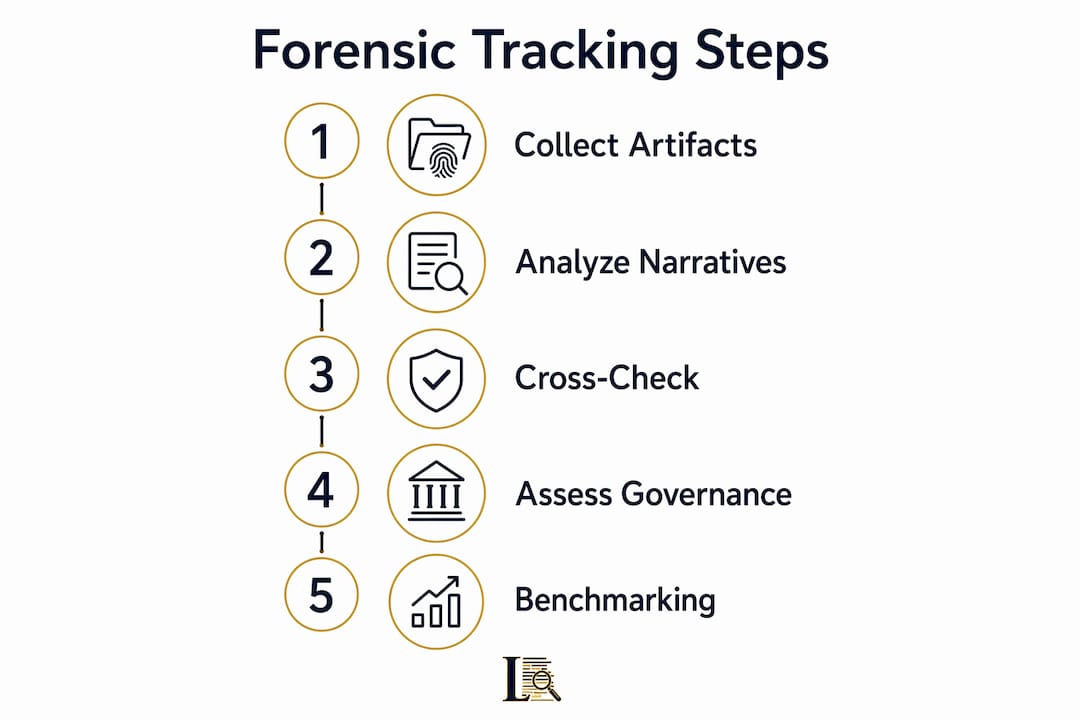
Step 4: Triangulate with external datasets. Public records alone sometimes lack the granularity to confirm or refute a specific claim. Combining limited proprietary datasets with linguistic and operational data analysis creates triangulation for promise verification without insider access. Whistleblower disclosures, supply chain audit summaries, and regulatory enforcement records supplement the public record when available.
Step 5: Validate through control process ownership. Each promise should have a documented owner, an approval workflow, and a reconciliation checklist that confirms every disclosure artifact references the same approved target definition and caveats. This step converts narrative analysis into an audit-ready process.
- Track dependency chains: when a baseline assumption changes, every dependent disclosure must update before publication.
- Archive evidence at each publishing cycle, including a "targets used" table with Target IDs, version numbers, and as-of dates.
- Flag any "on track" or "expected" language that lacks a corresponding quantitative status field in the source record.
Pro Tip: Changes in baseline assumptions or organizational boundary conditions are the highest-signal indicators of engineered disclosure. When a company silently shifts its baseline year or redefines scope coverage between reports, the resulting comparability gap often explains apparent progress that operational data does not support.
Why governance quality shapes the credibility of corporate promises
Promise tracking does not operate in isolation from the governance structures that produce disclosures. Enterprise Risk Management integration and board-level oversight of data governance are among the most reliable indicators of whether a company's public commitments reflect operational reality or aspirational positioning. Investors scrutinize board oversight as a proxy for "tone at the top," treating it as a systemic signal rather than a metric-by-metric assessment.
Governance quality functions as a standalone predictor of financial information trustworthiness, independent of executive earnings management incentives. Poor governance reduces the perceived utility of financial reporting regardless of whether compensation structures create misalignment. This distinction matters for journalists and analysts: attributing disclosure opacity solely to incentive misalignment understates the systemic risk embedded in weak governance architecture. For deeper analysis of how board oversight affects disclosure reliability, the governance red flags framework offers a structured evaluation approach.
Key governance factors that directly affect promise accountability include:
- Data ownership clarity: each reported metric has a named owner accountable for accuracy and consistency across artifacts.
- Review controls: formal approval gates prevent disclosures from publishing without reconciliation to the approved source record.
- Audit trail transparency: version history for every target and baseline is retained and accessible to external reviewers.
- Board engagement: directors with direct oversight of sustainability and operational commitments reduce the probability of undetected target drift.
- Separation of drafting and approval: the team that drafts forward-looking statements should not be the sole approver of the underlying assumptions.
Governance red flags, including frequent auditor changes, material weakness disclosures, and opaque related-party transactions, compound the aspiration-to-execution gap by reducing the reliability of the very data used to measure delivery.
What the absence of universal promise ratings costs investors and journalists
No standardized corporate promise ratings system exists in the United States. That structural gap creates a permissive environment for disclosure opacity: companies can shift targets, redefine baselines, and change organizational boundaries across reporting cycles without triggering a formal ratings downgrade or regulatory penalty. Disclosure consistency analysis reveals that comparing internal operational controls against public disclosure alignment identifies the highest-integrity companies more reliably than any single metric.
The strategic risks this void creates are asymmetric. Institutional investors who rely on headline sustainability or operational metrics without auditing the underlying assumptions are exposed to mispricing driven by narrative rather than performance. Journalists who accept disclosed progress figures at face value miss the story embedded in baseline redefinitions. Forensic analytics addresses this gap by measuring delivery objectively, using only the public record, and quantifying the aspiration-to-execution gap as a reportable score rather than a qualitative assessment.
Key finding: Investigative journalism combining linguistic analysis of corporate narratives with external operational data uncovers promise misalignments that quantitative-only approaches miss, particularly in sustainability-linked financial instruments where loan misuse is difficult to detect from public data alone.
Challenges and opportunities in this space include:
- Challenge: companies exploit the absence of ratings by presenting restated baselines as genuine progress.
- Challenge: inconsistent internal and external metric alignment makes cross-company comparisons unreliable without forensic normalization.
- Opportunity: forensic analytics can expose discrepancies and measure delivery gaps using only public data, without insider access.
- Opportunity: scenario planning frameworks applied to forward-looking statements help analysts stress-test narrative claims against plausible operational outcomes.
Ethical and legal constraints are real boundaries in this work. Defamation exposure requires that every published claim be traceable to a documented, reliable source. Publishing an incorrect inference, even unintentionally, carries legal risk under U.S. defamation standards. The forensic discipline of working exclusively from public records provides both analytical rigor and a defensible evidentiary foundation.
How Lacunaindex applies forensic analytics to corporate promise accountability
Lacunaindex operationalizes the methodology described above into a systematic, evidence-based platform for institutional investors, governance advocates, and financial journalists. The platform mines publicly available records, including earnings call transcripts, SEC filings, press releases, and proxy statements, to measure the gap between corporate narrative claims and actual delivery without any reliance on insider data or proprietary access.

Companies are classified into archetypes based on quantified performance and valuation metrics: earned (delivery matches or exceeds narrative), borrowed (valuation exceeds delivery, sustained by narrative), and undervalued (delivery exceeds narrative, creating potential mispricing). These classifications give investors and journalists a structured framework for forensic corporate analysis that goes beyond qualitative assessment.
| Platform Component | Description |
|---|---|
| Versioned promise tracking | Assigns stable Target IDs to each commitment, enabling cross-report comparison and baseline drift detection |
| Narrative content analysis | Applies NLP to evaluate tone, specificity, and hedging patterns across disclosure artifacts |
| Dependency mapping | Links each forward-looking statement to its source assumptions, flagging discrepancies when baselines change |
| Execution score | Quantifies the aspiration-to-execution gap as a normalized, sector-benchmarked metric |
| Governance integration | Incorporates board oversight indicators and audit trail transparency into the overall accountability assessment |
| Archetype classification | Categorizes companies as earned, borrowed, or undervalued based on delivery versus narrative |
Key platform capabilities relevant to the target audience:
- Sector benchmarks that contextualize execution scores within industry norms, enabling peer comparison without manual normalization.
- Audit-ready evaluation workflows that rely exclusively on public disclosures, satisfying media ethics standards and legal defensibility requirements.
- Automated detection of baseline shifts and boundary redefinitions across reporting cycles.
- Forensic reports structured for direct use in investment memos, governance reviews, and investigative journalism.
The platform's sector benchmarks provide the reference layer that individual disclosure analysis lacks, allowing users to distinguish company-specific delivery failures from sector-wide patterns.
Lacunaindex gives you objective promise delivery measurement

Institutional investors and financial journalists working on corporate accountability journalism face a specific problem: the public record contains the evidence, but extracting a defensible, quantified delivery score from thousands of disclosure artifacts requires systematic forensic infrastructure. Lacunaindex provides exactly that, without requiring insider access, proprietary data purchases, or manual cross-referencing across dozens of filings.
The platform's execution scores and archetype classifications are derived entirely from public records, making every finding reproducible and audit-ready. For governance advocates assessing board accountability, the dependency mapping and baseline drift detection features surface the governance red flags that headline metrics obscure. For journalists, the versioned promise tracking and narrative analysis layer provides the evidentiary foundation that defamation-conscious reporting requires.
Start with the Lacunaindex user guide to understand how forensic reports are structured, then apply sector benchmarks to contextualize your findings within industry norms.
Key Takeaways
Forensic corporate promise tracking requires versioned disclosure records, narrative content analysis, and governance quality assessment applied consistently to public data to produce defensible, quantified delivery scores.
| Point | Details |
|---|---|
| Treat promises as versioned baselines | Assign stable Target IDs to each commitment so baseline shifts are machine-detectable across reporting cycles. |
| Footnote divergence is high-signal | Discrepancies between MD&A narratives and financial footnotes predict negative stock returns and operational underperformance. |
| Governance quality is a standalone risk factor | Poor governance reduces financial information trustworthiness independently of executive earnings management incentives. |
| No universal ratings system exists | The absence of standardized promise ratings allows companies to shift baselines without triggering formal accountability mechanisms. |
| Lacunaindex quantifies the delivery gap | The platform classifies companies as earned, borrowed, or undervalued using only public disclosures, producing audit-ready execution scores. |