
Corporate promise gap governance risk is defined as the measurable discrepancy between a corporation's public commitments and its verified operational performance, creating material vulnerabilities in board oversight, regulatory compliance, and stakeholder trust. Industry practitioners use the term "aspiration-to-execution gap" to describe this same phenomenon with greater forensic precision. The risk is not theoretical. A Nature study on corporate climate pledges found that 96% of firms making climate pledges showed indicators of potential greenwashing, with 70% of net-zero commitments lacking Scope 3 emissions coverage. That figure signals a systemic failure in promise management, not isolated corporate misconduct. Governance professionals and institutional investors who cannot quantify this gap operate with an incomplete picture of the companies they oversee or hold.
What types of executive promise accountability gaps exist in corporate governance?
Promise accountability gaps fall into four distinct categories, each carrying a different risk profile for governance teams.
Strategic ambiguity gaps arise when executives use deliberately vague language to preserve operational flexibility. Research analyzing over 69,000 CEO earnings call transcripts from 2010 to 2022 found that low-specificity promises are a calculated tool, not an oversight. The problem is that strategic ambiguity shifts accountability risk onto the board when delivery fails and investors demand answers.
Sustainability promise gaps represent the most publicly visible category. The same Nature analysis of 3,574 companies found that 40% used questionable carbon offsets to support net-zero claims. These gaps attract regulatory scrutiny and litigation at a rate that operational shortfalls rarely match.

Proxy advisory accountability gaps emerge when governance decisions are delegated without independent verification. The SEC's Investment Management Director has questioned vote-all proxy practices, noting that habitual reliance on advisor recommendations without independent review raises fiduciary duty breach risks. Boards that treat proxy advisor outputs as final verdicts rather than inputs expose themselves to this gap.
Communication approval gaps occur when no single decision-maker owns the accuracy of a public statement. Shadow approval workflows describe the failure mode where accountability for misleading claims cannot be traced to any individual or process. This creates an impossible accountability scenario when regulators or plaintiffs demand attribution.
- Strategic ambiguity: vague executive language that defers accountability
- Sustainability gaps: unsubstantiated net-zero or ESG commitments
- Proxy advisory gaps: uncritical reliance on third-party voting recommendations
- Communication approval gaps: absent decision attribution in disclosure workflows
Pro Tip: Map every material public commitment to a named internal owner and a verification checkpoint before publication. This single practice eliminates the shadow approval problem at its source.
What are the main indicators and consequences of corporate promise gaps?
The clearest delivery gap indicators are measurable at the disclosure level, before any external audit or regulatory review occurs. Scope 3 emissions coverage is one example: a net-zero pledge that omits supply chain emissions is structurally incomplete and verifiable from the company's own SEC filings. Governance teams that monitor red flags in disclosures can identify these structural gaps before they escalate into legal events.
The consequences of unresolved promise gaps are concrete and escalating. Duke Fuqua research shows that each additional broken CEO promise increases the odds of involuntary CEO dismissal by approximately 22%. That figure reflects the board-level consequences of promise gaps, not just reputational noise. Beyond leadership instability, the legal liability risk from unsubstantiated disclosures has grown materially as regulators in the U.S. and EU treat unverified claims as potential securities violations.
"The promise-delivery gap has shifted from reputational to legal liability risk due to the lack of substantiation and evidentiary integrity in disclosures." — LSE Governance Analysis, 2026
| Indicator | Consequence |
|---|---|
| Net-zero pledge without Scope 3 coverage | Regulatory scrutiny and greenwashing litigation |
| Vague CEO earnings call commitments | Elevated involuntary dismissal risk (approx. 22% per broken promise) |
| No decision attribution in disclosures | Unresolvable accountability when claims are challenged |
| Proxy reliance without independent review | Fiduciary duty breach exposure |
| AI governance metrics without ownership | Accountability gap in transformation reporting |
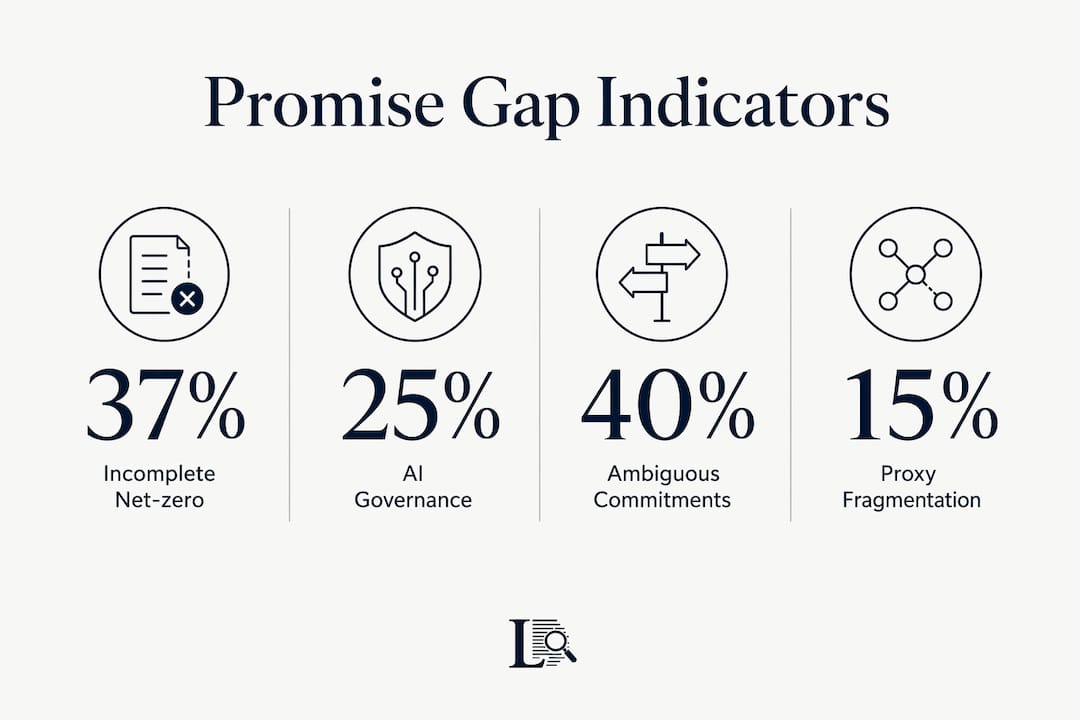
Only 25% of companies have fully operational AI governance programs, leaving transformation metrics without clear ownership. This pattern mirrors the broader promise gap problem: metrics exist, but no one is accountable for delivering them.
How are proxy advisors and institutional investors reshaping promise gap oversight?
The proxy advisory model is fragmenting, and that fragmentation creates new governance risk. Institutional investors are increasingly exercising independent judgment rather than deferring to advisory recommendations, requiring companies to engage each major investor with customized, evidence-based communication. The era of a single proxy advisor recommendation driving a shareholder vote is ending. That shift places greater demand on corporate governance teams to substantiate promises directly.
The fragmentation of governance stewardship creates a parallel risk: when no unified shareholder bloc enforces accountability, management faces less consistent pressure to close promise gaps. Fragmented oversight can allow delivery shortfalls to persist longer before triggering a governance response.
Governance teams navigating this environment need to account for three structural shifts:
- Proxy advisors are moving toward case-by-case assessment rather than uniform voting recommendations
- Large institutional investors are building internal stewardship teams that evaluate corporate promises independently
- Shareholder engagement must now be tailored to individual investor priorities rather than calibrated to a single advisory standard
A shareholder engagement checklist built around these three shifts provides a practical starting point for governance teams recalibrating their investor relations approach. Generic engagement strategies that worked under unified proxy advisory influence are no longer sufficient.
What governance strategies effectively reduce corporate promise gap risks?
Closing the aspiration-to-execution gap requires structural changes to governance processes, not incremental communication improvements. The following framework addresses the four gap categories identified earlier.
-
Implement evidentiary integrity systems. Every material public commitment must be traceable to a verification source before publication. LSE governance analysis confirms that evidence-based substantiation before disclosure is the primary defense against legal liability. This means audit trails, not just internal sign-offs.
-
Assign decision attribution for all disclosures. Each public statement requires a named owner who is accountable for its accuracy. Eliminating shadow approval workflows removes the accountability vacuum that regulators and plaintiffs exploit. Governance teams should treat corporate misrepresentation as a process failure, not a communication failure.
-
Conduct periodic promise delivery audits. Boards should review the status of material commitments on a defined schedule, comparing stated targets against disclosed performance data. Accountability benchmarks for peer companies provide a reference point for calibrating what constitutes acceptable delivery variance.
-
Build customized investor engagement programs. As proxy advisory influence fragments, direct engagement with institutional investors on promise delivery becomes a governance requirement. Engagement should be evidence-led, presenting verified performance data rather than narrative updates.
-
Integrate promise gap monitoring into board risk committees. The promise gap is a governance risk, not solely a communications or ESG risk. Boards that assign oversight of delivery gaps to a dedicated committee create a structural accountability mechanism that survives management turnover.
Pro Tip: Before any earnings call, run a structured review of prior-period CEO commitments against disclosed results. This practice surfaces delivery gaps before investors do, giving the board time to respond rather than react.
Governance teams that treat corporate transparency as a measurable output rather than a cultural aspiration are better positioned to detect and close promise gaps before they become legal or reputational events.
Key takeaways
Corporate promise gap governance risk is best managed through evidentiary integrity systems, decision attribution, and structured delivery audits applied consistently across all material public commitments.
| Point | Details |
|---|---|
| Define the gap precisely | The aspiration-to-execution gap is measurable from public disclosures alone, without insider access. |
| Sustainability gaps carry legal risk | 96% of climate-pledging firms show greenwashing indicators, shifting promise gaps from reputational to legal liability. |
| CEO promise failures have board consequences | Each additional broken CEO promise raises involuntary dismissal odds by approximately 22%. |
| Proxy advisory reliance is a fiduciary risk | Independent investor judgment now requires customized, evidence-based engagement beyond proxy advisor outputs. |
| Evidentiary integrity is the primary defense | Verifying claims before publication with traceable audit trails is the most effective mitigation against regulatory and legal exposure. |
The governance gap no one wants to own
After years of reviewing corporate disclosures, the pattern that stands out most is not the scale of the promises. It is the absence of any internal mechanism designed to track whether those promises were kept. Boards approve sustainability reports, earnings call scripts, and proxy statements with rigorous attention to legal language and far less attention to delivery accountability. The result is a governance structure that is technically compliant and substantively hollow.
The shift toward legal liability for unsubstantiated claims changes the calculus. Governance teams that treated promise gaps as a communications problem are now facing securities regulators and plaintiff attorneys who treat them as evidentiary problems. That distinction matters enormously. A communication problem is solved with better messaging. An evidentiary problem is solved only with documentation, attribution, and a verifiable audit trail.
The uncomfortable reality is that most governance frameworks were not designed to track promise delivery at all. They were designed to approve disclosures. Closing the promise gap requires building a parallel system that monitors what was said, verifies what was done, and assigns accountability for the difference. That system does not exist in most organizations today. The boards that build it first will carry materially lower governance risk than those that wait for a regulatory event to force the issue.
— Glen
How Lacunaindex helps governance teams measure promise delivery
Governance professionals who need an objective measure of corporate promise delivery have a direct resource in Lacunaindex.
Lacunaindex applies forensic analytics to public records including earnings calls, SEC filings, press releases, and proxy statements to quantify the gap between what companies say and what they deliver. The platform classifies companies into accountability archetypes and produces execution scores that governance teams and institutional investors can use to assess delivery risk without relying on management-supplied narratives. The Lacuna report guide explains the methodology in detail, and sector benchmarks provide peer-level context for evaluating promise gap exposure across industries. For governance teams building a systematic approach to promise accountability, Lacunaindex offers the evidentiary foundation that internal processes alone cannot provide.
FAQ
What is corporate promise gap governance risk?
Corporate promise gap governance risk is the discrepancy between a company's public commitments and its verified performance, creating exposure to regulatory action, legal liability, and board accountability failures. Governance professionals use the term "aspiration-to-execution gap" to describe the same concept with forensic precision.
What are the most common types of executive promise accountability gaps?
The four main types are strategic ambiguity gaps, sustainability promise gaps, proxy advisory accountability gaps, and communication approval gaps. Each carries a distinct risk profile and requires a different governance response.
How do proxy advisors affect corporate promise accountability?
Institutional investors are increasingly exercising independent judgment rather than relying solely on proxy advisor recommendations, requiring companies to engage investors directly with verified performance data. The SEC has flagged vote-all proxy reliance as a potential fiduciary duty breach.
What indicators signal a corporate promise delivery gap?
Key indicators include net-zero pledges without Scope 3 emissions coverage, vague CEO earnings call commitments with no measurable targets, and public disclosures lacking traceable decision attribution. These signals are detectable from publicly available filings before any external audit.
How does Lacunaindex measure the promise gap?
Lacunaindex mines public records including SEC filings, earnings call transcripts, and press releases to produce execution scores and accountability archetypes that quantify the distance between corporate narrative and actual delivery. The methodology relies entirely on publicly available information and requires no insider access.