
Corporate disclosure integrity is defined as the veracity, completeness, and transparency of information that public companies report to investors, regulators, and the market. The industry term for this practice is "disclosure quality," and both phrases describe the same foundational requirement: that reported information accurately reflects underlying business reality. Regulatory frameworks like the Sarbanes-Oxley Act (SOX) and the G20/OECD Principles of Corporate Governance treat disclosure integrity as a non-negotiable condition for investor protection and market efficiency. When companies engineer their narratives to outpace their actual delivery, the aspiration-to-execution gap widens, and capital allocation decisions built on those narratives become structurally unsound. Lacunaindex exists precisely to measure that gap, using only publicly available records.
What regulatory frameworks enforce corporate disclosure integrity?
The Sarbanes-Oxley Act of 2002 is the primary statutory foundation for disclosure integrity in U.S. public markets. SOX compliance requires management to certify the accuracy of financial statements and maintain effective internal controls, with auditor attestation confirming those controls annually. A material weakness in internal controls must be disclosed publicly, which creates a direct accountability mechanism between operational reality and reported information. The consequence of non-compliance is not merely regulatory censure. It exposes executives to personal criminal liability, which concentrates the incentive to report accurately.

The G20/OECD Principles of Corporate Governance define transparency as quality, clarity, and accessibility in disclosures, not simply the act of publishing information. This distinction matters. A company can technically disclose material facts while burying them in 400-page proxy statements written in opaque legal language. The OECD framework treats such opacity as a failure of transparency, even when the letter of the law is satisfied. Governance professionals who apply this standard evaluate whether disclosures are genuinely usable by investors, not merely technically present.
The SEC's antifraud rules, particularly Rule 10b-5, extend disclosure obligations beyond scheduled filings to any public statement that could mislead investors. Earnings call transcripts, press releases, and investor day presentations all fall within this scope. The practical implication is that corporate transparency principles apply across the full communication surface of a public company, not only to 10-K and 10-Q filings.
- SOX Section 302: CEO and CFO must personally certify the accuracy of each periodic report.
- SOX Section 404: Management and external auditors must assess and report on internal control effectiveness annually.
- Rule 10b-5: Prohibits material misstatements or omissions in any connection with the purchase or sale of securities.
- G20/OECD Principles: Define transparency as an accountability mechanism requiring quality and accessibility, not just volume.
Pro Tip: When reviewing a company's disclosure posture, cross-reference the SOX 404 auditor opinion with the narrative in the MD&A section. Divergence between auditor findings and management tone is a reliable early signal of disclosure opacity.
How is disclosure integrity measured and assessed in digital and ESG reporting?
The Metadata Incoherence Score (MIS) is a quantitative framework that measures disclosure integrity in digital corporate reports by assessing three dimensions: completeness, consistency, and semantic coherence. MIS ranges from 0 to 15, where 0 represents full compliance and 15 represents maximum deficiency. A high MIS score signals that a company's digital filings contain structural errors, missing fields, or internally contradictory data points. These are not cosmetic problems. They indicate that the underlying reporting process lacks the controls needed to produce reliable disclosures.
The format of a digital filing directly affects its MIS score. Machine-readable formats like XHTML/XBRL produce significantly lower incoherence scores than PDF-based reports because they enforce structured data entry and enable automated integrity checks. A PDF narrative allows a company to present numbers in prose without tagging them to a standardized taxonomy, which makes cross-period and cross-company comparison unreliable. Regulators and institutional investors increasingly require XBRL tagging precisely because it reduces the discretion companies have to present data selectively.
| Reporting Format | Metadata Coherence | Automated Integrity Check | Cross-Period Comparability |
|---|---|---|---|
| PDF narrative | Low | Not possible | Difficult |
| XHTML/XBRL tagged | High | Possible | Reliable |
| Hybrid (PDF + XBRL) | Moderate | Partial | Limited |
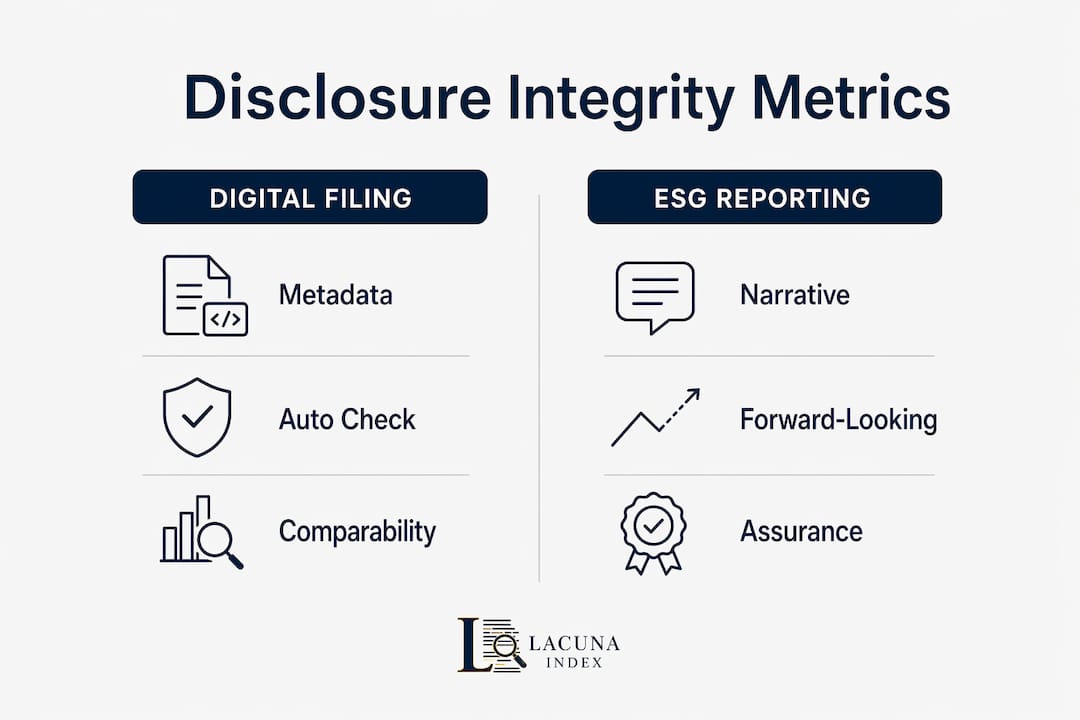
ESG disclosures present a distinct measurement challenge. Unlike financial statements, ESG reports often contain forward-looking narratives and qualitative claims that resist direct verification. Third-party assurance focused on Scope 1 and Scope 2 emissions represents the current best practice for verifiable ESG metrics, but it covers only a fraction of the total ESG disclosure surface. Governance professionals should treat unassured narrative ESG content with the same skepticism applied to unaudited pro forma financials.
Pro Tip: Use the MIS framework as a diagnostic screen before conducting deeper fundamental analysis. A company with a high MIS score on its XBRL filings warrants additional scrutiny of its internal control environment before you rely on its reported figures.
What is the practical importance of maintaining high disclosure integrity for investors?
High disclosure integrity reduces the probability of financial restatements, which are among the most costly events in a public company's reporting history. Research analyzing 2,386 U.S.-listed firms shows that companies with higher ESG scores are statistically less likely to restate financial statements. The interpretation is direct: firms that invest in governance discipline, including ESG oversight, tend to build the internal control infrastructure that prevents material reporting errors. ESG performance functions as a proxy for the broader organizational rigor that produces reliable disclosures.
Investors rely on disclosure consistency across filings to calibrate risk and allocate capital. When a company's earnings call narrative diverges from its 10-K risk factors, or when segment reporting changes without explanation, the aspiration-to-execution gap becomes visible. These divergences are not always intentional misrepresentation. They can reflect poor internal coordination between investor relations, legal, and finance teams. The effect on investor confidence, however, is the same regardless of intent.
The consequences of disclosure failure extend well beyond regulatory fines:
- Restatement risk: Financial restatements trigger immediate stock price declines and invite SEC investigation.
- Litigation exposure: Securities class actions frequently cite disclosure failures as the primary cause of action.
- Reputational damage: Institutional investors apply governance screens that penalize companies with disclosure deficiencies, reducing access to capital.
- Valuation mispricing: Markets that price a company on engineered narratives rather than delivered results create a correction risk that materializes when the gap closes.
Governance professionals who validate corporate claims in public disclosures before relying on them for investment decisions protect both their portfolios and their fiduciary obligations.
What are the nuanced challenges and emerging trends in disclosure integrity?
The current regulatory environment presents a specific structural challenge: deregulatory pressure is shifting more disclosure responsibility from mandatory frameworks to voluntary ones. Voluntary disclosure environments increase litigation and antifraud risks because companies retain more discretion over what they communicate, and investors have fewer guaranteed data points for comparison. The practical response for analysts is to treat voluntary disclosures as marketing materials until independently verified, not as equivalents to mandated filings.
Regulatory bifurcation in carbon accounting creates a second layer of complexity. In markets like India, the divide between business responsibility disclosure requirements and carbon market compliance rules produces underdisclosure and legal liability from inconsistent methodologies. A company may report Scope 1 emissions under one regulatory framework and carbon credits under another, with no reconciliation between the two. Analysts who accept either figure in isolation risk building models on incompatible data.
The following practices represent the current standard for managing disclosure integrity risk in a complex regulatory environment:
- Cross-reference mandatory and voluntary disclosures. Compare what a company files with the SEC against what it publishes in sustainability reports. Gaps between the two reveal where management exercises maximum discretion.
- Apply the MIS framework to digital filings. Screen XBRL data for completeness and consistency errors before relying on reported figures for valuation models.
- Prioritize third-party assured metrics. Weight ESG data points that carry independent assurance more heavily than unverified narrative claims.
- Monitor regulatory bifurcation risk. For companies operating across multiple jurisdictions, identify where carbon or ESG reporting methodologies differ and quantify the reconciliation gap.
- Track restatement history. A company with prior restatements carries elevated disclosure risk regardless of current auditor opinions. Historical patterns predict future control quality.
The regulatory oversight gaps that emerge from voluntary disclosure environments require analysts to build independent verification into their standard due diligence process, not treat it as optional.
Key Takeaways
Corporate disclosure integrity requires veracity, completeness, and transparency across all public communications, enforced by SOX, the G20/OECD Principles, and SEC antifraud rules, and measurable through frameworks like the Metadata Incoherence Score.
| Point | Details |
|---|---|
| SOX is the compliance baseline | SOX Sections 302 and 404 mandate certified financial accuracy and audited internal controls for all U.S. public companies. |
| MIS quantifies digital disclosure quality | The Metadata Incoherence Score measures completeness, consistency, and semantic coherence in digital filings on a 0–15 scale. |
| ESG scores predict restatement risk | Firms with higher ESG scores are statistically less likely to restate financials, making ESG a proxy for reporting discipline. |
| Voluntary disclosures carry elevated risk | Deregulatory shifts increase investor monitoring obligations because voluntary frameworks lack mandatory verification requirements. |
| Format determines verifiability | XHTML/XBRL filings enable automated integrity checks that PDF-based reports structurally cannot support. |
Why disclosure integrity is the analyst's most underused edge
The market prices most companies on the assumption that their disclosures are roughly accurate. That assumption is wrong more often than consensus models account for. In my experience working through public filings, the most revealing signals are rarely in the headline numbers. They appear in the gap between what management says on an earnings call and what the 10-K risk factors quietly acknowledge three months later.
The shift toward voluntary ESG disclosure has made this gap wider and harder to detect. Companies now have more latitude to shape their narrative without triggering a technical disclosure violation. That latitude is not neutral. It systematically favors management over investors in the information asymmetry equation. Analysts who treat voluntary sustainability reports with the same rigor they apply to audited financials will find more mispricing than those who accept the narrative at face value.
Digital reporting formats are genuinely improving the situation, but unevenly. XBRL adoption has made cross-period comparison more reliable for financial data. ESG data remains largely unstructured, narrative-heavy, and resistant to the kind of automated coherence checking that MIS enables for financial filings. The governance professionals who will perform best in this environment are those who build systematic verification into their process before they build a model, not after.
The governance red flags that predict disclosure failures are identifiable in public records. The question is whether analysts have a systematic method to find them at scale.
— Glen
Lacunaindex: forensic disclosure analysis at scale
Lacunaindex applies a consistent, evidence-based methodology to measure the gap between what public companies claim and what their public records actually show. The platform mines earnings calls, SEC filings, press releases, and proxy statements to produce execution scores and classify companies as earned, borrowed, or undervalued based on delivery versus narrative.
For financial analysts and governance professionals who need to assess disclosure quality across a sector, Lacunaindex provides sector-specific benchmarks that contextualize individual company performance against peer delivery standards. The methodology requires no insider access. Every finding derives from the same public records available to any investor, applied through a systematic forensic process that removes the subjectivity from narrative assessment. Explore the Lacunaindex platform to see how execution scoring works across your coverage universe.
FAQ
What is corporate disclosure integrity?
Corporate disclosure integrity is the requirement that public companies report financial and operational information that is accurate, complete, and transparent. Regulatory frameworks like SOX and the G20/OECD Principles define and enforce this standard.
How does SOX enforce disclosure integrity?
SOX Sections 302 and 404 require executives to certify financial statement accuracy and mandate annual auditor assessment of internal controls. Material weaknesses must be publicly disclosed, creating direct accountability between reported information and operational reality.
What is the Metadata Incoherence Score?
The Metadata Incoherence Score is a quantitative measure of digital disclosure quality, ranging from 0 (full compliance) to 15 (maximum deficiency), assessing completeness, consistency, and semantic coherence in corporate filings.
Why are ESG disclosures harder to verify than financial statements?
ESG disclosures contain narrative, forward-looking content that resists direct verification. Third-party assurance currently focuses on high-impact metrics like Scope 1 and Scope 2 emissions, leaving the majority of qualitative ESG claims unverified.
How does deregulation affect disclosure integrity risk?
Voluntary disclosure environments increase investor monitoring obligations because companies retain more discretion over what they communicate. Investor adaptation to deregulation requires treating voluntary disclosures as unverified until independently assessed.