
A corporate archetype classification maps what a public company says against what it actually delivers, then assigns a reproducible label: Earned, Borrowed, or Undervalued. Lacuna Index builds these labels entirely from public records, including SEC filings, earnings call transcripts, proxy statements, and press releases, scoring the distance between narrative and execution rather than relying on insider access or analyst sentiment.
For institutional users, the classification does two things immediately:
- Screen faster. Filter a coverage universe by archetype before allocating research hours to full forensic review.
- Prioritize engagement. Route governance questions and proxy-vote scrutiny toward companies flagged Borrowed rather than treating every holding equally.
Key Takeaways
Corporate archetype classification works because it forces every claim of "Earned" delivery to trace back to a specific, verifiable public disclosure rather than an analyst's impression.
| Point | Details |
|---|---|
| Three archetypes, three actions | Earned lowers scrutiny discount, Borrowed raises engagement priority, Undervalued flags a screening opportunity. |
| Evidence traceability is the differentiator | Every score should link to a specific filing, transcript, or proxy statement line, not an unverifiable composite. |
| Trend beats snapshot | Multi-period ROIC and execution trends matter more than any single strong or weak quarter. |
| Labels start hypotheses, not verdicts | Combine archetype signals with direct engagement and third-party checks before acting. |
| Lacuna Index applies this method directly | Its forensic reports score execution and narrative gaps from public records, with free sector benchmarks as an entry point. |
Table of Contents
- What Do the Earned, Borrowed, and Undervalued Archetypes Mean?
- How Is the Classification Built From Public Records?
- Which Metrics Actually Signal Delivery Risk?
- How Should Investors and Governance Teams Use These Labels?
- What Are the Limits of a Public-Records-Only Approach?
- Why a Forensic Archetype Lens Matters for Long-Term Capital Allocators
- See Your Coverage Universe Through Execution Scores and Sector Benchmarks
- Frequently Asked Questions
- Sources
What Do the Earned, Borrowed, and Undervalued Archetypes Mean?
Each archetype describes a relationship between what management communicates and what the record shows the company actually did.
Earned companies show disclosure that tracks delivery closely over multiple periods. Guidance lands where promised, capital allocation decisions match stated priorities, and proxy language rarely contradicts operational results. The investor implication is straightforward: these firms deserve a lower scrutiny discount and can support engagement focused on strategy rather than credibility.
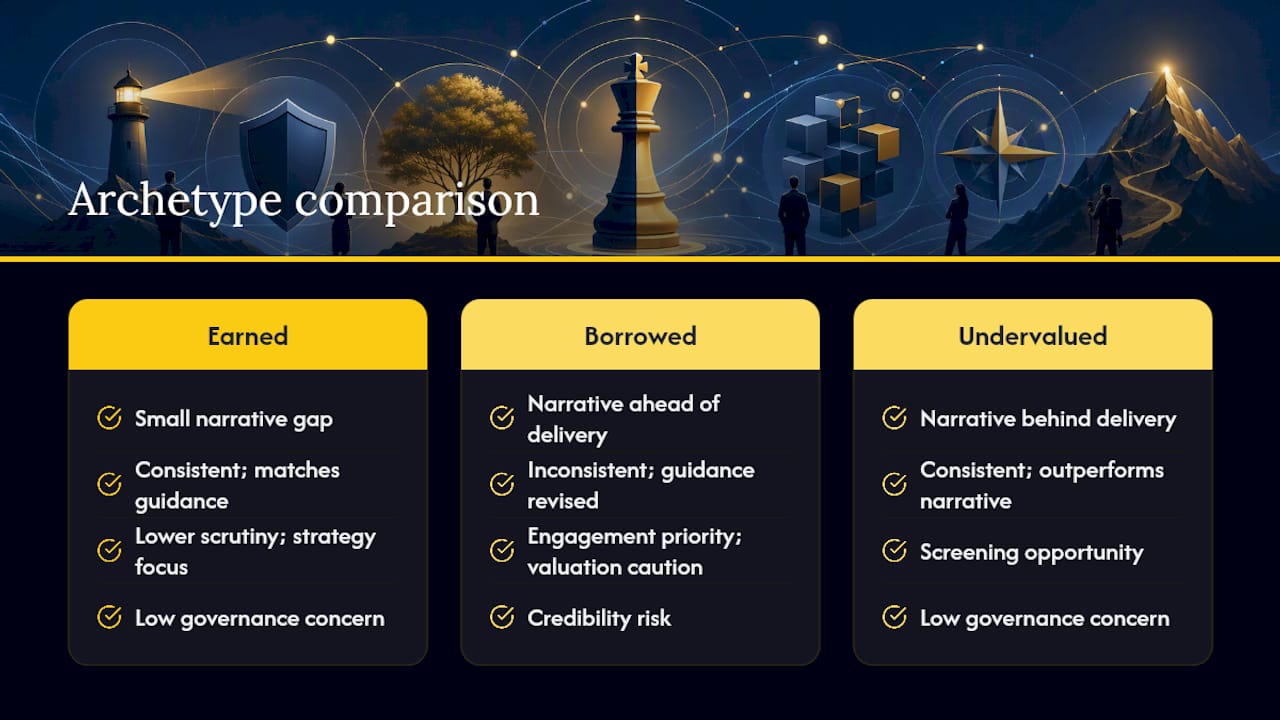
Borrowed companies show a narrative running ahead of delivery. Earnings calls emphasize ambition and framing; the underlying filings show repeated guidance revisions, vague risk-factor language, or execution metrics that lag stated targets. A useful anonymized example: a scale-up software firm that touts "record bookings" on calls while cash conversion and net retention quietly deteriorate across successive 10-Qs. The investor implication is engagement priority and valuation caution, since the perception gap between story and lived performance tends to close eventually, usually at the market's expense rather than management's.
Undervalued companies show delivery that outpaces their public narrative. Founder-led firms sometimes underplay results in earnings calls out of conservatism, and the disclosure record shows consistent execution the market has not yet repriced. Consider a founder-led industrial firm with understated investor communications but steady return on invested capital gains for several straight years. The implication here is a screening opportunity, not a governance concern.
Pro Tip: Do not read an archetype label as a static verdict. Pull the trailing four quarters of filings behind the score. An Undervalued label built on one strong year is a different signal than one built on a five-year execution trend.
How Is the Classification Built From Public Records?
The methodology follows a sequential flow, and each step generates evidence that traces back to a specific filing or transcript line.
- Data ingestion. The system pulls SEC filings (10-K, 10-Q, 8-K), earnings call transcripts, proxy statements, and press releases for the covered company and its sector peers.
- Signal extraction. Text and figures are parsed into two streams: narrative claims (what management says it will do or has done) and delivery data (what the filings and financials actually show).
- Indicator scoring. Each stream feeds quantitative indicators, an execution score and a narrative score, that together produce the narrative-versus-delivery gap.
- Archetype assignment. The gap, combined with trend direction, determines whether a company lands in the Earned, Borrowed, or Undervalued category.
- Evidence linking. Every component score attaches to the specific disclosure item that generated it, so a reviewer can trace a low execution score back to, say, a specific guidance cut disclosed in an 8-K filed eighteen months earlier.
Evidence traceability is the feature that separates forensic scoring from a sentiment model.
Public-record sources vary in traceability. SEC EDGAR filings carry the strongest audit trail since they are legally attested. Earnings call transcripts and press releases carry less legal weight but reveal tone and framing that filings alone don't. Sector benchmarks and multi-year historical baselines normalize both scores, since a 12% execution score in a capital-intensive sector like utilities means something different than the same score in software.
Pro Tip: When two companies in the same sector show identical narrative scores but diverging execution scores, check whether one benefited from a one-time item (asset sale, tax credit) inflating short-term delivery data. Trend consistency matters more than a single strong quarter.
Which Metrics Actually Signal Delivery Risk?
A Lacuna-style report surfaces a handful of indicators worth scanning before reading the full narrative.
- Execution score: a composite of delivered results against stated targets across recent reporting periods.
- Narrative-versus-delivery gap: the numeric distance between what leadership claims and what the record confirms.
- Disclosure consistency index: how often risk-factor language, guidance, and proxy statements contradict each other period to period.
- Recurring guidance misses: a count of consecutive periods where stated targets were revised downward.
- Cash-flow and ROIC trends: multi-period return on invested capital, checked for direction rather than a single snapshot.
- Governance red-flag counts: auditor changes, related-party transaction disclosures, or unusual proxy-statement language.
Read these directionally, not as absolute cutoffs. ROIC screens commonly use a threshold around 15% as a rough quality marker, but a single-period figure above that line means far less than a five-year trend holding steady above sector median. Moat-based analysis reinforces this: sustained high ROIC alongside switching costs or network effects is a stronger signal than a temporary spike, and context and trend analysis matter more than any single ratio. A capital-intensive sector's "good" ROIC baseline differs meaningfully from a software company's, so cross-sector comparison without normalization routinely misleads.
How Should Investors and Governance Teams Use These Labels?
Treat the archetype as a starting hypothesis, not a final verdict, and build it into repeatable process.
- Screen the universe. Tag holdings and watchlist candidates by archetype quarterly, flagging any label change since the prior period.
- Prioritize engagement. Route Borrowed-labeled companies to the top of the governance team's outreach queue ahead of proxy season.
- Structure due diligence questions. When a Borrowed label appears, ask management directly why guidance was revised three times in six quarters, and ask the audit committee what independent verification exists for disclosed execution metrics.
- Weight proxy votes. Use disclosure consistency and governance red-flag counts as a factor when evaluating say-on-pay or board-nominee support.
When you open a report, scan in this order:
- Top evidence links tied to the lowest-scoring indicators first.
- The execution score trend line over the last four to eight quarters.
- The narrative-versus-delivery gap and whether it is widening or closing.
What Are the Limits of a Public-Records-Only Approach?
No forensic method built solely on disclosures is complete, and professionals should treat labels as one input among several.
- Disclosure availability and timing lag mean a label can trail real-time operational change by a full reporting cycle.
- Sector-specific measurement issues mean some indicators (particularly ROIC) require different baselines across industries.
- False positives and negatives happen when a company under-discloses for legitimate competitive reasons yet still delivers.
Mitigate each by triangulating with management's historical track record, third-party vendor checks, and direct engagement rather than treating a label as automatic sell or buy logic. Automated trading decisions built solely on an archetype shift, or headlines that flatten "Borrowed" into "fraud," both misuse a tool meant for hypothesis generation.
Pro Tip: Treat a fresh archetype change as a trigger for a research call, not a trading signal on its own.
Why a Forensic Archetype Lens Matters for Long-Term Capital Allocators
Capital compounds fastest when it follows delivery, not story quality. Builders earn durable advantage through disciplined capital allocation that shows up in the record over years, not one earnings call. Audit-traceable scoring and sector benchmarks give allocators a way to verify that discipline rather than take it on faith.
See Your Coverage Universe Through Execution Scores and Sector Benchmarks
Lacuna Index turns the workflow above into a subscription product built for exactly this reader: forensic reports with execution and narrative scores, evidence links traced to specific filings, and sector benchmarks that normalize comparisons across peers.
Institutional users can start with the free sector benchmarks to see how execution and narrative scores compare across a given industry before committing to a subscription. For a walkthrough of how to interpret a full report, including how evidence links attach to specific disclosure items, the Lacuna user guide breaks down each output section. Institutional subscribers, proxy advisors, and financial journalists can request a sample company report to see the archetype methodology applied to a name already on their coverage list.
Frequently Asked Questions
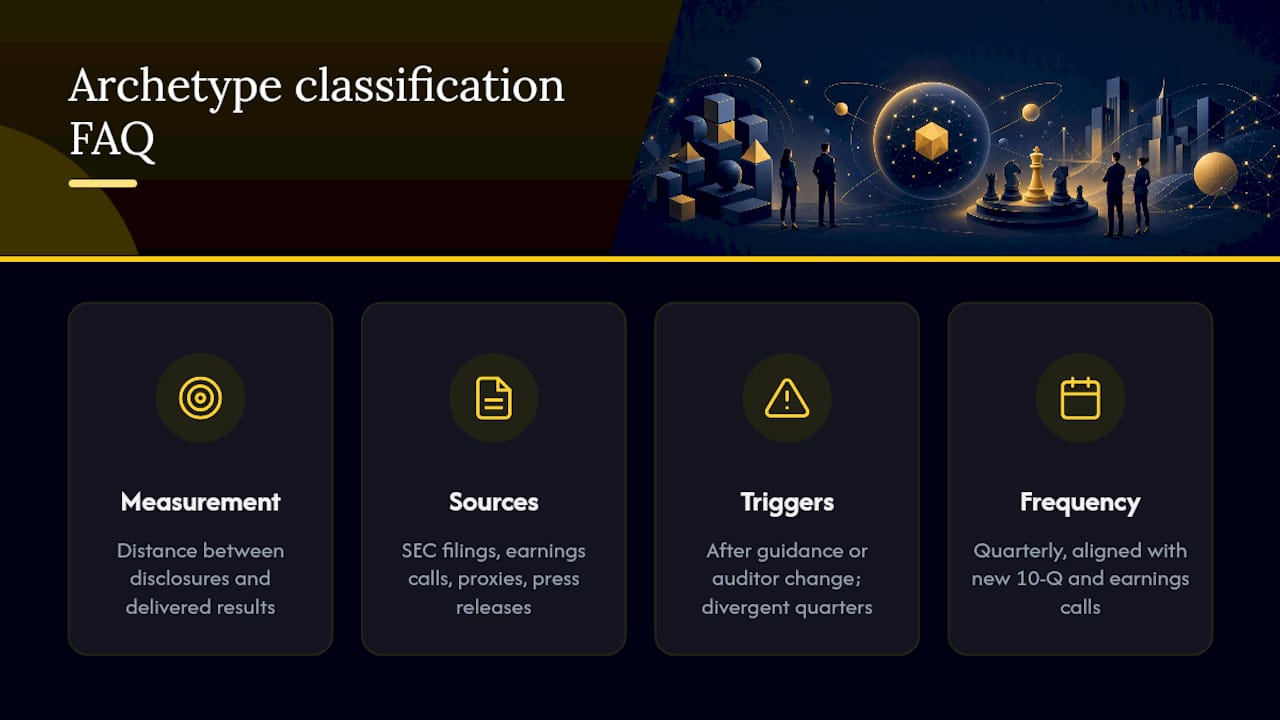
What does a corporate archetype regulatory classification explained approach actually measure? It measures the distance between what a company discloses in filings, calls, and proxy statements and what its financial results show it delivered, then assigns an Earned, Borrowed, or Undervalued label based on that gap and its trend.
Does this classification rely on insider information or analyst forecasts? No. It draws exclusively from public records, SEC filings, earnings call transcripts, proxy statements, and press releases, which is what makes the evidence trail auditable.
Can an archetype label change quickly? Yes, particularly after a guidance revision, an unexpected auditor change, or several consecutive quarters of execution data diverging from prior narrative. Treat any shift as a prompt for deeper review.
Is a Borrowed label the same as a fraud finding? No. It signals that disclosed narrative currently outpaces delivered results, which can stem from overly optimistic guidance rather than misconduct. It warrants scrutiny and engagement, not an automatic assumption of wrongdoing.
How often should institutional teams re-check archetype labels? Quarterly, aligned with new 10-Q and earnings call releases, since each filing cycle can shift the execution score and narrative gap materially.
This article is general information, not a substitute for advice from a qualified financial advisor. Consult a qualified financial professional about your own circumstances before acting on anything here.
Sources
- What Is a Perception Gap? The Complete Guide | Platonic — Blog of Paul Syng
- Enduring lessons from Builders (Morgan Stanley / Counterpoint Global)