
A capital allocation narrative is the explanation a company gives, and financial professionals demand, for where cash goes and why. It is credible only when it names explicit trade-offs, attaches time bounds to each investment phase, and defines objective milestones that would trigger a change of course. Absent those three markers, the narrative is marketing, not strategy.
TL;DR:
- Companies that lack clear milestones or explicit trade-offs in their capital allocation narratives risk appearing as marketing efforts rather than genuine strategies.
- Market valuation often penalizes firms when their actual spending diverges from their stated priorities, especially if the narrative does not align with observable actions like capex, hiring, or milestones met.
- Effective narratives prioritize high-potential segments with measurable timing and milestones, and tie funding to these objectives with transparent kill criteria.
- Monitoring macroeconomic factors like interest rate changes and inflation is essential, as they can invalidate original investment assumptions and require recalibration of the story.
- Analyst scrutiny increases when public disclosures consistently show alignment between claims and actual spend, particularly through milestones, with tracking tools aiding objective verification.
Table of Contents
- Why the Capital Allocation Narrative Is the Real Strategy Statement
- Core Components of an Effective Capital Allocation Narrative
- Metrics and Decision Criteria That Separate Claims From Execution
- Structuring the Narrative for Investors and Stakeholders
- A Forensic Checklist for Verifying the Narrative Against Public Records
- How Capital Allocation Narratives Evolved Into Today's Equity Story
- Why Investors Treat the Narrative as a Confidence Signal
- Weaving ESG and Sustainability Into the Allocation Story
- What Successful and Failed Narratives Teach About Delivery
- How Macroeconomic Conditions Reshape the Allocation Story
- Why Allocation Rarely Matches the Official Strategy
- Verify the Narrative With Lacuna Index
- Sources
- FAQ
Why the Capital Allocation Narrative Is the Real Strategy Statement
Capital allocation is the process of deciding how a company's cash gets distributed across competing uses. The narrative is the explanation management offers for that process, and the two frequently diverge. A CEO can describe an "innovation-first" strategy on an earnings call while capital expenditure data shows flat R&D spend and rising buyback authorizations. Spending is truth in a way rhetoric never is, because a budget line cannot be spun after the fact once the fiscal year closes and the 10-K files. HBS Online's framing of the resource allocation process argues that funding decisions reflect a company's actual profit formula, which can systematically favor high-margin initiatives even when leadership claims otherwise.
Investors and analysts watch a handful of recurring allocation actions, including how mergers and acquisitions allocate intangible assets such as brands and goodwill, which affects the overall capital distribution strategy: Acquisto ramo di azienda: allocare marchi e avviamento - Coviello Marchi Brevetti.
- Organic investment (capex, R&D, headcount) signals confidence in internal growth, but only if paired with measurable capacity or output targets.
- Mergers and acquisitions reveal whether management prefers to build or buy, and at what multiple discipline breaks down.
- Debt paydown suggests balance-sheet caution or a response to rising rates.
- Dividends commit to a payout investors will punish the company for cutting.
- Buybacks return cash but can also mask a lack of attractive internal projects.
Markets re-price companies around capital intensity because each of these choices carries a different risk and return profile, and analysts treat mismatches between stated priority and actual spend as a warning sign.
Core Components of an Effective Capital Allocation Narrative
A narrative earns credibility through structure, not adjectives. Five components separate a testable capital management strategy from a slide full of aspirational language.
- Strategic prioritization. The company states explicitly where capital is going, in rank order, and why those segments beat the alternatives. BCG's 2026 analysis of roughly 600 multi-business companies found that the strongest allocators concentrate investment in high-potential segments rather than spreading funds evenly across business units.
- Magnitude and timing. Every investment phase carries a dollar range and a duration. A narrative that says "we are investing in AI infrastructure" without a timeframe cannot be tested.
- Milestones and kill criteria. Funding releases in tranches tied to objective checkpoints, with a defined condition under which the company would stop.
- Trade-off clarity. The narrative names what was NOT funded. Reinvestment, buybacks, dividends, and cash reserves are competing uses, and a credible story shows the reasoning behind the split.
- Governance and incentive alignment. Executive compensation ties to the same metrics the narrative promotes, not to a separate set of short-term targets.
McKinsey's framework for reallocation reduces this to three questions: where to invest, how much to move, and how to implement the shift, each requiring an analytical baseline rather than instinct.
Pro Tip: Ask for the kill criteria before you ask for the growth story. A management team that cannot name the condition under which it would halt a project usually has not modeled the downside at all.
Metrics and Decision Criteria That Separate Claims From Execution
Numbers convert a capital allocation narrative from opinion into a testable hypothesis. Four metrics carry the most weight in that test.
- ROIC (return on invested capital) measured against the WACC (weighted average cost of capital). A project narrative that does not clear this spread is destroying value even when revenue grows.
- Free cash flow trajectory across the guided investment window, not just a single quarter's snapshot.
- NPV (net present value) of flagship projects, when disclosed, which shows whether management's own math supports the story.
- Execution signals: hiring patterns, capex cadence, and whether funding actually arrives in the staged tranches the narrative described.
Guidance ranges matter more than point estimates. A wide range paired with clear leading indicators (utilization rates, backlog growth, unit economics) suggests management is hedging honestly. A narrow range with no supporting indicator often signals a forecast built for effect.
A well-documented inefficiency runs the other way, too. Research published in Springer found that many enterprises using traditional, non-optimized allocation methods, rather than analytical models, suffer material value loss. That finding cuts against any narrative that leans on tradition or "how we've always funded projects" as justification.
Red flags cluster around the same pattern: forecasts that never show a downside case, missing baseline comparisons, and guidance that shifts every quarter without a matching change in the underlying business.
Structuring the Narrative for Investors and Stakeholders
A capital allocation narrative that survives analyst scrutiny follows a consistent sequence rather than scattering claims across a deck.
- State the claim. One sentence: where capital is going and the strategic reason.
- Show the plan. Dollar ranges, phases, and duration for each major investment.
- Name the milestones. Specific, dated checkpoints that trigger continued funding or a pivot.
- Attach the metrics. ROIC targets, free cash flow expectations, and the return threshold the project must clear.
- Disclose the trade-offs. What was deprioritized, and why.
IR Impact's analysis of the current investor climate argues that capital allocation has become the primary equity story in sectors dominated by heavy infrastructure spending, and that investors now demand clarity on capex mix, duration, and the leading indicators tying spend to eventual returns.
Earnings commentary should carry the same discipline: break out capex mix, state which phase of the investment cycle the company is in, and attach the guardrails that would change the plan. Q&A preparation benefits from scenario ranges rather than single-point answers.
Pro Tip: Internal capital committees and external investor decks should use the same evaluation criteria. When the finance team optimizes for one set of metrics internally while IR presents a different framing externally, the mismatch surfaces eventually, usually during a downturn when someone finally asks for the reconciliation.
A Forensic Checklist for Verifying the Narrative Against Public Records
Verification does not require insider access. Earnings call transcripts, SEC filings, proxy statements, and press releases contain enough detail to test whether spending matches the story, provided someone builds the evidence log properly.
- Compare guided capex ranges against actual reported capex across at least four consecutive quarters.
- Track hiring announcements against the segments the narrative claims are the priority.
- Log every milestone the company has stated publicly, with the date it was due and whether it was met.
- Flag repeated narrative shifts (a "growth phase" becoming a "consolidation phase") that lack a corresponding change in headcount, capex, or segment reporting.
- Note any staged-funding claim that lacks a disclosed kill criterion.
Analysts building this log by hand can use a structured verification spreadsheet as a starting template, and a systematic version of this process underlies how Lacuna Index's methodology converts public disclosures into a delivery score.
How Capital Allocation Narratives Evolved Into Today's Equity Story
Capital allocation used to live in the footnotes. Through most of the twentieth century, annual reports treated capex and dividend policy as bookkeeping detail, disclosed because regulation required it, not because investors demanded a story around it. Warren Buffett's Berkshire Hathaway letters, starting in the 1970s, were among the earliest widely read documents to argue that how a company allocates capital is the single clearest measure of management quality, a position considered unusual at the time.
The framing shifted again during the private equity boom of the 1980s and 1990s, when leveraged buyouts made capital structure itself a strategic weapon rather than a passive constraint. Activist investors in the 2000s and 2010s pushed the conversation further, forcing companies to defend buyback-versus-reinvestment decisions in public letters rather than boardrooms.
The current phase, driven by capital-intensive infrastructure cycles in sectors like semiconductors, cloud computing, and energy transition, has made the allocation narrative central to the equity story itself rather than a supporting detail. IR Impact's analysis frames this directly: heavy infrastructure spend now requires the same narrative discipline that revenue guidance once demanded alone. A company that once could say "we are investing in the future" and move on now faces questions about capacity ramp, utilization assumptions, and payback period on every call.
Why Investors Treat the Narrative as a Confidence Signal
Markets price uncertainty, and an unclear capital allocation narrative reads as unpriced risk rather than neutral information. When a company cannot explain its own spending logic in specific terms, analysts assume the company itself may not have a clear one, and that assumption shows up in a wider valuation discount than the underlying fundamentals would justify on their own.
Industry commentary on capital allocation frames spending choices as the place where strategy becomes verifiable, since a stated priority that never receives budget was never a real priority. Investors extend that logic to earnings calls: vague capex commentary triggers more follow-up questions, not fewer, and repeated vagueness compounds into a credibility discount that outlasts any single quarter's results.
The inverse holds too. Companies that consistently tie spend to milestones and hit them earn a form of narrative capital, a reserve of investor trust that buys patience during a rough quarter. BCG's research found that top capital allocators, defined by their willingness to concentrate investment and reallocate actively rather than fund every unit equally, achieved measurably higher returns on invested capital than peers who spread capital evenly. That performance gap becomes a market signal in its own right once analysts start tracking it across cycles, and it explains why activist campaigns increasingly target allocation discipline specifically rather than operational efficiency alone. A narrative that survives multiple quarters of scrutiny without revision becomes self-reinforcing: each accurate milestone lowers the market's discount rate on the next one.
Weaving ESG and Sustainability Into the Allocation Story
Sustainability commitments have become a formal line item in the capital allocation narrative rather than a separate disclosure. Boards now face direct questions about how much capex supports emissions reduction, renewable infrastructure, or supply-chain resilience, and analysts increasingly expect that spend to carry the same milestone structure as any other investment category.
The risk is treating ESG capital as exempt from the discipline applied elsewhere. A company that announces a decarbonization target without attaching a dollar figure, a timeline, or a measurable interim checkpoint is making the same unverifiable claim that a vague growth narrative makes, just wrapped in different language. The same test applies: does the spend show up in capex disclosures, does hiring in sustainability-linked roles track the stated priority, and does the company report progress against a fixed baseline rather than a moving one.
Governance frameworks that tie executive compensation to sustainability metrics need the same scrutiny given to financial incentive structures. If a bonus formula rewards a target that requires no real trade-off, the ESG narrative functions as marketing rather than allocation. Applying the same ROIC and milestone-gating discipline used for traditional capex, rather than a softer standard, is what separates a genuine sustainability allocation strategy from a disclosure exercise designed to satisfy a rating agency questionnaire.
What Successful and Failed Narratives Teach About Delivery
The clearest lesson from companies that get capital allocation right is concentration paired with follow-through. Businesses that state a narrow set of priorities, fund them in stages, and report against the same milestones quarter after quarter tend to earn analyst trust that compounds, because each accurate checkpoint reduces the market's need to discount future guidance.
The clearest lesson from failure is almost always the same pattern in reverse: a narrative that shifts framing (a "growth investment" becomes a "strategic repositioning" becomes a "cost discipline initiative") without a corresponding change in headcount, capex, or segment structure. When the label changes but the spend does not, or when the spend changes but the stated reason never gets revisited, the mismatch eventually surfaces in a earnings call where an analyst asks the reconciliation question directly and management has no clean answer.
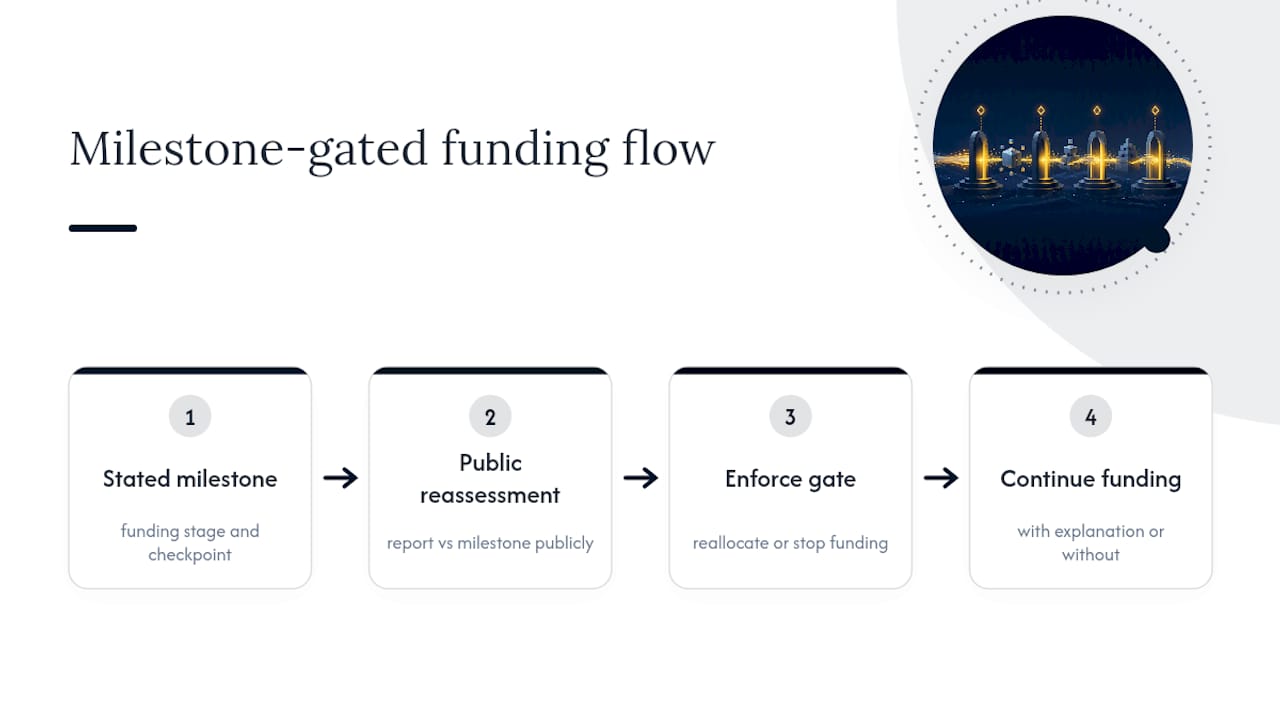
A second recurring failure mode involves kill criteria that exist in theory but never trigger in practice. A project that was supposed to be reevaluated at a specific milestone continues receiving funding past that date with no public explanation, which tells analysts the gating mechanism was never real. The synthesis of consulting research on milestone-gated funding suggests that the discipline of actually enforcing a kill criterion, not merely stating one, is what separates companies that reallocate capital efficiently from those that let sunk cost drive every subsequent decision.
How Macroeconomic Conditions Reshape the Allocation Story
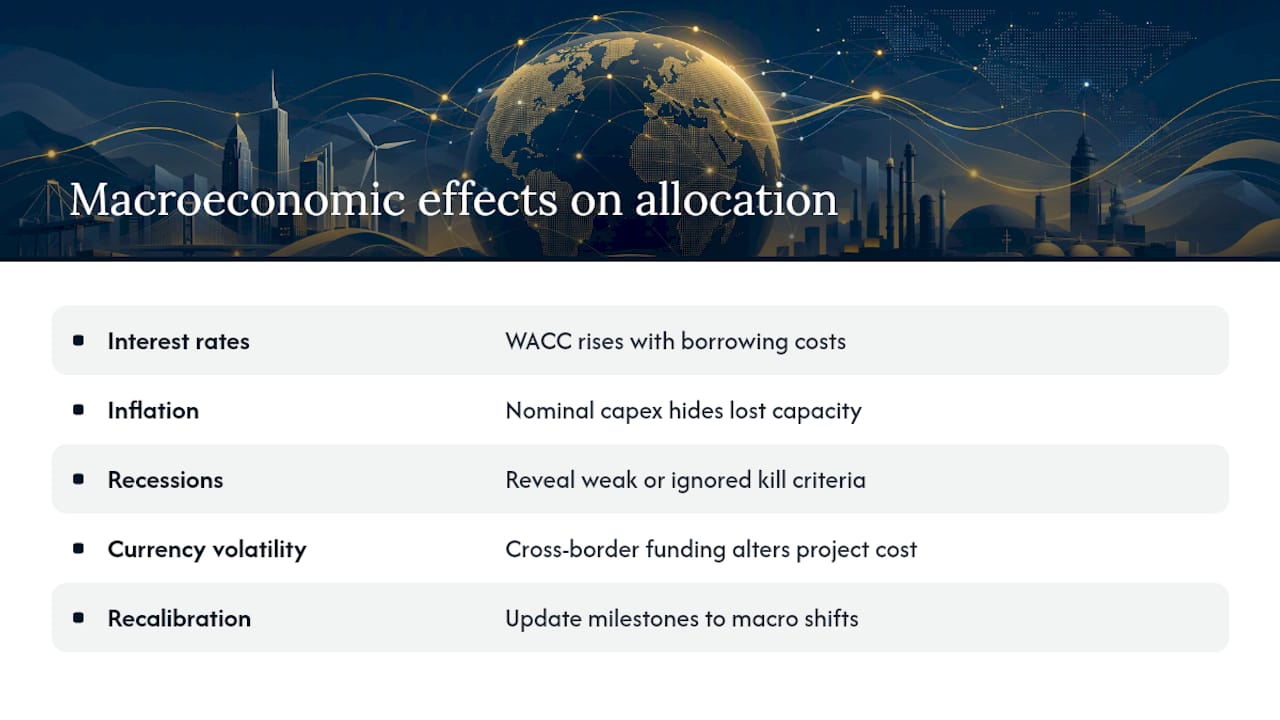
Interest rate cycles change the math behind every capital allocation decision, because WACC moves directly with borrowing costs. A project narrative built during a low-rate period can fail its own return threshold once rates rise, even if nothing about the underlying business changed. Companies that fail to revisit their stated hurdle rate as conditions shift are effectively running an outdated narrative on new economics.
Inflation complicates the comparison between guided capex and actual capex, since a company can technically hit its dollar-denominated spending target while buying meaningfully less capacity than the narrative implied. Analysts increasingly ask for unit-based metrics (capacity added, square footage built, chips produced) rather than dollar figures alone, precisely because inflation erodes the informational value of a nominal number.
Recessions and demand shocks are the real test of kill criteria. A narrative that survives a downturn without triggering any of its stated stop conditions either had criteria set too loosely to matter, or the company is ignoring its own governance framework under pressure. Currency volatility adds another layer for multinational allocators, since a capital plan denominated in one currency can shift materially in relative cost when funded across borders. None of this invalidates the underlying discipline. It simply means the milestones and thresholds embedded in a credible narrative need periodic recalibration against the macro environment, not a one-time setting at the moment of announcement.
Why Allocation Rarely Matches the Official Strategy
Incentive structures, not intent, explain most of the gap between stated strategy and actual spend. Promotion cycles reward managers who deliver visible wins within a fiscal year, which pushes capital toward short-payback projects even when the official narrative promises long-horizon investment. Boards rarely correct for this because the KPI framework that drives bonuses is set separately from the strategic narrative presented to investors, and few governance committees reconcile the two.
Decentralized capital committees with real milestone gating tend to produce more honest allocation than centralized approval processes dominated by whoever tells the most persuasive story. Gating restores optionality: capital can be redirected the moment a project misses a checkpoint, rather than staying locked in because canceling it would embarrass whoever championed it. Boards and management teams that want their narrative to hold up under scrutiny should start by auditing whether their internal incentive metrics match the external claims, before touching a single slide in the investor deck.
— Glen
Verify the Narrative With Lacuna Index
Reading the checklist above is one thing. Applying it across dozens of holdings, every quarter, against filings that run hundreds of pages, is another problem entirely. There are forensic analytics platforms that quantify the distance between what a company claims about its capital allocation and what its public disclosures actually show, using only earnings calls, SEC filings, proxy statements, and press releases, with no reliance on insider access.
For analysts tracking milestone slippage or narrative drift across a coverage list, per-company forensic reports translate scattered filings into an execution score and a documented evidence trail. Governance teams evaluating board-level oversight can start with free sector benchmarks to see how a company's delivery pattern compares against its peers before committing to a deeper review. The Cohort Pulse and Sector Sweep subscriptions give institutional teams ongoing access to that scoring rather than a one-time snapshot. Start with the sector benchmarks for your coverage universe, then request access to the full report for any company whose narrative deserves a closer look.
Sources
- Optimization of financial resource allocation using management information systems and linear programming models
- How the Best Companies Allocate Capital in 2026 | BCG
- Where, how much, and how: Answering the hardest questions of resource allocation
- Understanding the Resource Allocation Process | HBS Online
- Why capital allocation is the new equity story in the AI era - IR Impact
FAQ
What does "capital allocation" mean?
Capital allocation is the process of deciding how a company distributes its available cash among competing uses, including organic investment, acquisitions, debt paydown, dividends, and buybacks. The choices a company actually makes, more than any stated policy, reveal its real strategic priorities.
What are the different types of capital allocation?
The main categories are organic growth investment (capex, R&D, hiring), mergers and acquisitions, debt reduction, dividend payments, and share buybacks. Each carries a different risk profile and signals a different confidence level in internal versus external opportunities.
What is the 12/20/80 rule?
This is not a standardized capital allocation framework, and definitions vary widely depending on the source. Rather than cite an unverified rule, evaluate any allocation plan against concrete tests: ROIC versus WACC, staged milestones, and disclosed trade-offs.
What is another word for "capital allocation"?
Common alternatives include capital distribution, financial resource allocation, and capital management strategy. Investor relations materials also use "capex strategy" or "investment thesis" depending on context, though each term carries slightly different emphasis.
How can I verify a company's capital allocation narrative?
Compare guided capex against actual reported spend across several quarters, track whether hiring matches the stated priority segments, and check whether disclosed milestones were actually met on schedule. Platforms like Lacuna Index automate this comparison using public filings, converting scattered disclosures into a documented execution score.