
Systematic accountability scoring is defined as an objective, consistent method for evaluating organizational governance and transparency by mapping stated corporate claims against measurable, documented delivery. The benefits of systematic accountability scoring extend well beyond compliance checklists. The Governance Accountability Score framework quantifies the degree to which firms align operational behavior with stated mandates, while the AIR transparency framework establishes auditable standards for institutional disclosure. Together, these approaches give investors, analysts, and governance professionals a repeatable, evidence-based lens for assessing corporate performance. Lacunaindex applies this methodology by mining SEC filings, earnings calls, proxy statements, and press releases to measure the aspiration-to-execution gap with no reliance on insider access.
1. Benefits of systematic accountability scoring through automation and AI
Automated scoring removes the two largest sources of error in traditional governance review: reviewer fatigue and inconsistent rubric application. When scoring runs on a defined algorithm rather than a rotating panel of analysts, the same criteria apply to every disclosure, every quarter, without drift.

The efficiency gains are measurable. Automated goal tracking improves goal attainment efficiency by 30% by enabling early intervention and eliminating manual grading overhead. That gain comes from the system's ability to flag divergence from stated targets within days rather than at quarter-end.
AI-generated quality scores show 86.7% agreement with expert assessments and outperform traditional ranking methods in 75% of cases. This means an AI-generated accountability score can serve as an early, unbiased signal before slower human review cycles complete.
- Automated scoring applies identical rubric weights to every document in the corpus
- Early divergence flags allow governance teams to intervene before a gap widens
- Elimination of reviewer fatigue removes the score drift that accumulates across long review cycles
- AI signals arrive before peer review latency, giving analysts a timing advantage
Pro Tip: Set your automated scoring model to flag any company whose execution score drops more than 10 points quarter-over-quarter. That threshold catches narrative drift before it becomes a material disclosure risk.
2. Auditable evidence trails and transparent scoring
Intelligent scoring provides auditable evidence linking scores directly to source documentation, replacing subjective gut-based assessments with objective analytics. Every score component traces back to a specific filing, transcript line, or press release paragraph. An analyst can verify any sub-score within seconds rather than reconstructing a judgment call from memory.
This traceability matters because institutional investors increasingly require systematic transparency measurement as a condition of fiduciary due diligence. A score without a source trail is an opinion. A score with a source trail is evidence.
"Building an auditable evidence trail transforms accountability evaluation from subjective judgment to transparent, instant analytic verification. When every score links to its source, the methodology becomes the argument."
Open rubric frameworks prevent the "black-box" distrust that causes scoring models to be abandoned. When stakeholders can inspect the weights assigned to disclosure frequency, language consistency, and forward guidance accuracy, they can challenge and validate the model rather than simply accepting or rejecting its output.
- Scores trace to specific document locations, not aggregate impressions
- Open weights allow governance boards to audit the scoring logic itself
- Transparent rubrics reduce adversarial compliance by making the evaluation criteria visible
- AIR transparency audits cost approximately £20,000–30,000 annually for 50–100 documents, making systemic transparency economically viable at scale
3. Trend evaluation and longitudinal consistency
Accountability is shown through trend lines, not isolated snapshots. A single strong earnings call does not establish accountability. A pattern of consistent delivery across eight consecutive quarters does. The effectiveness of accountability systems depends on tracking sustained behavioral patterns rather than point-in-time metrics.
Longitudinal scoring separates performative accountability from genuine ownership. A company that scores well once after a governance crisis but reverts to prior disclosure patterns within two quarters is not accountable. The trend line exposes that reversion in a way that a snapshot score cannot.
Systematic scoring enables this distinction through three mechanisms:
- Behavioral consistency tracking monitors whether a company applies the same disclosure standards across multiple reporting periods, not just when under regulatory scrutiny.
- Improvement trajectory measurement records whether execution scores move directionally toward stated targets over time, distinguishing genuine progress from one-time corrections.
- Ownership attribution links specific score changes to identifiable management decisions, such as a CFO transition or a revised forward guidance policy, rather than treating score movement as unexplained variance.
This longitudinal view is where corporate promise gap analysis becomes most useful. A widening aspiration-to-execution gap over six quarters signals a structural governance problem, not a temporary miss.
4. Core advantages for investors and governance professionals
The accountability score advantages that matter most to institutional investors fall into four categories: transparency, risk identification, regulatory readiness, and stakeholder communication.
Enhanced transparency is the foundational benefit. Standardized metrics across companies and sectors allow direct comparison of disclosure quality without adjusting for industry-specific reporting conventions. A corporate transparency metrics framework applied consistently across a portfolio produces comparable scores that support allocation decisions.
- Standardized scoring enables apples-to-apples comparison across sectors and market caps
- Early risk identification surfaces governance deterioration before it appears in financial statements
- Systematic documentation supports audit readiness and reduces regulatory response time
- Consistent scoring improves communication between boards, investors, and external auditors by establishing a shared factual baseline
Risk mitigation is the second major advantage. Systematic scoring identifies disclosure opacity, forward guidance accuracy decay, and language consistency failures before they become material events. An analyst tracking regulatory oversight gaps can use execution scores to prioritize which companies warrant deeper forensic review.
Regulatory compliance benefits from systematic documentation. When every score links to a source filing, the evidence trail satisfies audit requirements without additional reconstruction work. Governance professionals can produce a complete scoring history for any company in the portfolio on demand.
Stakeholder communication improves when boards and investors share a common scoring vocabulary. Disagreements about corporate performance shift from subjective interpretation to score-based discussion grounded in public records.
5. Challenges and best practices in implementation
The most common failure mode in accountability scoring is post-hoc weight adjustment. Adjusting scoring model weights after observing outcomes introduces cognitive bias and destroys the objectivity that makes the model credible. Weights must be set before the scoring run, not calibrated to produce a preferred result.
| Practice | Approach |
|---|---|
| Weight adjustment timing | Set weights before scoring; never adjust after observing outcomes |
| Model update cadence | Update rubrics quarterly with documented rationale for each change |
| Score explainability | Link every score component to a traceable source document |
| Metric selection | Track 5–15 leading activity metrics weekly rather than lagging financial results |
| Black-box risk | Publish scoring weights and rubric criteria to maintain stakeholder trust |
Transparent, living scoring models updated quarterly with traceable links to source data maintain stakeholder trust and consistent accuracy. A model that never changes is not credible. A model that changes without documentation is not trustworthy. The discipline is in updating with full transparency.
Metric selection is equally critical. Leading indicators such as weekly activity metrics are more actionable and predictive than lagging financial metrics in accountability scorecards. Governance professionals who score only on revenue outcomes miss the behavioral signals that precede those outcomes by two to four quarters.
Pro Tip: Maintain a scoring model changelog that records every rubric adjustment, the rationale behind it, and the date it took effect. This log becomes your primary defense against claims of score manipulation.
Effective accountability scorecards monitor 5–15 leading metrics weekly to enable real-time governance adjustments. That cadence gives governance teams enough data to distinguish a one-week anomaly from a structural trend.
Key takeaways
Systematic accountability scoring produces measurable, auditable, and comparable governance insights that no subjective review process can replicate at scale.
| Point | Details |
|---|---|
| Automation drives efficiency | Automated scoring improves goal attainment by 30% and removes reviewer fatigue from the process. |
| Auditability builds trust | Every score must trace to a specific source document to replace subjective judgment with verifiable evidence. |
| Trends reveal true accountability | Longitudinal scoring over multiple quarters distinguishes genuine delivery from performative compliance. |
| Leading metrics outperform lagging ones | Track 5–15 weekly activity indicators rather than quarterly financial outcomes for real-time governance signals. |
| Weight discipline preserves objectivity | Scoring weights must be set before observation and updated only with documented rationale. |
Why accountability scoring is reshaping governance culture
My view, after years of working with forensic analytics and governance data, is that the most underappreciated benefit of systematic accountability scoring is not efficiency or comparability. It is the cultural shift it forces inside organizations that know they are being scored.
When a company understands that its disclosure language, forward guidance accuracy, and execution consistency are being tracked quarter-over-quarter against a defined rubric, the incentive structure changes. Boards begin asking different questions. CFOs choose their language more carefully. Investor relations teams stop treating earnings calls as narrative exercises and start treating them as scored events.
That shift is not compliance. It is governance culture. Scoring systems that are transparent, consistent, and publicly accessible create accountability pressure that no regulatory filing requirement alone can generate. The accountability scoring in governance literature increasingly supports this view, and I expect fiduciary duty frameworks to formalize it within the next regulatory cycle.
The next frontier is integration into investment mandates. Institutional allocators will begin requiring minimum execution scores as a condition of inclusion in governance-screened portfolios. When that happens, systematic accountability scoring will move from a research tool to a market-access criterion.
— Glen
Lacunaindex: forensic accountability scoring for institutional investors
Lacunaindex applies systematic accountability scoring to public companies using only SEC filings, earnings call transcripts, proxy statements, and press releases. Every execution score traces to a specific document and a specific claim, producing the kind of auditable evidence trail that institutional due diligence requires.
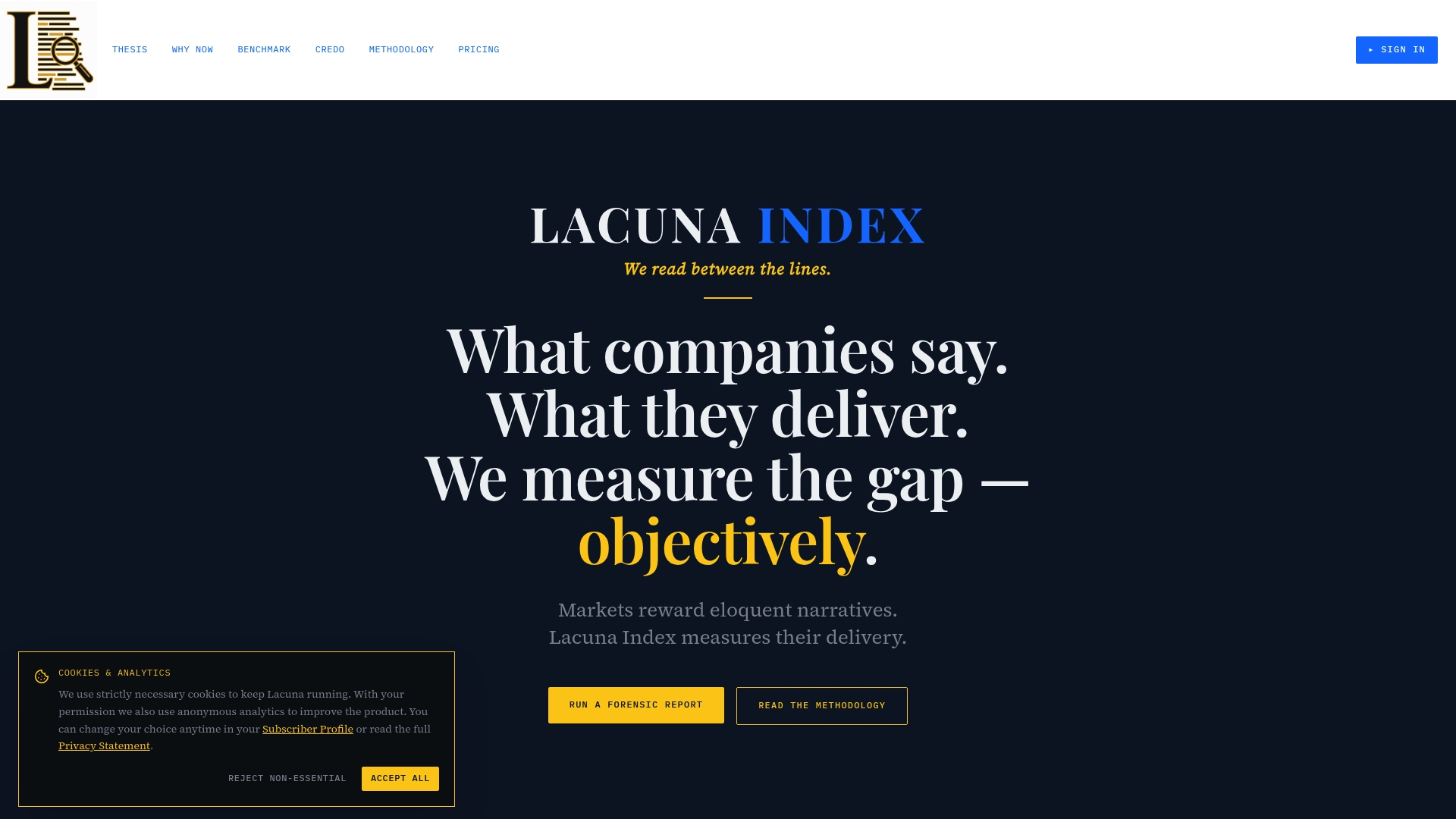
The platform's sector benchmarks allow investors and governance professionals to contextualize any company's execution score against its peer group, not just its own history. That comparative layer is where mispricing becomes visible. Lacunaindex classifies companies as earned, borrowed, or undervalued based on the gap between narrative and delivery, giving analysts a structured starting point for deeper forensic review. The Lacunaindex guide explains how to read each report component and interpret execution scores in the context of sector norms.
FAQ
What is systematic accountability scoring?
Systematic accountability scoring is an objective, repeatable method for evaluating organizational governance and transparency by mapping stated claims against documented delivery using standardized rubrics and auditable source trails.
How does accountability scoring help investors?
Accountability scoring gives investors a standardized, comparable metric for assessing disclosure quality and execution consistency across companies, enabling earlier identification of governance risk before it appears in financial statements.
What makes an accountability score auditable?
An accountability score is auditable when every sub-score links directly to a specific source document, such as an SEC filing or earnings call transcript, allowing any component to be verified independently within seconds.
How often should accountability scoring models be updated?
Scoring models should be updated quarterly, with each rubric change documented and rationale recorded, to maintain accuracy without introducing post-hoc bias that undermines scoring objectivity.
What is the difference between leading and lagging metrics in accountability scorecards?
Leading metrics, such as weekly disclosure frequency and language consistency, predict governance outcomes before they appear in financial results. Lagging metrics, such as quarterly revenue, confirm what has already occurred and offer no early warning signal.