
The correct way to assess board narrative vs outcomes is a reproducible, audit-traceable "talk–walk" assessment: code the specific claims management makes, link them to verifiable outcome metrics with an explicit time lag, and score the resulting gap. This is not a subjective read of tone. It is a measurable comparison, and the base rate of misalignment is high. One empirical validation using ASSET4 data on S&P 1500 firms found that a large majority of sampled firms showed some form of policy–practice decoupling between 2016 and 2022.
Lacuna Index builds its entire methodology around this gap, treating it as the primary signal for mispricing risk. The TCFD framework matters here because talk that references it correlates with measurable follow-through more often than generic disclosure language does.
- Pull the last two 10-Ks, the most recent 8-Ks, and three earnings call transcripts.
- Extract every claim that includes a metric, a baseline, and a date.
- Match each claim to a lagged outcome indicator, not a same-quarter one.
- Score the result and flag the archetype.
Pro Tip: Never score a claim against outcomes in the same reporting period it was made. Operational change takes quarters, sometimes years, to register in the data, and scoring on immediate output almost always overstates delivery.
Key Takeaways
Assessing board narrative against outcomes requires a reproducible, lagged, audit-traceable methodology, not a subjective read of tone or intent.
| Point | Details |
|---|---|
| Misalignment is common | Over 80% of a sampled set of S&P 1500 firms showed policy-practice decoupling in one empirical validation. |
| Anchor to mandatory filings | Treat 10-Ks and 8-Ks as the evidentiary base before crediting voluntary sustainability reports. |
| Lag structure is essential | Match immediate, medium, and long-term outcome metrics to the timeline the original claim specified. |
| Archetypes guide action | Storyteller and Decoupled patterns call for engagement or avoidance; Earned and Transitioning call for monitoring. |
| Commission the score | Lacuna Index produces execution and narrative scores with a published audit trail and free sector benchmarks. |
Table of Contents
- What Counts as Narrative and What Counts as Outcome?
- How Do You Build a Reproducible Talk–Walk Methodology?
- What Do the Archetype Results Actually Mean for Investors?
- What Makes a Talk–Walk Assessment Credible to an Institution?
- What Should Investors and Journalists Check First?
- How Does Lacuna Index Approach This Assessment?
- Why Talk–Walk Scores Are Evidence, Not a Verdict
- Get Sector Benchmarks and a Forensic Report From Lacuna Index
- Frequently Asked Questions
- Sources
What Counts as Narrative and What Counts as Outcome?
Narrative is anything management chooses to say about intent, plans, or progress. Outcome is what shows up, independently, in operational or financial records. Confusing the two, or worse, treating a repeated narrative claim as its own evidence, is the single most common error in surface-level ESG or governance research.
The narrative universe has a hierarchy. Mandatory filings, the 10-K and 8-K, sit at the top because they carry legal liability for false statements, which imposes real discipline on what gets written. Earnings call prepared remarks are scripted and closer to marketing copy. Unscripted Q&A sits below prepared remarks in polish but often above them in evidentiary value, since executives improvise and occasionally contradict the script. Sustainability reports, press releases, and proxy statements round out the set, each voluntary and each requiring more skepticism.
Outcome metrics need to trace back to something independently verifiable: operational KPIs like production volume, uptime, or recall rates; Scope 1 through 3 emissions where disclosed; safety incident rates; capital expenditure execution against stated plans; delivery and fulfillment data; and the revenue or margin trend tied to the specific claim being tested.
| Source Type | Typical Evidence Item | Verifiability Guidance |
|---|---|---|
| 10-K / 8-K (MD&A) | Stated targets, capex commitments | High — mandatory, legally attested |
| Earnings call Q&A | Unscripted clarifications, hedges | Medium to high — unscripted, harder to spin |
| Sustainability report | Emissions data, target dates | Medium — voluntary, verify against 10-K |
| Press release | Announcements, partnerships | Low to medium — promotional framing |
| Proxy statement | Compensation ties to targets | High — regulated disclosure |
Pro Tip: Always anchor a narrative claim to the closest mandatory disclosure element, typically the MD&A section, before treating a voluntary sustainability report as confirmation. The MD&A is where management explains what it chose to disclose, and what it skipped often carries as much signal as what it stated outright.
How Do You Build a Reproducible Talk–Walk Methodology?
A defensible assessment follows six steps, each documented well enough that another analyst could reproduce the score from the same public record.
Step 1: Define the claim set. A statement only counts as measurable if it contains a metric, a baseline, and a timeline. "We are committed to sustainability" is not a claim.
Step 2: Code the narrative into variables. Build a dictionary that tags operational claims, framework references (SBTi, TCFD, CDP, GRI), and rhetorical qualifiers such as "on track," "aspire," or "aim." Qualifiers matter because they signal confidence level, and firms that hedge heavily tend to cluster in lower-routinization archetypes.
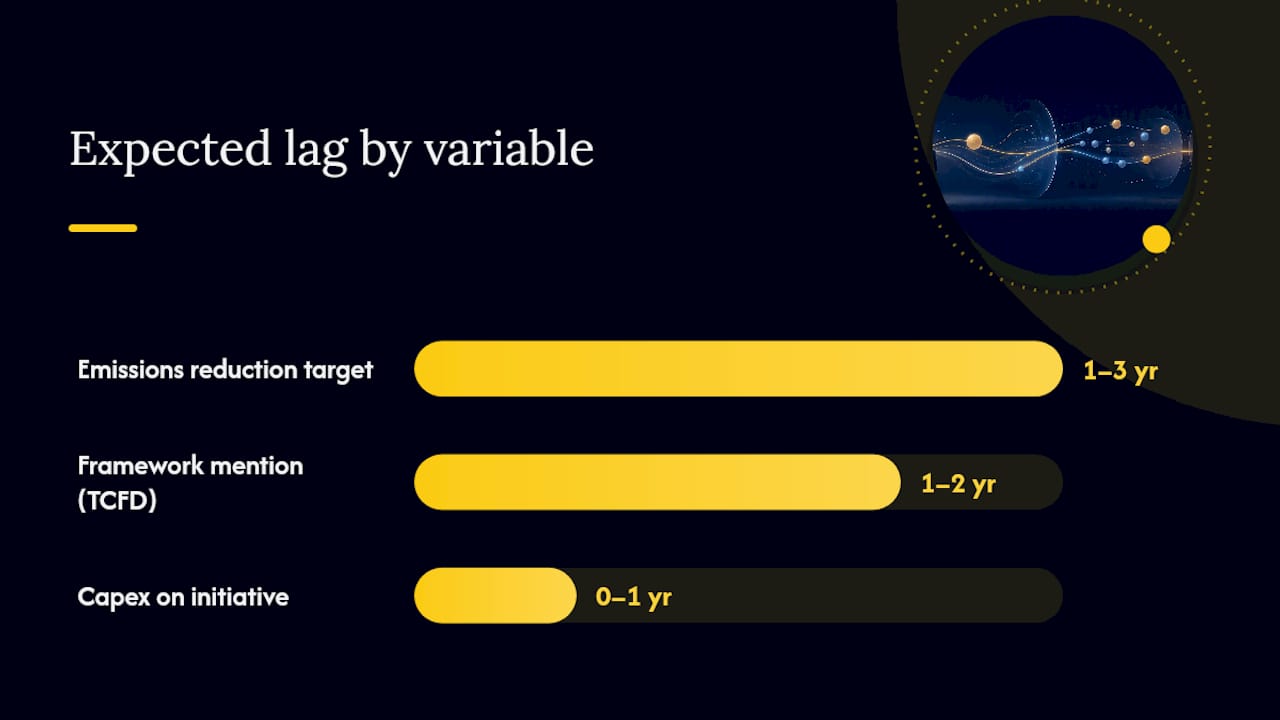
Step 3: Select outcome indicators and set the lag. Immediate outputs (quarterly KPIs) move fast; medium-term outcomes (year-over-year emissions) take one to two years; long-run transition metrics take three to five. Document which lag applies to which claim and why.
Step 4: Run the quantitative linkage. Use regression models or pre-specified directional comparisons with sensitivity bands, and report effect sizes rather than relying on a single point estimate.
Step 5: Score and classify. Produce a 0 to 100 execution score plus an archetype tag using fixed cutoffs decided before the analysis, not after seeing the results.
Step 6: Publish the audit trail. The dictionary, codebook, data sources, and model specification should all be available for someone else to check.
| Variable | Source | Verifiability | Expected Lag |
|---|---|---|---|
| Emissions reduction target | 10-K, sustainability report | Medium to high | 1–3 years |
| Capex on stated initiative | 10-K, 8-K | High | Immediate to 1 year |
| Framework mention (TCFD) | Earnings call, filings | High (disclosure exists) | 1–2 years for outcome |
| Safety/recall rate | Regulatory filings | High | Immediate |
Panel research on this exact question backs the lag requirement. A 5-year study of 593 large-cap firms found that "Storyteller" firms, those with low routinization and persistent talk–walk gaps, made up the largest single archetype over time, and that gap only became visible once outcomes were tracked across multiple years rather than one reporting cycle.
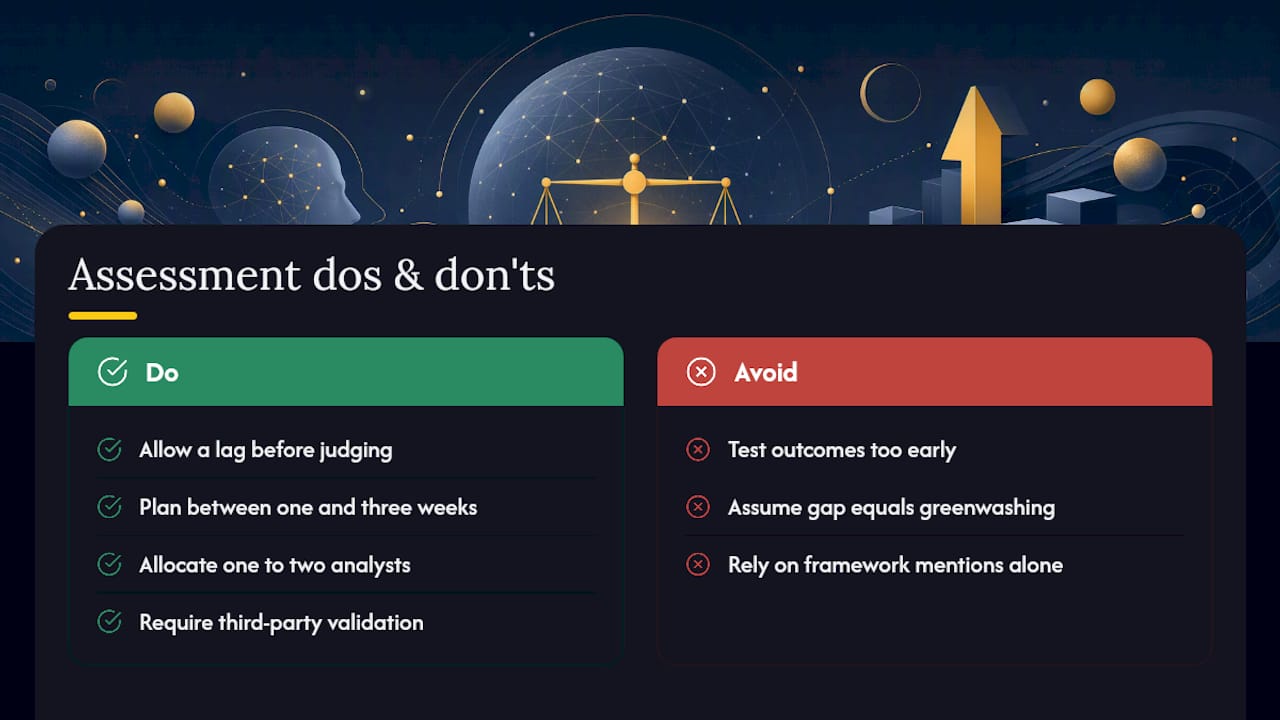
Pro Tip: When a company invokes TCFD, SBTi, or CDP by name, treat the mention as a directional signal only. Require third-party validation or an explicit operational disclosure before crediting it as genuine routinization rather than framework name-dropping.
What Do the Archetype Results Actually Mean for Investors?
Once scored, companies sort into four recognizable patterns, and each implies a different next step for an investor or governance professional.
- Earned: High walk, consistent talk. Targets are met or exceeded, operational linkage is clear, and third-party verification exists. Action: monitor for continuation, use as a sector benchmark comparator.
- Storyteller: High talk, low routinization. Frequent framework mentions with weak capex or process evidence behind them. Action: escalate to direct engagement and demand specificity on next earnings call.
- Decoupled / greenwashing risk: A sizable talk–walk gap combined with weak verifiability and no third-party audit. Action: treat as a short or avoid candidate pending further evidence, since narrative masking of this kind is often a deliberate disclosure strategy rather than simple error.
- Transitioning: Measurable routinization is underway, often with visible short-term margin or capex drag. Action: monitor with milestone gating rather than reacting to either the narrative or the near-term cost alone.
Pro Tip: Pair the archetype tag with a financial stress test before sizing any position change. A "Storyteller" classification alone tells you where to look, not how much capital to move.
What Makes a Talk–Walk Assessment Credible to an Institution?
Credibility rests on four pillars: a published codebook and dictionary so the coding rules are transparent, use of mandatory filings as the anchor rather than voluntary reports alone, third-party verification such as SBTi target approval, and a model specification detailed enough for someone else to rerun it.
Statistical discipline matters just as much as source selection. Lagged models, sensitivity bands, and reported effect sizes separate a defensible assessment from a narrative-reading exercise dressed up with a scorecard. One panel study found that TCFD-aligned talk correlated with statistically significant emissions reductions across several lagged model specifications, even though talk–walk correlations across the broader sample were mixed. That mix is itself the point: it justifies weighting specific, verifiable framework references higher than boilerplate ESG language.
- Heavy reliance on voluntary reports with no mandatory-filing anchor is a red flag.
- Missing baselines or ambiguous timelines should drop a claim out of the "measurable" bucket entirely.
- Undisclosed data imputation in any sustainability figure warrants a discount on verifiability.
What Should Investors and Journalists Check First?
A minimal desk review is achievable in one to three weeks with one or two analysts who can read financial filings and code text. Start by collecting the last two 10-Ks, the most recent 8-Ks, three earnings call transcripts, the latest sustainability report, the proxy statement, and any third-party certifications the company references.
- Confirm every headline claim includes a metric, a baseline, and a date.
- Check whether the claim ties to a capex line, a supplier commitment, or a process change, not just a statement of intent.
- Look for third-party validation, such as an SBTi-approved target or an outside audit.
- Verify the timeline stays consistent across filings from one year to the next.
Pro Tip: Insist on an audit trail that cites the exact filing section and transcript timestamp behind every coded claim. Without it, the score is an opinion with a number attached.
A full forensic assessment, the kind that supports a portfolio decision rather than a watchlist flag, takes longer and needs a broader skill mix: someone who can code text systematically, someone who understands accounting mechanics well enough to trace capex claims, and a domain specialist who knows the sector's typical lag structure. Structured checklists for qualitative filing analysis consistently produce more defensible output than ad hoc reading, largely because they force the same evidence standard onto every company in a sector.
- Deliverables for a single-company review: evidence log, execution score, archetype tag, and recommended next steps.
- Deliverables for a sector sweep: the same package for each firm plus a comparative benchmark table.
- Time budget for a desk review: roughly 20 to 40 analyst hours per company.
- Time budget for a full forensic report with third-party corroboration: several weeks, depending on filing volume and framework references to chase down.
Reading how public disclosures reveal management gaps before starting the review helps calibrate what a genuine gap looks like versus routine corporate hedging.
How Does Lacuna Index Approach This Assessment?
Lacuna Index runs this exact methodology as its core product: forensic, public-record analysis that produces an execution score, a narrative score, and an archetype tag for individual companies, built entirely from mandatory filings, earnings calls, press releases, and proxy statements, with no insider access involved.
- A commissioned report includes the underlying data sources, the coding dictionary, the scored outputs, and sector benchmark positioning.
- Scope options run from a single-company deep dive to a full sector sweep for comparability across peers.
- Every score carries a reproducible audit trail, so the reasoning behind a "Storyteller" or "Decoupled" tag is checkable, not asserted.
- Sector benchmarks provide the comparison baseline referenced throughout this methodology, including the identification of high-risk narrative companies before deeper review begins.
Pro Tip: Use the sector benchmark first to see where a company sits relative to peers before commissioning a full report. It tells you whether the gap you're worried about is company-specific or an industry-wide pattern.
Why Talk–Walk Scores Are Evidence, Not a Verdict
A high talk–walk gap is a flag, not a conviction. Misalignment sometimes reflects deliberate spin, but it can also reflect a genuine capability gap between what a board intends and what an organization can execute on the stated timeline, or a strategic choice to disclose ambition before operational systems catch up. Treating every gap as intentional deception overstates what the data can prove.
Industry variation matters more than most single-company analyses admit. Emissions data quality, especially Scope 3, varies enormously by sector, and lag structures that fit a manufacturer poorly fit a services firm. A twelve-month lag that catches a factory retrofit will miss a multi-year supply chain transition entirely.
The responsible use of a talk–walk score is as one input among several, triangulated with direct engagement outcomes, regulator filings, and independent third-party audits before it drives a large capital allocation decision. Scores answer "where should we look harder," not "what should we do next" on their own.
Get Sector Benchmarks and a Forensic Report From Lacuna Index
Running this methodology in house takes weeks and a mixed skill team. Lacuna Index compresses that work into a subscription product built specifically for institutional investors, governance professionals, and financial journalists who need a scored, audit-traceable answer rather than a raw filing pile to sort through themselves.
Every Lacuna Index report applies the same evidence hierarchy covered here: mandatory filings as the anchor, lagged outcome linkage, and a published codebook, so the score can be checked rather than taken on faith. Sector benchmarks are free to browse and give a quick read on where a company sits against its peers before you commit to a full company-level report, which is where the gated, in-depth scoring lives. Start by reviewing the sector benchmarks for the industry you're tracking, then request a tailored forensic assessment on the specific company where the gap looks worth escalating.
Frequently Asked Questions
What does it mean to assess board narrative vs outcomes? It means comparing specific, dated claims a board or management team makes in public disclosures against independently verifiable results, using a lag structure that gives the claim time to materialize before judging it.
How long does a basic assessment take? A desk-level review of a single company typically takes one to two analysts between one and three weeks, assuming the standard document set (10-Ks, 8-Ks, earnings calls, sustainability report, proxy statement) is readily available.
Why use a lag between the claim and the outcome measurement? Operational change rarely shows up in the same reporting period a commitment is announced. Testing outcomes too early tends to overstate delivery and produce false negatives on genuine transition efforts.
Is a talk–walk gap always evidence of greenwashing? No. A gap can reflect deliberate spin, but it can also reflect a genuine capability shortfall or a deliberate strategic sequencing where disclosure precedes operational capacity. The score identifies where to investigate further, not a final verdict.
What role do frameworks like TCFD or SBTi play in scoring? Framework mentions function as directional signals. They should carry more weight when paired with third-party validation, such as an SBTi-approved target, than when cited without operational follow-through.
Sources
- Are corporate climate efforts genuine? An empirical analysis of the climate talk–walk 2022
- Narrative masking and the strategic use of corporate disclosure (PMC article)
- ESG Policy–Practice Decoupling: A Measurement Framework and Empirical Validation