
A filing that shows unexplained material metric changes, contradictory narrative claims across MD&A and footnotes, or cross-reference mismatches warrants immediate escalation. The core principle is straightforward: treat any divergence between what management says and what the numbers show as a disclosure inconsistency until a documented, verifiable explanation exists. Analysts who apply this standard consistently will catch the majority of material reporting discrepancies before they compound into larger governance or investment failures.
Apply this initial checklist at the outset of any financial disclosure review:
- Unexplained material metric changes. Flag any period-over-period change of 10% or more in a key metric that lacks a corresponding MD&A explanation or footnote disclosure.
- Narrative contradictions across sections. Compare language in the MD&A, Item 8 footnotes, and the risk-factor section for adjective drift or contradictory characterizations of the same event.
- Cross-reference errors. Verify that note numbers, exhibit references, and defined terms are consistent throughout the filing and match the table of contents.
- Timing mismatches. Compare executive statements in earnings calls and press releases against the dates and language of subsequent SEC filings for divergence.
- Missing required disclosures. Check for omitted related-party disclosures, revenue recognition policy notes, and covenant waiver disclosures required under U.S. GAAP and SEC rules.
- ASC 606 disaggregation alignment. Reconcile MD&A revenue descriptions against the ASC 606 disaggregation table in the notes; unexplained category shifts are a primary red flag.
Lacunaindex applies a systematic forensic methodology to this process, extracting claims from earnings calls, SEC filings, and press releases and scoring them for contradiction against the filing record. The SEC and PCAOB both treat omitted or inconsistent required disclosures as material misstatements, which means the threshold for escalation is lower than many analysts assume.
Pro Tip: When triaging a large filing, prioritize issues where a numeric mismatch and a narrative contradiction co-occur in the same section. The combination is a far stronger signal of intentional obfuscation than either flag alone.

Table of Contents
- How do disclosure inconsistencies actually appear in filings?
- Why do inconsistencies happen? Motives, incentives, and strategic complexity
- What does the empirical evidence show about inconsistency detection?
- What detection techniques and red flags should analysts prioritize?
- What workflow should analysts follow when investigating inconsistencies?
- What are the U.S. audit and regulatory consequences of inconsistent disclosures?
- When are apparent inconsistencies actually legitimate?
- A forensic worked example using Lacunaindex methodology
- How should analysts communicate findings to committees and counsel?
- Key Takeaways
- The gap between detection and judgment
- Lacunaindex: forensic disclosure analysis for analysts and governance teams
- Useful sources and further reading
How do disclosure inconsistencies actually appear in filings?
Disclosure inconsistencies take four distinct forms, and each requires a different detection lens. Recognizing the form early determines which analytical tools to deploy and how quickly to escalate.
Tone and narrative inconsistencies are the most common and the most easily dismissed. A company might describe revenue performance as "moderate growth" in the risk-factor section while the CEO's letter to shareholders characterizes the same period as "accelerating demand." Neither statement is technically false, but the divergence signals that different authors drafted different sections without reconciling their characterizations. Practitioners find that the most dangerous inconsistencies are subtle narrative drifts across filing sections, where slightly different adjectives describe the same event, often indicating deliberate obfuscation rather than a drafting error.
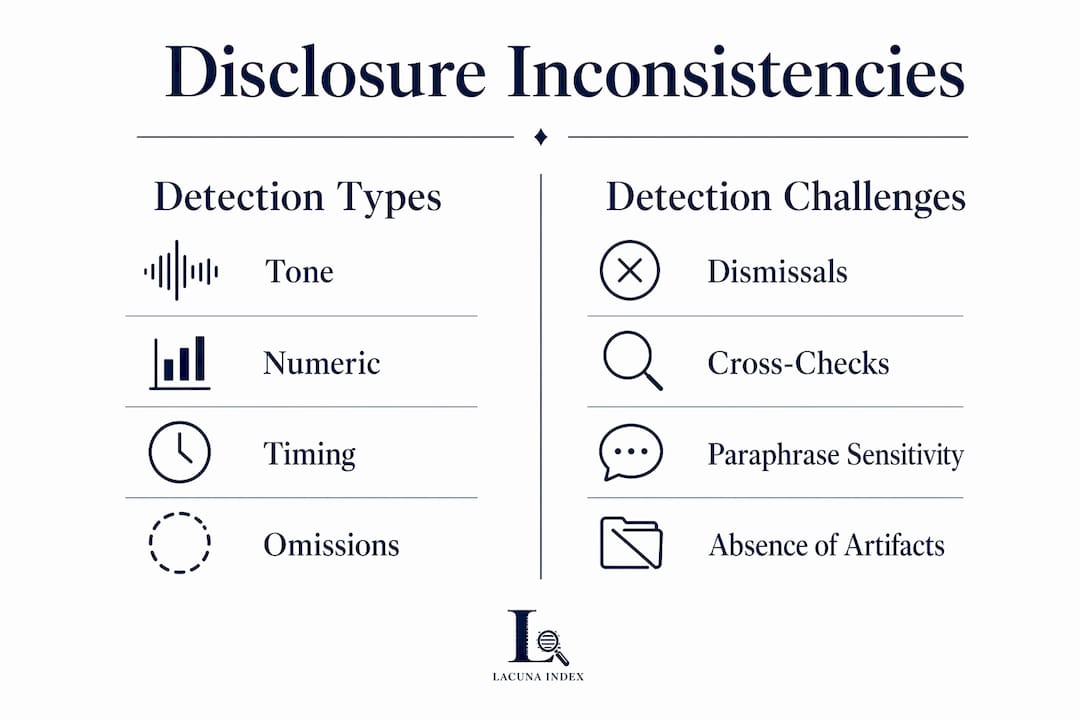
Numeric inconsistencies are structurally cleaner to detect but require cross-document reconciliation. A common pattern: the MD&A states that "software subscription revenue grew 18% year-over-year," but the ASC 606 disaggregation table in the footnotes shows the subscription line increasing by only 11%, with the remainder attributable to a professional services reclassification that is not mentioned in the MD&A. The gap is not a rounding difference; it is an undisclosed accounting policy change embedded in a footnote.
Timing and public-statement contradictions arise when an executive's earnings-call statement precedes a filing that tells a materially different story. Consider a CFO who characterizes a credit facility as "fully available and undrawn" on a Tuesday earnings call, while the 10-Q filed the following Friday discloses a covenant waiver obtained two weeks prior. The sequence is not coincidental; it reflects a disclosure management decision with potential SEC Rule 10b-5 implications.
Omissions are the hardest to detect because the absence of a disclosure leaves no textual artifact to compare. Analysts should check for missing related-party transaction notes, absent revenue recognition policy change disclosures, and omitted going-concern language when liquidity indicators deteriorate. The disclosure gaps that reveal management weaknesses are often structural rather than incidental.
Pro Tip: Build a disclosure checklist from the prior year's filing before reading the current one. Items present in the prior year but absent in the current year are omission candidates worth investigating immediately.
Why do inconsistencies happen? Motives, incentives, and strategic complexity
Disclosure inconsistencies are not uniformly accidental. Academic research distinguishes three causal categories: process failures, strategic complexity, and outright misrepresentation. Analysts who conflate these categories will either over-escalate benign drafting errors or under-weight deliberate obfuscation.
- Process failures. Multiple contributors drafting separate sections without a centralized validation step produce mechanical inconsistencies: stale cross-references, inconsistent defined terms, and adjective drift. These are correctable and generally not indicative of intent.
- Strategic complexity and signaling. Managers facing negative news may increase disclosure volume and complexity to obscure the signal. Research on strategic complexity in disclosure shows that managers deploy this tactic differentially depending on investor sophistication: less-sophisticated investor bases are more likely to encounter obfuscatory complexity when negative news exists.
- Earnings and guidance management. Incentive compensation tied to short-term earnings targets creates pressure to manage both the numbers and the narrative. Guidance management, in particular, involves calibrating forward-looking language to shape analyst expectations without technically misrepresenting current results.
- Litigation risk mitigation. Companies facing potential securities litigation may deliberately hedge language in ways that create internal inconsistencies, using cautious boilerplate in risk factors while maintaining optimistic language in the MD&A.
The role of audit-committee independence is significant here. Expanded audit reporting through KAMs has improved disclosure quality primarily in firms with independent audit committees. Where audit-committee independence is weak, the governance mechanism that would otherwise constrain strategic complexity is absent, and the probability of intentional obfuscation rises.
The table below maps the three causal categories against their observable signatures and the appropriate analyst response.
| Causal category | Observable signature | Analyst response |
|---|---|---|
| Process failure | Stale note numbers, inconsistent defined terms, minor rounding differences | Document; low escalation priority unless material |
| Strategic complexity | Increased text volume, hedged adjectives, MD&A-footnote divergence on same metric | Quantify gap; assess materiality; monitor for pattern |
| Misrepresentation | Numeric contradiction, omitted required disclosure, timing mismatch with public statements | Escalate; document evidence chain; consider counsel |
Peer comparability also shapes disclosure strategy. Firms with lower financial-statement comparability disclose more text, more complex MD&A content, and more numerical detail in notes to reduce information asymmetry. This means that a firm with low peer comparability may appear more transparent by volume while being less transparent by precision.
What does the empirical evidence show about inconsistency detection?
The empirical literature on disclosure inconsistencies has matured considerably, and several findings have direct operational implications for analysts conducting a disclosure consistency audit.
Research on Key Audit Matter disclosures demonstrates that textual similarity in KAM audit procedures is associated with greater earnings comparability among client firms. The implication is that when KAM language is boilerplate and procedural descriptions are generic, the audit provides less signal about management's disclosure choices. Analysts should read KAMs for procedural specificity, not just risk identification.
Separately, the finding that audit procedures are a more reliable signal of audit depth than boilerplate risk descriptions has a direct consequence for financial disclosure review: a KAM that describes specific sampling procedures, confirmation steps, or valuation model reviews indicates a more rigorous audit than one that lists risk factors without describing how they were tested.
| Empirical finding | Signal for analysts | Source type |
|---|---|---|
| KAM procedural similarity correlates with earnings comparability | Generic KAMs reduce audit signal; flag for deeper review | Peer-reviewed study |
| Low-comparability firms increase disclosure volume and complexity | Volume alone is not a transparency indicator | Peer-reviewed study |
| NLI contradiction scores above 0.7 with model confidence above 0.6 produce a Bearish Alert in prototype systems | Quantitative threshold for automated contradiction detection | Open-source prototype |
| Independent audit committees improve KAM disclosure quality | Governance structure predicts disclosure reliability | Peer-reviewed study |
NLI-based contradiction detection systems assign scores when a claim in an earnings call contradicts a claim in a subsequent filing. In prototype implementations, a contradiction score above 0.7 combined with model confidence above 0.6 generates a Bearish Alert. Historical outputs from such systems have shown that contradiction events sometimes align with negative price reactions, though analysts should treat these correlations as hypothesis-generating rather than predictive in isolation.
The finding on disclosure volume is particularly counterintuitive: firms with lower financial-statement comparability increase text length and numerical detail to compensate for reduced transparency. More disclosure does not equal better disclosure. An analyst who uses word count or footnote density as a proxy for transparency will systematically misread the signal.
What detection techniques and red flags should analysts prioritize?
Detection of reporting discrepancies requires a layered approach that combines numeric reconciliation, textual analysis, cross-reference validation, and event-timing checks. Each layer catches a different class of inconsistency.
Numeric checks
- Apply a 10% period-over-period threshold as the default triage criterion for material metric changes requiring MD&A or footnote explanation.
- Cross-foot all subtotals and totals in financial statements; arithmetic errors in filed documents are rare but occur and indicate weak internal review.
- Reconcile MD&A revenue descriptions against ASC 606 disaggregation tables line by line; category shifts without policy-change disclosures are a primary inconsistency signal.
- For SaaS and subscription businesses, a KPI reconciliation audit that maps disclosed ARR, churn, and expansion metrics against recognized revenue is a high-yield check.
Textual and narrative checks
- Compare adjective and modal verb choices for the same event across the MD&A, risk factors, CEO letter, and earnings-call transcript. Shifts from "strong" to "stable" to "resilient" across sections describing the same quarter are a narrative drift signal.
- Apply natural-language inference (NLI) contradiction detection to earnings-call statements paired with filing language. A contradiction score above 0.7 at model confidence above 0.6 warrants manual review.
- Flag passive-voice constructions that obscure agency ("costs were incurred" vs. "the company incurred costs related to the settlement") as potential omission signals.
Cross-reference and structural checks
- Verify that all exhibit references, note numbers, and defined terms are consistent throughout the filing and match the table of contents.
- Check for stale cross-references: a note that references "Note 12" when the current filing's equivalent content is in "Note 14" indicates the document was not fully updated after restructuring.
- Compare the current filing's segment definitions against the prior year; undisclosed segment redefinitions can mask performance deterioration in a formerly disclosed segment.
Pro Tip: Combine numeric and narrative flags for the highest predictive value. A 12% revenue decline that is described as "a modest adjustment" in the MD&A is a stronger escalation signal than either the number or the language alone.
| Detection layer | Threshold / heuristic | Tool or method |
|---|---|---|
| Numeric change | 10% period-over-period without explanation | Manual reconciliation; filing health scan |
| NLI contradiction score | > 0.7 with model confidence > 0.6 | NLI-based contradiction engine |
| Narrative drift | Adjective shift for same event across sections | Side-by-side text comparison; NLP tone analysis |
| Cross-reference error | Note number or exhibit mismatch | Structural document scan |
| Timing mismatch | Executive statement vs. filing date divergence | Earnings-call transcript vs. 8-K/10-Q comparison |
| ASC 606 alignment | MD&A category description vs. disaggregation table | Line-item reconciliation |
- Run a filing health scan to flag all three inconsistency categories (narrative drift, cross-reference mismatches, material metric changes) before beginning manual review.
- Prioritize flags where numeric and narrative inconsistencies co-occur in the same section.
- Apply NLI contradiction scoring to earnings-call/filing pairs for the most recent two quarters.
- Validate all cross-references and segment definitions against the prior-year filing.
- Document every flag with section location, page number, and a verbatim excerpt before proceeding to deeper analysis.
What workflow should analysts follow when investigating inconsistencies?
A reproducible workflow is the difference between an ad hoc observation and a defensible, documented finding. The steps below apply to any cross-filing consistency check conducted on U.S. public companies.
- Gather all relevant documents. Pull the most recent 10-K, 10-Q, and 8-K filings from SEC EDGAR. Download the earnings-call transcript, investor-day presentation, and any press releases issued in the same reporting period. Retrieve the prior-year 10-K for baseline comparison.
- Run an initial scan. Apply a filing health scan or manual checklist to flag the three primary inconsistency categories: narrative drift, cross-reference mismatches, and material metric changes without disclosure support.
- Numeric reconciliation. Reconcile MD&A claims against segment footnotes, ASC 606 disaggregation tables, and the income statement. Document every gap with the specific line item, the MD&A claim, the footnote figure, and the arithmetic difference.
- Narrative alignment check. Compare language for the same event or metric across all documents in the review set. Record adjective and modal verb shifts. Apply NLI contradiction scoring where available.
- External-statement matching. Map executive statements from earnings calls and press releases against the filing dates and language of the corresponding 10-Q or 10-K. Flag any statement that contradicts or materially qualifies a filing claim made within 30 days.
- Deeper forensic checks. For flagged items, review prior filings for pattern recurrence, check auditor KAM language for procedural specificity, and assess whether the audit committee's independence profile supports reliable oversight.
Documentation template (minimum fields per flagged item):
- Document type and filing date
- Section and page number (or transcript timestamp)
- Verbatim excerpt from the source
- Verbatim excerpt from the contradicting source
- Arithmetic difference (if numeric)
- Preliminary classification: process error, strategic complexity, or potential misrepresentation
- Evidence links and screenshot file names
- Date and analyst name
Pro Tip: Timestamp every screenshot and save the SEC EDGAR filing URL with the accession number, not just the company name. Filing URLs with accession numbers are stable; company-name searches return amended filings that may overwrite the original.
Recommended data sources include SEC EDGAR for all primary filings, earnings-call transcript services for verbatim records, and real-time reporting tools that flag filing amendments and 8-K submissions as they occur. Teams with limited resources should prioritize the numeric reconciliation and external-statement matching steps; these two layers catch the highest proportion of material inconsistencies relative to time invested.
What are the U.S. audit and regulatory consequences of inconsistent disclosures?
Under U.S. auditing frameworks, omitted or inconsistent required disclosures are treated with the same gravity as numeric misstatements. The conceptual equivalence of disclosure failures and factual misstatements means that an auditor who identifies a missing related-party note or an inconsistent revenue recognition policy disclosure must follow the same materiality and pervasiveness analysis used for a misstated dollar figure.
The auditor's procedural response follows a defined sequence:
- Request correction. The auditor first requests that management correct the omitted or inconsistent disclosure before the filing date.
- Evaluate materiality and pervasiveness. If management declines, the auditor assesses whether the disclosure failure is material to the financial statements taken as a whole and whether it is pervasive (affecting multiple elements) or isolated.
- Modify the opinion. A material but non-pervasive disclosure failure typically results in a qualified opinion. A pervasive failure, or one that undermines the overall fair presentation of the financial statements, can result in an adverse opinion.
For analysts and governance researchers, the SEC's enforcement record is instructive. The SEC has pursued enforcement actions against companies for material misstatements in public filings where the misstatement consisted of omitted or misleading disclosures rather than falsified numbers. The Sarbanes-Oxley Act imposes personal certification requirements on CEOs and CFOs for the accuracy and completeness of periodic reports, which means that a disclosure inconsistency identified by an analyst carries potential personal liability implications for the signing officers.
Practical escalation steps for analysts:
- Document the inconsistency with verbatim evidence, section references, and the specific disclosure requirement that was omitted or contradicted.
- Assess materiality using the quantitative threshold (10% of a key metric as a starting point) and qualitative factors (nature of the omission, whether it affects investor decision-making).
- Raise the finding with the audit committee in writing, referencing the specific GAAP or SEC rule that requires the disclosure.
- If the audit committee does not respond or the company does not correct the filing, consider whether the finding warrants a referral to the SEC's Office of the Whistleblower under SOX whistleblower protections.
- Consult legal counsel before any external disclosure or regulatory referral; the legal and evidentiary standards for a formal complaint differ from those for an internal governance finding.
This article provides general analytical and educational information. It is not legal advice. Analysts should consult qualified legal counsel before taking any action with potential legal or regulatory consequences.
Regulatory oversight gaps in public reporting often persist precisely because the escalation pathway from analyst observation to formal regulatory action is poorly understood. The steps above are intended to close that gap.
When are apparent inconsistencies actually legitimate?
Not every flagged inconsistency is a red flag. Calibrating the threshold correctly, and documenting why a flagged item was closed, is as important as detecting the inconsistency in the first place. Over-calling produces noise that desensitizes governance committees and undermines the credibility of genuine findings.
Common legitimate explanations include:
- Rounding and timing differences. A 1–2% variance between an MD&A percentage and a footnote figure often reflects rounding conventions applied at different levels of precision. These are not material inconsistencies.
- Disclosure template updates. Companies periodically update their disclosure templates to reflect new SEC guidance or FASB standards. A change in note structure or terminology that tracks a known regulatory update is not a drafting error.
- Segment redefinitions. A company that reorganizes its operating segments under ASC 280 is required to restate prior-period comparatives; if the restatement is disclosed, the apparent numeric inconsistency between current and prior filings is legitimate.
- Benign policy changes. A change in revenue recognition policy that is disclosed in the notes and reflected in the auditor's report is not an inconsistency, even if it creates a year-over-year numeric discontinuity.
- Deliberate hedging in forward-looking statements. Safe-harbor language in forward-looking statements is structurally more cautious than historical performance descriptions; the tone difference is required by law, not evidence of obfuscation.
To verify whether a flagged item has a legitimate explanation, cross-check the company's prior filings for the same disclosure, review the auditor's report for policy-change references, and check whether the SEC issued relevant guidance in the period between filings. For segment redefinitions, the restatement footnote should explicitly reconcile prior-period figures.
Threshold calibration should account for sector and company size. A 10% change threshold is appropriate as a default, but sector-specific benchmarks can refine this: a financial-services firm with high revenue volatility may warrant a higher threshold, while a utility with stable cash flows may warrant a lower one.
Pro Tip: When closing a flagged item as a legitimate inconsistency, document the specific evidence that supports the closure: the note reference, the regulatory update, or the restatement footnote. An undocumented closure is indistinguishable from an overlooked flag in a subsequent review.
A forensic worked example using Lacunaindex methodology
The following anonymized example illustrates the end-to-end detection process as applied through the Lacunaindex forensic methodology. The company is a mid-cap U.S. technology firm; all identifying details have been removed.
- Claim extraction. Lacunaindex extracted 47 narrative claims from the company's Q3 earnings call transcript and mapped each claim to the corresponding disclosure in the subsequent 10-Q filing. Claims were categorized by topic: revenue, margins, product pipeline, and liquidity.
- NLI contradiction scoring. Each claim pair was scored using a natural-language inference model. Three claim pairs produced contradiction scores above 0.7 with model confidence above 0.6. The highest-scoring pair: the CFO's earnings-call statement that "gross margins have stabilized above 62%" versus the 10-Q footnote disclosing a 58.4% gross margin for the same period, with a note that the prior-quarter figure had been restated.
- Numeric reconciliation. The 3.6-percentage-point gap between the earnings-call claim and the filed figure exceeded the 10% materiality threshold when applied to the gross-margin line. The restatement note in the 10-Q had not been mentioned on the earnings call, and the MD&A described margins as "broadly consistent with prior guidance."
- Narrative drift assessment. Across the filing, the MD&A used "stabilized," the risk-factor section used "subject to ongoing pressure," and the earnings-call transcript used "above 62%." Three different characterizations of the same metric across three documents constituted a clear narrative drift pattern.
- Signal interpretation. The combination of a numeric contradiction, an undisclosed restatement, and a three-way narrative drift produced a high-confidence inconsistency signal. Lacunaindex assigned an elevated aspiration-to-execution gap score, classifying the company in the "borrowed" archetype: a firm whose narrative claims outpace its documented delivery.
Methodology limitations: NLI contradiction scores are sensitive to paraphrase and domain-specific language. A score above 0.7 is a hypothesis, not a conclusion. Analysts should treat the score as a triage signal that directs manual review, not as a standalone finding. Confidence calibration should be validated against a sample of known-clean filings from the same sector before applying thresholds operationally.
| Step | Action | Output |
|---|---|---|
| Claim extraction | Map earnings-call claims to filing disclosures | Claim-pair inventory |
| NLI scoring | Score each pair for contradiction | Contradiction score per pair |
| Numeric reconciliation | Reconcile MD&A figures against footnotes | Gap table with arithmetic differences |
| Narrative drift | Compare adjective choices across sections | Drift map by topic |
| Signal classification | Assign aspiration-to-execution gap score | Archetype classification |
How should analysts communicate findings to committees and counsel?
A well-documented finding that is poorly communicated will not produce a governance response. The memo structure below is designed for internal escalation to an investment committee, audit committee, or legal counsel.
Memo structure:
- Headline verdict. One sentence: what was found, in which filing, and the preliminary materiality assessment.
- Evidence summary. Numbered list of specific inconsistencies, each with document type, section, page number, verbatim excerpt, and the contradicting source.
- Risk implication. A brief statement of the potential regulatory, financial, or reputational consequence if the inconsistency is not corrected.
- Recommended action. A specific, time-bound request: correction of the filing, a management response within a defined period, or referral to counsel.
Sample phrasing for internal reports:
"The Q3 10-Q filed [date] contains a material inconsistency between the CFO's earnings-call statement of [date] and the gross-margin figure disclosed in Note 4. The earnings-call statement characterized gross margins as 'above 62%'; Note 4 discloses 58.4% for the same period, with a restatement of the prior-quarter figure. This inconsistency was not addressed in the MD&A."
Checklist for submissions to counsel or the audit committee:
- Evidence links with stable SEC EDGAR accession-number URLs
- Timestamps on all screenshots and transcript excerpts
- Verbatim excerpts from both the source claim and the contradicting disclosure
- Arithmetic difference (if numeric) and the applicable materiality threshold
- Suggested corrective language or disclosure addition
- A statement of what the analyst is not concluding (e.g., "This analysis does not constitute a legal finding of fraud or intentional misrepresentation")
- Send the memo to the audit committee chair and general counsel simultaneously when the finding involves a potential material misstatement.
- Request a written response within a defined period (typically 10 business days for a material finding).
- If no response is received, document the non-response and assess whether the finding meets the threshold for an SEC whistleblower submission.
- For findings that do not meet the materiality threshold but establish a pattern, retain the documentation for the next filing cycle review.
Pro Tip: Frame every finding in terms of what a reasonable investor would conclude, not what the analyst suspects. Governance committees respond to investor-impact framing; legal counsel responds to evidentiary specificity. Write the memo to satisfy both simultaneously.
The decision between private escalation and public disclosure is consequential. Private escalation through the audit committee is the appropriate first step in nearly all cases. Public disclosure, whether through a research report, a regulatory referral, or a market communication, should follow only when private escalation has failed and the finding is material, documented, and reviewed by counsel. Governance red flags in public disclosures that are escalated prematurely without a documented evidence chain can expose the analyst to legal risk.
Key Takeaways
Disclosure inconsistencies that combine a numeric mismatch with a narrative contradiction in the same section are the highest-priority escalation signals, and a reproducible detection workflow, applied consistently across SEC filings, earnings calls, and press releases, is the most reliable method to identify and document them.
| Point | Details |
|---|---|
| Primary triage threshold | Flag any metric change of 10% or more period-over-period that lacks an MD&A or footnote explanation. |
| Highest-priority signal | Numeric and narrative inconsistencies co-occurring in the same section indicate potential intentional obfuscation. |
| Audit and regulatory weight | U.S. auditors treat omitted or inconsistent required disclosures as material misstatements, with potential for qualified or adverse opinions. |
| Workflow anchor | Gather SEC EDGAR filings, earnings-call transcripts, and press releases before beginning any reconciliation; document every flag with verbatim excerpts and stable URLs. |
| Lacunaindex application | Lacunaindex applies claim extraction and NLI contradiction scoring to public filings, classifying companies by their aspiration-to-execution gap for analyst and governance use. |
The gap between detection and judgment
The technical machinery for detecting disclosure inconsistencies has advanced considerably. NLI contradiction scoring, filing health scans, and cross-document reconciliation tools have reduced the time required to surface a potential inconsistency from days to hours. What has not changed is the judgment required to determine whether a flagged inconsistency is worth escalating, and to whom.
The most common error in forensic disclosure analysis is not false negatives but false positives that are escalated without sufficient evidence documentation. A governance committee that receives three poorly documented findings will discount the fourth, even when it is material. The discipline of closing flagged items with documented explanations, and of framing findings in investor-impact terms rather than suspicion language, is what separates a credible forensic analyst from one whose work is dismissed as noise.
There is also a structural asymmetry worth noting: companies have legal teams, disclosure counsel, and audit committees reviewing every word of a filing before it is published. An analyst working from public records alone is operating with a fraction of the context. That asymmetry does not make the analysis less valuable. It makes the documentation standard higher. Every finding should be presented as a hypothesis supported by evidence, not a conclusion, and every escalation should be reviewed by counsel before it leaves the analyst's desk.
The corporate disclosure integrity framework that produces reliable findings is not primarily a technical one. It is a disciplined, evidence-first process applied consistently across every filing in the review set.
Lacunaindex: forensic disclosure analysis for analysts and governance teams
Where manual reconciliation identifies individual inconsistencies, Lacunaindex systematizes the entire detection process across a company's full disclosure record. The platform extracts claims from earnings calls, 10-K and 10-Q filings, press releases, and proxy statements, then scores each claim pair for contradiction using NLI methodology calibrated against historical price reactions and sector benchmarks.
Two use cases define the platform's operational value. For institutional investors, Lacunaindex produces an aspiration-to-execution gap score that quantifies the distance between what management claims and what the filing record supports, classifying companies as earned, borrowed, or undervalued. For governance researchers and audit committees, the platform's filing health checks surface narrative drift, cross-reference mismatches, and undisclosed metric changes before they become regulatory findings. Both use cases rely entirely on public records, with no insider access required.
Analysts who want to apply this methodology to a specific company or sector can begin with the Lacunaindex sector benchmarks to calibrate detection thresholds against peer comparables, then consult the Lacunaindex user guide for a step-by-step walkthrough of contradiction scores, execution scores, and evidence interpretation.
Useful sources and further reading
The sources below are organized by the section of the analysis they most directly support. Each entry includes a brief note on its practical application.
Academic and empirical studies:
- Audit procedures and KAM informativeness (International Journal of Accounting, Auditing and Taxation): Demonstrates that procedural disclosures in KAMs are more informative than risk descriptions; use this to evaluate audit depth when reviewing KAM language in a 10-K.
- Key audit matter disclosures and earnings comparability (Accounting and Business Research): Shows that KAM procedural similarity correlates with earnings comparability; use when assessing whether a company's audit provides a reliable check on disclosure quality.
- Financial statement comparability and qualitative disclosures (Journal of Accounting and Public Policy): Establishes that low-comparability firms increase disclosure volume and complexity; use to avoid misreading disclosure volume as a transparency indicator.
- Strategic complexity in disclosure (Journal of Accounting and Economics): Provides the theoretical framework for managerial use of complexity as an obfuscation tool; use in the motives analysis when assessing whether increased text volume is strategic.
Regulatory and legal references:
- Sarbanes-Oxley Act (Cornell Law School LII): Primary reference for CEO/CFO certification requirements and the personal liability framework for disclosure failures.
- SOX whistleblower protections (whistleblowers.gov): Governs the escalation pathway from internal governance finding to formal regulatory referral; review before any external disclosure.
- SEC enforcement: material misstatements in public filings: Illustrative enforcement action demonstrating the SEC's treatment of disclosure-based misstatements; use to calibrate escalation thresholds.
Practical tools and methodology references:
- Filing Health Check: Finrep: Describes the three-category inconsistency framework (narrative drift, cross-reference mismatches, material metric changes) and the 10% default threshold; use as a triage checklist reference.
- Corporate Narrative Consistency Engine (GitHub): Open-source prototype for NLI-based contradiction detection; use to understand the model threshold logic (contradiction score > 0.7, confidence > 0.6) before applying or evaluating similar tools.
- CPA Exams Mastery: Omitted or Inconsistent Required Disclosures: Concise summary of U.S. audit standards for disclosure failures; use as a quick reference when assessing auditor response options.
| Source | Primary use | Section relevance |
|---|---|---|
| Finrep Filing Health Check | Triage thresholds and inconsistency categories | Sections 1, 5, 6 |
| KAM comparability study | Audit depth signal from procedural KAMs | Sections 3, 4 |
| Strategic complexity study | Managerial obfuscation motives | Section 3 |
| NLI contradiction engine (GitHub) | Model threshold illustration | Section 5 |
| CPA Exams Mastery audit guidance | Auditor response and opinion modification | — |
| Sarbanes-Oxley (Cornell LII) | Personal liability for disclosure failures | — |
| SEC enforcement releases | Escalation calibration | Section 10 |