
Public disclosures are the primary mechanism through which investors, governance advocates, and stakeholders can advocate transparency using public disclosures to hold corporations and governments accountable. The industry term for this practice is disclosure-based accountability advocacy, and it encompasses the systematic use of SEC filings, earnings call transcripts, proxy statements, ESG reports, and government financial records to detect gaps between stated commitments and actual performance. Regulatory frameworks such as the Financial Disclosure Modernization Act and ESG reporting mandates have expanded the volume and specificity of available data. Financial transparency goes beyond disclosure by adding voluntary context and plain-language interpretation, which is the difference between raw data and genuine accountability. Platforms like Lacunaindex apply forensic analysis to these public records, quantifying the aspiration-to-execution gap that disclosures often obscure.
What prerequisites are needed to advocate transparency using public disclosures?
Effective disclosure-based advocacy begins with understanding what types of disclosures exist and what each one reveals. Financial disclosures cover earnings, debt, and asset positions. ESG disclosures address environmental, social, and governance commitments. Governmental disclosures include budget reports, audit findings, and official financial statements. Each category serves a distinct accountability function, and advocates who conflate them risk drawing inaccurate conclusions.
Three categories of prerequisite knowledge define competent advocacy:
- Data literacy: The ability to read financial statements, interpret footnotes, and identify material omissions in SEC filings or proxy statements.
- Contextual analysis: Understanding sector norms, regulatory cycles, and historical disclosure patterns to distinguish genuine change from cosmetic restatement.
- Regulatory fluency: Familiarity with frameworks such as the SEC's Regulation S-K, the Global Reporting Initiative (GRI), and the Task Force on Climate-related Financial Disclosures (TCFD).
Technology access is equally foundational. The SEC's EDGAR database provides free access to all public company filings. Transparency International publishes audit and governance reports that map civil society oversight gaps. Lacunaindex mines these same public records to produce execution scores and sector benchmarks, giving advocates a structured starting point rather than raw document searches.
| Disclosure type | Primary source | Advocacy focus |
|---|---|---|
| Financial statements | SEC EDGAR, annual reports | Earnings quality, debt structure |
| ESG reports | GRI, TCFD filings | Environmental and social commitments |
| Government financials | Supreme Audit Institutions | Budget integrity, public spending |
| Proxy statements | SEC EDGAR | Board composition, executive pay |
| Press releases | Company IR pages | Narrative versus reported results |

Pro Tip: Before analyzing any disclosure, establish a baseline by pulling three consecutive years of the same filing type. Trend analysis reveals drift in language, metric definitions, and scope that a single-year review will miss entirely.
Persistence and accessibility are non-negotiable prerequisites. Accountability infrastructure requires specificity, persistence, accessibility, and comparison to move beyond advocacy slogans. Advocates who access disclosures sporadically, or who rely on press summaries rather than source documents, produce analysis that institutions can easily dismiss.
How to use public disclosures to promote transparency and public accountability?
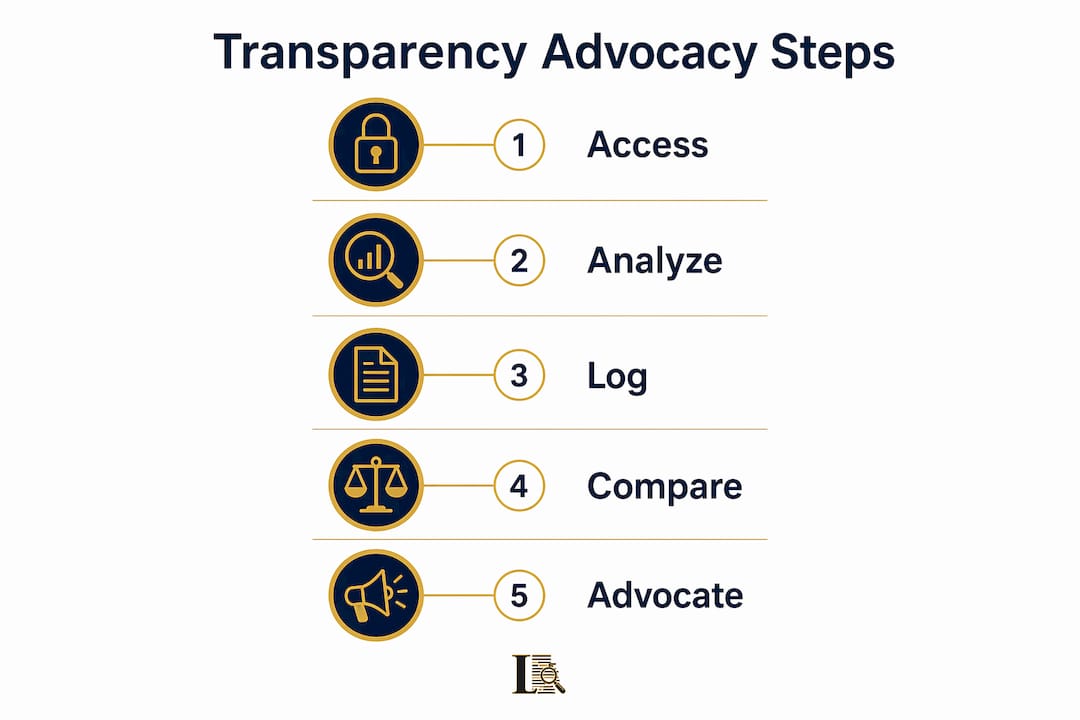
Disclosure analysis follows a repeatable methodology. The steps below apply equally to corporate filings and government financial records.
- Identify the disclosure set. Collect all relevant filings for a defined period: annual reports, quarterly filings, proxy statements, and any supplemental ESG disclosures. Use SEC EDGAR for public companies and the relevant Supreme Audit Institution portal for government entities.
- Establish the narrative baseline. Extract the company's or agency's stated commitments, targets, and forward guidance from earnings calls, press releases, and investor presentations.
- Map claims to reported results. Compare stated targets against audited figures. Note any changes in metric definitions, restatements, or scope adjustments that alter comparability.
- Flag material inconsistencies. Document discrepancies between the narrative and the numbers. A company that repeatedly revises its definition of "adjusted EBITDA" is exhibiting disclosure opacity that warrants further scrutiny.
- Cross-reference over time. Compare disclosures across at least three reporting periods. Patterns of omission or redefinition are more probative than any single inconsistency.
- Engage regulatory and civil society channels. Submit findings to the SEC's Office of the Whistleblower, engage proxy advisory firms, or present evidence to civil society organizations with audit oversight mandates.
The following methods amplify the impact of disclosure-based findings:
- Submit formal comment letters during SEC rulemaking periods, citing specific filing evidence.
- Engage financial journalists with disclosure-based evidence packages that include direct document citations.
- Present findings at shareholder meetings using proxy statement data to support governance proposals.
- Coordinate with civil society and audit bodies to align advocacy priorities with ground-level oversight realities.
ESG disclosure mandates increased detection of corporate misconduct in firms and regions with strong institutional oversight. That finding confirms that advocacy grounded in mandatory disclosure data carries greater evidentiary weight than advocacy based on voluntary reporting alone.
Pro Tip: Maintain a factual log of every claim you extract from a disclosure, including the exact page, paragraph, and date of the filing. Regulators and journalists require source-level precision. Paraphrased summaries without document references are routinely disregarded.
What are the common challenges when advocating transparency via public disclosures?
Information overload is the most common obstacle. Large public companies file thousands of pages annually across 10-K reports, proxy statements, and supplemental ESG disclosures. Advocates who attempt comprehensive review without a defined scope lose focus and produce unfocused findings.
- Data quality gaps: Voluntary disclosures often lack auditor attestation, making them difficult to verify. ESG metrics in particular vary in definition across companies, reducing comparability.
- Regulatory gaps: Not all jurisdictions mandate the same disclosure standards. Cross-border advocacy requires mapping which framework applies to each entity.
- Disclosure fatigue: Stakeholders exposed to high volumes of disclosure material disengage over time. A risk-based approach that concentrates analysis on the highest-impact disclosures prevents this.
- Privacy and data protection limits: Some government disclosures are restricted under privacy law. Advocates must distinguish between legitimately protected data and improperly withheld public records.
The 2026 New Jersey Supreme Court ruling established that government business on private devices remains subject to public records laws. This precedent closes a common evasion route and gives advocates a legal basis to demand records that officials previously claimed were beyond reach.
The gap between disclosure and genuine transparency is real. Disclosures alone do not fully mitigate perceived autonomy loss or guarantee informed engagement. Advocates who treat disclosure volume as a proxy for transparency will misread situations where companies file extensively but reveal little of substance. The solution is to focus on the quality and comparability of disclosed information, not its quantity.
Bridging the gap between disclosure and true transparency requires monitoring disclosure consistency across filings over time. Advocates who track how companies define and redefine key metrics across reporting periods can identify engineered opacity that single-period analysis misses entirely.
What tools and frameworks support ongoing transparency advocacy?
The four pillars of effective accountability infrastructure are specificity, persistence, accessibility, and comparison. Specificity means tracking named metrics against named commitments. Persistence means maintaining records across reporting cycles, not just during high-profile events. Accessibility means publishing findings in formats that non-specialist stakeholders can act on. Comparison means benchmarking one entity's disclosures against sector peers or regulatory standards.
Several frameworks and legislative initiatives support this infrastructure:
- The Financial Disclosure Modernization Act proposes a new $1 billion asset tier for government officials, improving precision in public financial reporting beyond the existing $50 million threshold.
- The Global Reporting Initiative (GRI) provides sector-specific disclosure standards that enable cross-company comparison.
- The TCFD framework structures climate-related financial disclosures around governance, strategy, risk management, and metrics.
- Supreme Audit Institutions, when partnered with civil society organizations, produce oversight findings grounded in practical service delivery realities.
Pro Tip: Apply a risk-based disclosure model by ranking your target entities by sector, market cap, and prior disclosure irregularities. Concentrate advocacy resources on entities where the aspiration-to-execution gap is widest and the public interest impact is highest.
| Disclosure category | Key framework | Advocacy application |
|---|---|---|
| Corporate financial | SEC Regulation S-K, GAAP | Earnings quality, restatement tracking |
| ESG and sustainability | GRI, TCFD, SASB | Commitment versus reported outcome |
| Government financial | Supreme Audit Institutions | Budget integrity, public spending |
| Executive compensation | SEC proxy rules | Pay-for-performance alignment |
| Political and lobbying | FEC filings, state registries | Influence mapping, conflict detection |
Lacunaindex applies this four-pillar model systematically. Its execution scores measure the gap between corporate narrative claims and audited results across earnings calls, SEC filings, and press releases, giving advocates a structured comparison baseline without requiring insider access. Governance advocates can use Lacunaindex sector benchmarks to contextualize individual company disclosures against peer performance, which is the comparison pillar in practice.
The disclosure gap no one talks about
The standard advice in transparency advocacy circles is to read more filings and file more FOIA requests. That advice is correct but incomplete. After years of working with public disclosure data, the more consequential skill is knowing what a disclosure is not saying.
Companies that engineer their disclosures are not typically lying outright. They are selecting which metrics to foreground, redefining terms between periods, and burying material changes in footnotes that most readers skip. The aspiration-to-execution gap that Lacunaindex measures is not always visible in any single filing. It accumulates across periods, and it becomes legible only when you hold three or four years of disclosures side by side and ask why the definition of a key metric changed in the same quarter that performance declined.
The legislative reforms of 2025 and 2026, including the Financial Disclosure Modernization Act and the New Jersey Supreme Court ruling on private device records, signal that the legal infrastructure for transparency is strengthening. Civil society organizations and audit bodies are building formal partnerships that give advocacy findings institutional weight. The tools are improving. What remains scarce is the analytical discipline to use them with the specificity and persistence that accountability actually requires. Advocates who develop that discipline, and who ground their work in corporate transparency principles rather than headline-driven campaigns, will produce findings that institutions cannot ignore.
— Glen
How Lacunaindex supports your disclosure analysis work
Lacunaindex is built for the exact analytical challenge this article describes: measuring the gap between what companies say and what their public records confirm.
The Lacunaindex user guide walks through the methodology for reading a forensic report, including how execution scores are calculated from earnings calls, SEC filings, and proxy statements. Governance advocates and institutional investors can use these reports to identify companies classified as "borrowed reputation" archetypes, where narrative quality outpaces delivery. The sector benchmarks provide the comparison baseline that the four-pillar accountability framework requires. Every finding in a Lacunaindex report traces directly to a named public document, giving advocates the source-level precision that regulators and journalists demand.
FAQ
What does it mean to advocate transparency using public disclosures?
Disclosure-based transparency advocacy is the systematic use of publicly available filings, such as SEC reports, ESG disclosures, and government financial statements, to identify gaps between stated commitments and actual performance. The goal is to produce evidence-based findings that regulators, investors, and civil society can act on.
What are the benefits of public transparency for investors?
ESG disclosure mandates increase the detection of corporate misconduct, and markets respond more negatively when misconduct claims become verifiable through disclosures. Investors who analyze disclosure quality alongside financial metrics gain a more accurate picture of actual corporate performance versus communicated promises.
How do you ensure transparency when disclosures are incomplete?
Apply the four-pillar accountability model: specificity, persistence, accessibility, and comparison. Cross-reference multiple disclosure types over at least three reporting periods, and use regulatory channels such as SEC comment letters or Supreme Audit Institution partnerships to flag material gaps.
What public disclosure standards should advocates prioritize?
Advocates should prioritize SEC Regulation S-K for corporate financial disclosures, the GRI and TCFD frameworks for ESG reporting, and the relevant Supreme Audit Institution standards for government financial records. These frameworks provide the comparability baseline that makes cross-entity analysis credible.
Can government officials avoid transparency laws by using private devices?
The 2026 New Jersey Supreme Court ruling confirmed that government business conducted on private devices remains subject to public records laws. Officials cannot use personal communication channels to circumvent disclosure obligations.
Key takeaways
Effective disclosure-based accountability advocacy requires specificity, persistence, and comparison across multiple reporting periods, not just access to individual filings.
| Point | Details |
|---|---|
| Disclosures versus transparency | Disclosures are legally required data releases; transparency requires adding context so stakeholders understand the story behind the numbers. |
| Four-pillar accountability model | Specificity, persistence, accessibility, and comparison are the structural requirements for advocacy that institutions cannot dismiss. |
| ESG mandates increase misconduct detection | Mandatory ESG disclosures raise the volume of verifiable misconduct claims, with markets responding most strongly where oversight is strongest. |
| Risk-based focus prevents fatigue | Concentrating advocacy on the highest-impact disclosures, ranked by sector and prior irregularities, sustains analytical quality over time. |
| Legislative reforms strengthen the infrastructure | The Financial Disclosure Modernization Act and the 2026 New Jersey Supreme Court ruling expand the legal basis for demanding precise and complete public records. |