
An accountability gap is a measurable mismatch between who can act and who can be audited, sanctioned, or credibly held to account — identifiable through SEC public filings, corroborated by Gallup's finding that accountability ranks last across leadership competency ratings, and quantified by Lacunaindex's forensic scoring methodology. Two primary types exist: a structural gap, where socio-technical design prevents any continuous identity from being held accountable across time and networks; and an organizational gap, where role definitions, delegation chains, or follow-through mechanisms fail at the execution layer. For rapid triage, classification yields one of three outcomes:
- Actionable: Evidence is sufficient to map agent, domain, principal, and sanction right; engagement or escalation is warranted.
- Monitor: Partial evidence exists; gaps are present but not yet material or confirmed across multiple disclosure sources.
- Engage/Exit: Recurring, unresolved gaps with regulatory exposure or valuation risk justify proxy action or position reduction.
Table of Contents
- What does accountability gap classification explained mean in practice?
- The four-element test for classifying a gap
- Common accountability-gap types and Lacunaindex archetypes
- How to perform a forensic evaluation using public records
- Mistakes analysts make and how to avoid them
- A practical checklist for institutional teams
- How classification maps to investment and governance decisions
- Key Takeaways
- Why the classification framework matters more than the label
- Useful sources
What does accountability gap classification explained mean in practice?
Forensic work on corporate governance requires precise vocabulary. Scholars warn that conflating distinct senses of responsibility produces conceptual stretching, which corrupts classification outcomes and makes engagement letters legally fragile.
Three senses must be held separate:
- Attributability: Who performed the act? This is a causal question answered by signature blocks, role titles, and system logs.
- Answerability: Who is obligated to explain the act? This is a procedural question answered by delegation language in proxy statements and board charters.
- Accountability (sanctionability): Who holds the right to impose consequences? This is a governance question answered by compensation committee authority, board removal powers, and regulatory enforcement records.
A structural accountability gap arises when the socio-technical architecture itself prevents any single continuous identity from being held accountable — harms propagate across time and networks with no mechanism that fits the structure. The Hilton Foundation's AI accountability research categorizes this as a distinct fifth problem in ethics, separate from bias or safety failures. In corporate forensics, the analog is a multi-entity signing structure where no individual officer's authority maps cleanly to a disclosed outcome.
An organizational gap is a follow-through failure: expectations exist, but role ownership, measurement, or consequence mechanisms are absent or stale. The EMMA model (Expectations, Motivation, Measurement, Accountability) treats accountability as the terminal stage; without the prior three elements, fixing accountability in isolation fails.
Pro Tip: When reviewing a proxy statement, check whether the compensation committee's authority language explicitly names the metric it can sanction. Vague language ("as determined by the committee") signals an organizational gap, not a structural one.
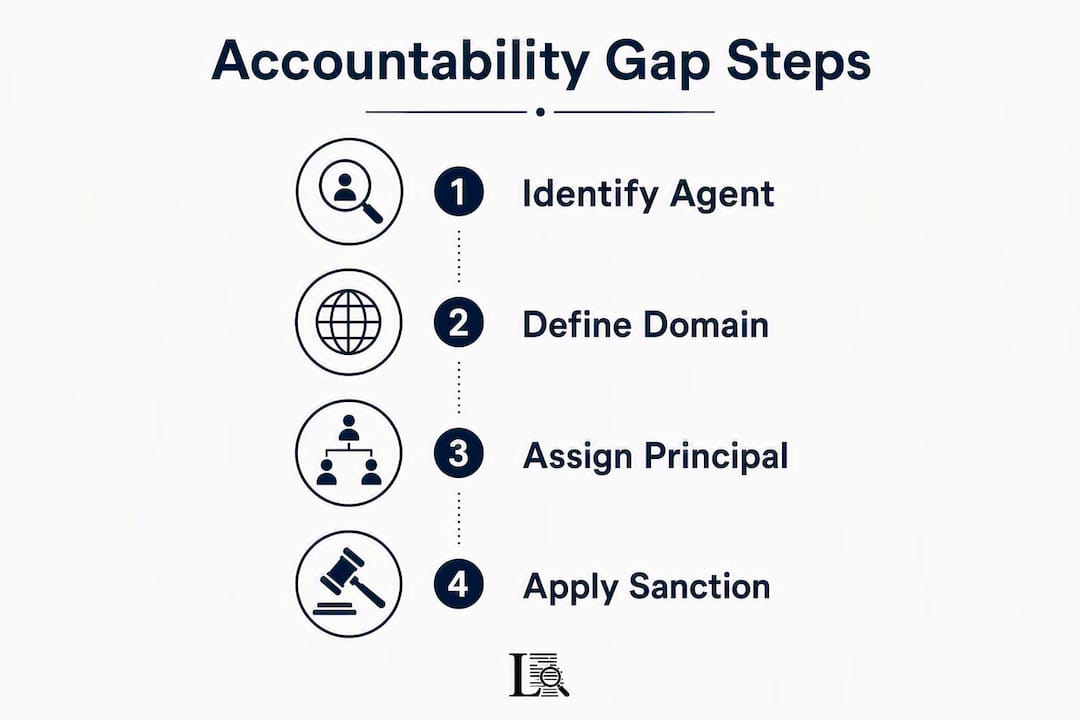
The four-element test for classifying a gap
A robust forensic classification requires all four elements. Missing any one produces an incomplete diagnosis.
- Agent: Who acts, or who the system enables to act? Identified from signature blocks, officer certifications (SOX Section 302/906), and API or service-account disclosures in 10-K risk factors.
- Domain: What conduct or outcome is subject to account? Defined by the scope language in board resolutions, material contract exhibits, and MD&A commitments.
- Principal: To whom is account owed? Identified from governance documents — audit committee charters, investor relations disclosures, and regulatory filings naming oversight bodies.
- Principal's right to sanction: Does the principal hold an enforceable right to impose consequences? Confirmed through compensation clawback provisions, board removal procedures, and SEC enforcement referral authority.
When all four elements map cleanly to named individuals and documented authorities in public records, the gap is classifiable. When one or more elements are absent or ambiguous, the gap type shifts.
Structural example: A company discloses an automated trading system in its 10-K risk factors but names no individual officer as accountable for its runtime decisions, illustrating common challenges explored in account evaluation strategies for proprietary traders. Agent exists (the system), domain exists (trading activity), principal exists (the board), but the sanction right cannot attach to any continuous human identity. Classification: structural gap.
Organizational example: A CEO's letter commits to a 20% emissions reduction by 2025. The proxy names no executive owner, no measurement protocol, and no compensation linkage. Agent is named, domain is stated, principal is implied (shareholders), but the sanction path is absent. Classification: organizational/follow-through gap.

Pro Tip: Search proxy exhibits for explicit delegation resolutions. A board resolution that delegates authority without naming a successor or expiration date is a delegated-persistence gap waiting to be classified.
Common accountability-gap types and Lacunaindex archetypes
Four gap types appear most frequently in public-company forensics:
- Identity-to-action gap: Non-human identities (automated systems, service accounts) act without a named human owner. NHIMG notes that non-human identities outnumber human identities by 25x–50x in many enterprises, making this the highest-volume gap type.
- Delegated-persistence gap: Authority delegated to a role or individual remains active after the original context has changed — departed executives, restructured divisions, or expired board resolutions.
- Many-hands gap: Layered sign-off across multiple officers or committees diffuses individual attribution. The Helen Suzman Foundation's accountability typology identifies this as a primary attribution challenge when departed decision-makers are involved.
- Follow-through failure: Management assumes execution without establishing measurement or consequence mechanisms; the EMMA gap.
Lacunaindex maps these gap types to three primary archetypes:
| Archetype | Primary evidence sources | Likely engagement response |
|---|---|---|
| Earned | Consistent delivery against disclosed targets; clawback provisions active; named owners in filings | Monitor; no immediate escalation required |
| Borrowed | Narrative exceeds delivery; delegation language vague; compensation not linked to stated metrics | Active engagement; request board clarification |
| Undervalued | Delivery exceeds narrative; gap is a market mispricing signal, not a governance failure | Re-rate valuation assumptions; monitor for catalyst |
How to perform a forensic evaluation using public records
The methodology below produces audit-traceable classifications from public disclosures only — no insider access required. SEC filings, earnings calls, proxy statements, and press releases form the complete evidentiary set.
- Scope the evaluation. Define the company, reporting period, and the specific commitment or outcome under review.
- Assemble the source set. Collect the relevant 10-K, DEF 14A (proxy), 8-K filings, earnings call transcripts, and press releases for the period.
- Map identity to action. Extract every named officer, committee, or system that appears in connection with the commitment. Note signature blocks, certification language, and any delegation resolutions in proxy exhibits.
- Reconstruct the temporal trace. Order disclosures chronologically to identify when the commitment was made, when delivery was due, and what subsequent filings reported.
- Classify the gap. Apply the four-element test. Assign gap type (structural, organizational, many-hands, delegated-persistence).
- Score confidence. Weight evidence by source reliability and corroboration across filings.
| Evidence type | Example locator | Scoring weight |
|---|---|---|
| Officer certification (SOX 302/906) | 10-K cover page | High |
| Compensation committee authority | Proxy — committee charter exhibit | High |
| MD&A commitment language | 10-K MD&A section | Medium |
| Earnings call management Q&A | Transcript, analyst Q&A segment | Medium |
| Press release commitment | IR press release archive | Low–Medium |
| Third-party attestation | Audit report, sustainability assurance | High (when present) |
Mistakes analysts make and how to avoid them
Three errors recur in forensic classification work:
- Documentation fallacy: Assuming that audit logs or disclosure volume equals accountability. Even perfect logs leave a gap if events do not map to a named owner with an enforceable sanction right.
- Technical solutionism: Research confirms that improving logging or technical controls alone does not close gaps rooted in organizational design. Governance evidence — decision frameworks, sanction rights — must accompany technical telemetry.
- Conceptual stretching: Treating attributability as accountability. Knowing who acted does not establish who can be sanctioned.
Mitigations: require identity-to-owner linkage for every material commitment; confirm the sanction path by naming the principal and verifying their enforcement authority in public documents; triangulate across at least two independent filing types before classifying.
Pro Tip: To surface hidden delegated authorities, search proxy statement exhibits for board resolutions filed as Exhibit 99 or within the governance section. Resolutions that predate the current management team by more than two years warrant a delegated-persistence classification.
A practical checklist for institutional teams
Map each item to its public source before escalating.
- Identify every material commitment in the MD&A and CEO letter; note the named owner (or absence of one).
- Confirm whether the proxy compensation discussion links stated metrics to named executives with clawback authority.
- Review 8-K filings for the period; flag any restatements, leadership changes, or material contract amendments that break the identity-to-action chain.
- Extract management Q&A from earnings call transcripts; note whether analysts' follow-up questions on delivery gaps received specific or evasive answers.
- Check for third-party attestations (audit opinions, sustainability assurance reports) that independently verify delivery claims.
- Assign a confidence level (high/medium/low) based on corroboration across at least two filing types.
- Set an escalation threshold: medium confidence with two or more gap types present warrants active engagement; high confidence with a structural gap and regulatory exposure warrants proxy action or independent investigation.
Expected analyst time: 8–16 hours per company for an initial classification; 20–40 hours for a full forensic report with sector benchmarking. Systematic accountability scoring reduces that range materially by pre-mapping evidence locators.
How classification maps to investment and governance decisions
Classification outcomes translate directly into prioritized responses. A fourfold accountability typology shows that governance remedies differ by the source and intensity of control — hierarchical, professional, legal, or political — which determines both the appropriate engagement lever and the realistic remediation timeline.
- Earned archetype / no gap: Monitor. No immediate action; include in sector benchmark for comparative reference.
- Organizational gap / borrowed archetype: Active engagement. Request board clarification on ownership and measurement; flag in proxy voting analysis. Typical remediation: one to two proxy cycles.
- Structural gap / engineered disclosure: Re-rate valuation assumptions and escalate. Recommend director votes or independent investigation where regulatory exposure is material. Remediation timeline is indeterminate without structural redesign.
- Undervalued archetype: Re-rate upward. The gap is a market mispricing signal; monitor for a catalyst that closes the narrative-to-delivery spread.
Materiality signals that accelerate escalation include: a recurring pattern across two or more reporting periods, explicit regulatory inquiry (SEC comment letters, enforcement actions), and a delivery shortfall that exceeds the sector benchmark by a statistically meaningful margin. For public disclosure gap analysis, the combination of a structural gap and a borrowed archetype classification represents the highest-priority escalation case.
Key Takeaways
Accountability gap classification is most reliable when all four elements — agent, domain, principal, and sanction right — are confirmed from independent public sources before any engagement decision is made.
| Point | Details |
|---|---|
| Four-element test | Every classification requires agent, domain, principal, and an enforceable sanction right; missing any one element produces an incomplete diagnosis. |
| Structural vs organizational | Structural gaps arise from design-level identity mismatches; organizational gaps are follow-through failures addressable through governance changes. |
| Public-records methodology | SEC filings, proxy statements, earnings call transcripts, and press releases are sufficient to build an audit-traceable classification without insider access. |
| Archetype-to-action mapping | Earned warrants monitoring; borrowed warrants active engagement; structural gaps with regulatory exposure warrant proxy action or re-rating. |
| Gallup and SEC as anchors | Gallup leadership data and SEC filings provide the two most reliable external corroboration sources for organizational and structural gap classification respectively. |
Why the classification framework matters more than the label
The most common failure in governance analysis is treating the accountability gap as a single, undifferentiated problem. It is not. A structural gap in a company's automated decision systems requires a different response than a follow-through failure in its capital allocation process — and conflating the two produces engagement letters that boards can dismiss as imprecise.
Lacunaindex's forensic methodology is built on this distinction. By anchoring every classification to public disclosures — SEC filings, proxy statements, earnings call transcripts — and requiring all four elements before assigning an archetype, the platform produces reproducible scores that hold up under scrutiny. No insider access, no proprietary data, no subjective judgment calls that cannot be traced back to a named document and page reference. That audit-traceability is what converts a classification from an opinion into evidence. Sector benchmarks are publicly available; detailed company-level forensic reports are accessible to subscribers.
Useful sources
The following sources support forensic classification work, organized by primary use:
Conceptual framing and definitions:
- Analysing and Assessing Accountability: A Conceptual Framework — foundational typology; best for establishing the actor-forum-consequence structure.
- APPP — Accountability: the core concept and its subtypes — primary source for the four-element test.
- Springer — Accountability definitions and distinctions — authoritative on distinguishing attributability, answerability, and sanctionability.
- Springer — Four responsibility gaps with AI — maps culpability, moral accountability, public accountability, and active responsibility gaps.
Structural and technical gap analysis:
- Hilton Foundation — AI accountability — best source for structural gap definition and the fifth-problem framing.
- NHIMG — Accountability gap glossary — practical definition with identity-to-action linkage requirements.
- Springer — Warnings on technical solutionism — essential reading before recommending technical controls as a gap remedy.
Organizational and follow-through gaps:
- Adaptive Leaders — The accountability gap — Gallup leadership data; best for organizational gap evidence.
- Helen Suzman Foundation — Spotlight on accountability III — many-hands attribution and actor-based classification.
Legal/regulatory and public-records forensics:
- SEC EDGAR — primary source for 10-K, DEF 14A, and 8-K filings; mandatory starting point for any public-company classification.
- Lacunaindex — How public disclosures reveal management gaps — practical guide to evidence extraction from public filings.
This article provides general analytical and educational information on accountability gap classification. It does not constitute legal, investment, or professional advice. Readers should verify current regulatory requirements with the SEC or qualified legal counsel for their specific situation.